MCQ
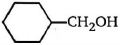
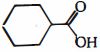
Product $(P)$ in the reaction is

  • B

  • C

  • D

Answer

Correct option: A.

a

Need a full question paper?

Generate a complete, print-ready paper with questions like this in minutes — across 16+ boards, with answer keys.

Start Generating Free

Similar questions

Consider the following reversible reaction at equilibrium, $2{H_2}{O_{(g)}}$ $\rightleftharpoons$ $2{H_{2(g)}} + {O_{2(g)}}$; $\Delta H = 241.7\,kJ$ Which one of the following changes in conditions will lead to maximum decomposition of ${H_2}{O_{(g)}}$
Which of the following salts when dissolved in water will get hydrolysed
The yield of alkyl bromide obtained as a result of heating the dry silver salt of carboxyic acid with bromine if $CCl_4$ is :
The hyperconjugative stabilities of tert-butyl cation and $2$-butene, respectively, are due to
Which of the following bonds has the highest energy
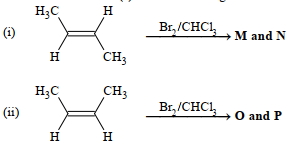
The correct statement(s) for the following addition reactions is(are)

(IMAGE)

$[A]$ ( $M$ and $O)$ and ( $N$ and $P$ ) are two pairs of diastereomers

$[B]$ Bromination proceeds through trans-addition in both the reactions

$[C]$ $O$ and $P$ are identical molecules

$[D]$ (M and $O)$ and ( $N$ and $P)$ are two pairs of enantiomers
The sum of the number of lone pairs of electrons on each central atom in the following species is

$\left[\mathrm{TeBr}_6\right]^{2-},\left[\mathrm{BrF}_2\right]^{+}, \mathrm{SNF}_3 \text {, and }\left[\mathrm{XeF}_3\right]^{-}$  (Atomic numbers : $\mathrm{N}=7, \mathrm{~F}=9, \mathrm{~S}=16, \mathrm{Br}=35, \mathrm{Te}=52, \mathrm{Xe}=54$ )

Calculate the energy in joule corresponding to light of wavelength $45\ nm.$ (Planck's constant, $h=6.63 \times 10^{-34} \ J \ s,$ speed of light, $c=3 \times 10^8 \ m \ s^{-1}$)
Which of the following is wrongly matched
When $0.1\, mol\, MnO_4^{2-}$ is oxidised the quantity of electricity required to completely oxidise $MnO_4^{2-}$ to $MnO_4^-$ is ........ $C.$