MCQ
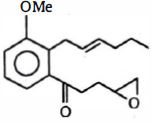
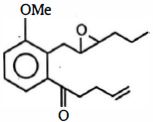
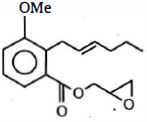
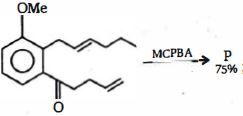
Product $(P)$ is
  • A


  • C

  • D
    None of these

Answer

Correct option: B.

b
$(b)$ More substituted alkene will undergo epoxide formation.

Need a full question paper?

Generate a complete, print-ready paper with questions like this in minutes — across 16+ boards, with answer keys.
Start Generating Free

Similar questions

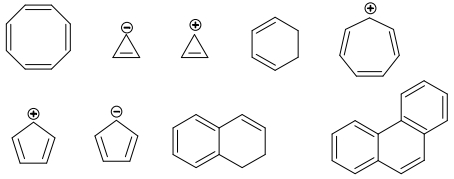
Among the following, the number of aromatic compound($s$) is
Glycerol was distilled with oxalic acid crystals and the products were led into Fehling solution and warmed. Cuprous oxide was precipitated. It is due to
If the bond energies of $H—H,\, Br—Br$ and $H—Br$ are $433,\, 192$ and $364\, kJ\, mol^{-1}$ respectively, $\Delta H^o$ for the reaction ${H_{2(g)}} + B{r_{2(g)}} \to 2HB{r_{(g)}}$ is.....$kJ$
For $N{H_4}H{S_{\left( s \right)}} \rightleftharpoons N{H_3}_{\left( g \right)} + {H_2}{S_{\left( g \right)}}$; observed pressure for reaction mixture at equilibrium is $1.12\, atm$ at $106\,^oC$. The value of $K_P$ for the reaction is
$2 \cdot 3\, g$ फॉर्मिक अम्ल तथा $4 \cdot 5\, g$ ऑक्सेलिक अम्ल को सान्द्र $\ce{H_{2}SO_{4}}$ से क्रिया करवाने पर उत्सर्जित गैसीय मिश्रण को $\ce{KOH}$ के छोटे टुकड़ों से गुज़ारा जाता है । $\ce{STP}$ पर बचे हुए उत्पाद का भार $(g$ में$)$ होगा
The degree of dissociation in a weak electrolyte increases
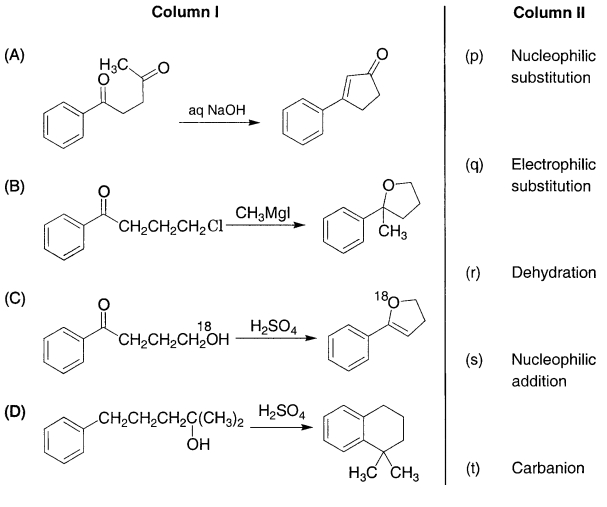
Match the reactions in column $I$ with appropriate types of steps/reactive intermediate involved in these reactions as given in column $II$
In the reaction,

$BrO_{3(aq)}^ - \, + \,5Br_{(aq)}^ - \, + \,6{H^ - }\, \to \,3B{r_{2(l)}}\, + \,3{H_2}{o_{(l)}}.$

The rate of appearance of bromine $(Br_2)$ is related to rate of disappearance of bromide ions as

If two compounds have the same empirical formula but different molecular formula, they must have
$[Co(NH_3)_4(NO_2)_2]Cl$ exhibits