MCQ
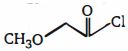
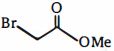
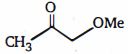
Product $(Q)$ is
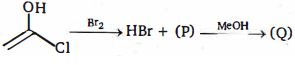
  • A


  • C
    $\begin{array}{*{20}{c}}
      {O\,} \\ 
      {||\,} \\ 
      {C{H_3} - C - OMe} 
    \end{array}$
  • D

Answer

Correct option: B.

b
$\begin{matrix}
   \,\,\,\,\,\,\,\,\,\,\,\,\,\,\,\,\,\,\,\,\,\,\,O\,\,  \\
   \,\,\,\,\,\,\,\,\,\,\,\,\,\,\,\,\,\,\,\,||  \\
   Br-C{{H}_{2}}-C-Cl  \\
\end{matrix}\xrightarrow{C{{H}_{3}}OH}$ $\begin{matrix}
   \,\,\,O  \\
   \,\,\,||  \\
   Br-C{{H}_{2}}-C-O-C{{H}_{3}}  \\
\end{matrix}$

Need a full question paper?

Generate a complete, print-ready paper with questions like this in minutes — across 16+ boards, with answer keys.

Start Generating Free

Similar questions

Which reaction involves a change in the electron pair geometry for the underlined element ?
$CH_3 -C \equiv C-CH$ $\xrightarrow[{(2)\,{H_2}O}]{{(1)\,\,{O_3}}}X\xrightarrow[\Delta ]{{\left( {NaOH + CaO} \right)}}Y$; $Y$ is
The most polar bond is
The surface of copper gets tarnished by the formation of copper oxide. $N _2$ gas was passed to prevent the oxide formation during heating of copper at $1250 K$. However, the $N _2$ gas contains $1$ mole $\%$ of water vapour as impurity. The water vapour oxidises copper as per the reaction given below:

$2 Cu ( s )+ H _2 O ( g ) \longrightarrow Cu _2 O ( s )+ H _2( g )$

$P _{ H _2}$ is the minimum partial pressure of $H _2$ (in bar) needed to prevent the oxidation at $1250 K$. The value of $\ln \left( p _{ H _2}\right)$ is. . . . .

(Given: total pressure $=1$ bar, $R$ (universal gas constant) $=8 JK ^{-1} mol ^{-1}, \ln (10)=2.3$. $Cu ( s )$ and $Cu _2 O ( s )$ are mutually immiscible.

At $1250 K : 2 Cu ( s )+1 / 2 O _2( g ) \longrightarrow Cu _2 O ( s ) ; \Delta G ^\theta=-78,000 J mol ^{-1}$

$H _2( g )+1 / 2 O _2( g ) \longrightarrow H _2 O ( g ) ; \Delta G ^\theta=-1,78,000 J mol ^{-1} ; G$ is the Gibbs energy)

Standard free energies of formation (in $kJ/mol$) at $298\, K$ are $-237.2, -394.4$ and $-8.2 $ for $H_2O_{(l)} , CO_{2(g)}$ and pentane$_{(g)}$ respectively. The value of $E^o_{cell}$ for the pentane-oxygen fuel cell is .......... $V$.
The $ IUPAC$ name of following compounds is $\begin{array}{*{20}{c}}
  {HOOC - C{H_2} - CH - C{H_2} - C{H_2} - COOH} \\ 
  {|\,\,\,\,\,\,\,\,\,\,\,\,\,\,\,\,\,\,} \\ 
  {\,\,\,COOH\,\,\,\,\,\,\,\,\,\,\,\,} 
\end{array}$
The dependence of Gibbs free energy on pressure for an isothermal process of an ideal gas is given by
Which of the following is/ are example $(s)$ of herbicides?
One mole of ice is converted into water at $1$ $atm$ & $273\, K$. The entropies of $H_2O(s)$ and $H_2O(l)$ are $38.2$ and $60.01\, J\, mol^{-1} \,K^{-1}$ respectively the enthalpy change for the conversion is ......$J \,mol^{-1}$
$\Delta H{^o _f}$ $(298\, K)$ of methanol is given by the chemical equation