MCQ
Projection of vector $\vec A$ on $\vec B$ is
  • A
    $\mathop A\limits^ \to .\mathop B\limits^ \to $
  • $\mathop A\limits^ \to .\hat B$
  • C
    $\mathop B\limits^ \to .\mathop A\limits^ \to $
  • D
    $\hat A.\hat B$

Answer

Correct option: B.
$\mathop A\limits^ \to .\hat B$
b
The projection of $\vec{A}$ on $\vec{B}$ is a vector with length $P Q$ which begins at $P$ in the same direction as $\vec{B}$.

The projection of $\vec{A}$ on $\vec{B}$ is defined as $\frac{\vec{A} \cdot \vec{B}}{|\vec{B}|}=\vec{A} \cdot \hat{B}$

Need a full question paper?

Generate a complete, print-ready paper with questions like this in minutes — across 16+ boards, with answer keys.
Start Generating Free

Similar questions

The relation between two specific heats of a gas is
Which is constant for a satellite in orbit
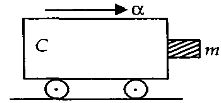
A block of mass $m$ is in contact with the cart $C$ as shown in the figure. The coefficient of static friction between the block and the cart is $\mu .$ The acceleration $\alpha$ of the cart that will prevent the block from falling satisfies
A box contains n molecules of a gas. How will the pressure of the gas be effected, if the number of molecules is made $2n$
A particle moves with a velocity $6\hat i - 4\hat j + 3\hat k\,m/s$ under the influence of a constant force $\overrightarrow F = 20\hat i + 15\hat j - 5\hat k\,N.\,$ The instantaneous power applied to the particle is......... $J/s$
A sample of an ideal gas is contained in a cylinder. The volume of the gas is suddenly decreased. A student makes the following statements to explain the change in pressure of the gas
$I.$ The average kinetic energy of the gas atoms increases
$II.$ The atoms of the gas hit the walls of the cylinder more frequently
$III.$ Temperature of the gas remains unchanged
Which of these statements is true?
A disc of radius $R$ and thickness $\frac {R}{6}$ has moment of inertia $I$ about an axis passing through its centre and perpendicular to its plane. Disc is melted and recast into a solid sphere. The moment of inertia of a sphere about its diameter is
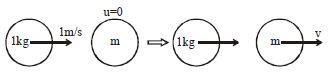
A particle of mass $1\, kg$ moving with velocity $1\, m/s$, collides elastically with another particle of mass $m$. In the collision particle of mass $1\, kg$ loses $\frac{3}{4}$of its $K.E.$ The value of $m$ is :
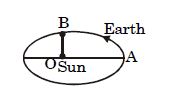
The earth moves around the Sun in an elliptical orbit as shown in figure.The ratio $OA/OB = x$ . The ratio of the speed of the earth at $B$ to that at $A$ is nearly
When a car is moving along a circle on a level road, then centripetal force is provided by f, where f denotes as: