Question
Prove that (4, 3), (6, 4) (5, 6) and (3, 5) are the angular points of a square.
Answer

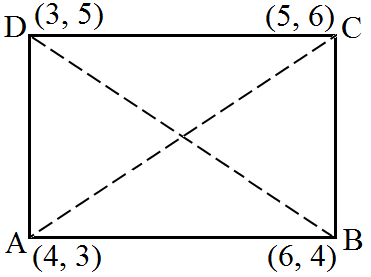
Let the given points be, A(4, 3), B(6, 4) C(5, 6) and D(3, 5) respectively. Then, Now, $\text{AB}=\sqrt{(6-4)^2+(4-3)^2}$ $=\sqrt{4+1}$ $=\sqrt{5}\ \text{units}$ and $\text{BC}=\sqrt{(5-6)^2+(6-4)^2}$$=\sqrt{1+4}$
$=\sqrt{5}\ \text{units}$ $\text{CD}=\sqrt{(3-5)^2+(5-6)^2}$ $=\sqrt{4+1}$ $=\sqrt{5}\ \text{units}$ $\text{AD}=\sqrt{(3-4)^2+(5-3)^2}$ $=\sqrt{1+4}$ $=\sqrt{5}\ \text{units}$ Thus, AB = BC = CD = AD Diagonal $\text{AC}=\sqrt{(5-4)^2+(6-3)^2}$ $=\sqrt{1+9}$ $=\sqrt{10}\ \text{units}$ Diagonal $\text{BD}=\sqrt{(3-6)^2+(5-4)^2}$ $=\sqrt{9+1}$ $=\sqrt{10}\ \text{units}$ $\therefore$ AB = BC = CD = AD and diagonal AC = diagonal BD. Thus, ABCD is a quadrilateral in which all sides are equal and the diagonal are equal. Hence, ABCD is a square.

Need a full question paper?

Generate a complete, print-ready paper with questions like this in minutes — across 16+ boards, with answer keys.

Start Generating Free

Similar questions

Time spent in queue by 100 passengers is classified and given below:
Time
in mins
20-2930-3940-4950-5960-69Total
No. of
passengers
820322812100
Find the median no. of passengers.
Three measuring rods are $64\ cm,$ $80\ cm$ and $96\ cm$ in length. Find the least length of cloth that can be measured an exact number of times, using any of the rods.
Find the ratio in which the point (-3, k) divides the join of A(-5, -4) and B(-2, 3). Also find the value of k.
The sum of two roots of a quadratic equation is 5 and sum of their cubes is 35, find the equation.
Find the co-ordinates of the points of trisection of the segment joining the points $\mathrm{A}(2,-2)$ and $\mathrm{B}(-7,4)$.(The two points that divide the line segment in three equal parts are called as points of trisection of the segment.)
A bucket is in the form of a frustum of a cone. its depth is 15cm and the diameters of the top and the bottom are 56cm and 42cm, respectively. Find how many litres of water can the bucket hold. $\Big[\text{Take}\ \pi=\frac{22}{7}.\Big]$
If the sum of 7 terms of an A.P. is 49 and that of 17 terms is 289, find the sum of n terms.
Find the roots of the following equations, if they exist, by applying the quadratic formula:$\frac{\text{m}}{\text{n}}\text{x}^2+\frac{\text{n}}{\text{m}}=1-2\text{x}$
Three consecutive positive integers are such that the sum of the square of the first and the product of the other two is $46$. Find the integers.