Question
Prove that:
$\bigg[7\Big\{(81)^\frac{1}{4}+(256)^\frac{1}{4}\Big\}^\frac{1}{4}\bigg]^4=16807$

Answer

$\text{L.H.S}=\bigg[7\Big\{(81)^\frac{1}{4}+(256)^\frac{1}{4}\Big\}^\frac{1}{4}\bigg]^4=16807$
$=\bigg[7\Big\{3^{4\times\frac{1}{4}}+4^{4\times\frac{1}{4}}\Big\}^\frac{1}{4}\bigg]^4$
$=\bigg[7\big\{3+4\big\}^\frac{1}{4}\bigg]^4$
$=\Big[7\big\{7\big\}^\frac{1}{4}\Big]^4$
$=7^4\times7^{\frac{1}{4}\times4}$
$=7^4\times7$
$=7^5$
$=16807$
$=\text{R.H.S.}$

Need a full question paper?

Generate a complete, print-ready paper with questions like this in minutes — across 16+ boards, with answer keys.
Start Generating Free

Similar questions

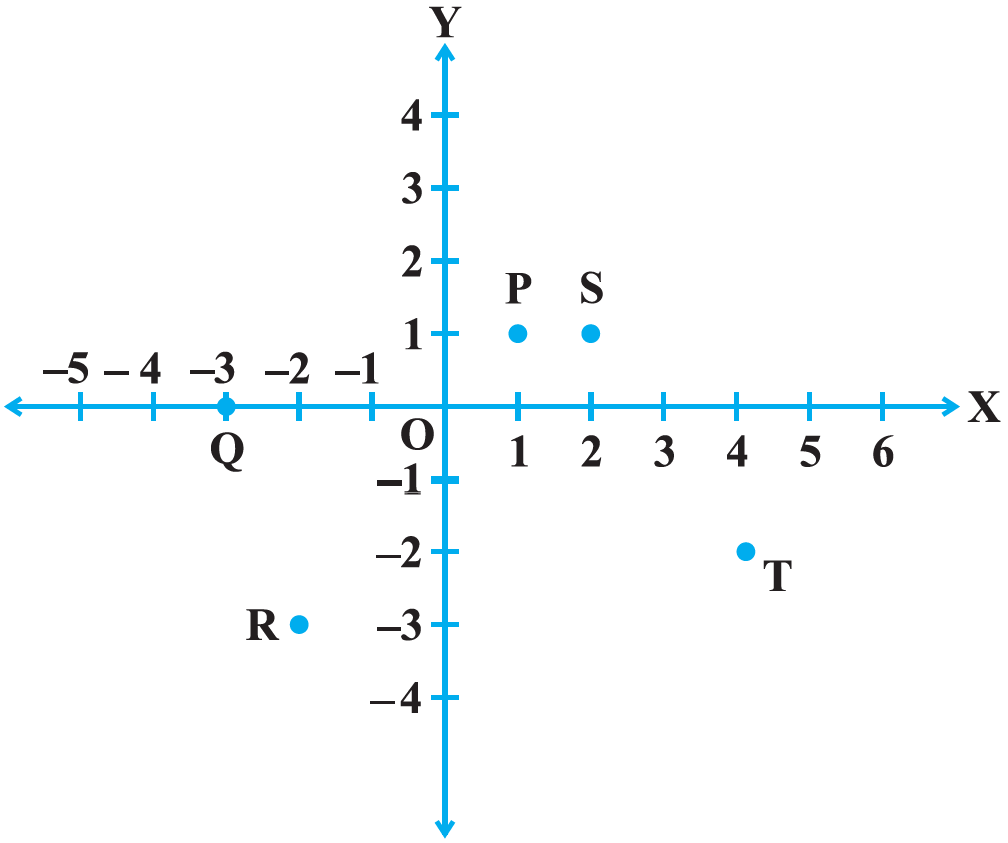
Write the coordinates of each of the points P, Q, R, S, T and O from the:

Find the median of the data:
12, 17, 3, 14, 5, 8, 7, 15
Evaluate:
$\Big(\frac{81}{16}\Big)^{-\frac{3}{4}}\Big[\Big(\frac{25}{9}\Big)^{-\frac{3}{2}}\div\Big(\frac{5}{2}\Big)^{-3}\Big]$
Find the values of x in each of the following:

$\Big(\frac{3}{5}\Big)^\text{x}\Big(\frac{5}{3}\Big)^{2\text{x}}=\frac{125}{27}$

The diameters of two cones are equal. If their slant height are in the ratio 5 : 4, find the ratio of their curved surfaces.
A company selected 4000 households at random and surveyed them to find out a relationship between income level and the number of television sets in a home. The information so obtained is listed in the following table:
Monthly income (in Rs.) Number of Televisions/ household
  0 1 2 Above 2
<10000
10000-14999
15000-19999
20000-24999
25000 and above
20
10
0
0
0
80
240
380
520
1100
10
60
120
370
760
0
0
30
80
220
Find the probability:
  1. Of a household earning Rs. 10000 - Rs 14999 per year and having exactly one television.
  2. Of a household earning Rs. 25000 and more per year and owning 2 televisions.
  3. Of a household not having any television.
Express the following decimals in the form $\frac{\text{p}}{\text{q}},$ where p, q are integers and $\text{q}\neq0.$
$0.00\overline{32}$
Rationalise the denominator of the following:
$\frac{\sqrt{3}+\sqrt{2}}{\sqrt{3}-\sqrt{2}}$
The table given below shows the marks obtained by 30 students in a test.
Marks
(Class interval)
1 - 10
11 - 20
21 - 30
31 - 40
41 - 50
Number of students
(Frequency)
7
10
6
4
3
Out of these students, one is chosen at random. What is the probability that the marks of the chosen student:
  1. Are 30 or less?
  2. Are 31 or more?
  3. Lie in the interval 21 - 30?
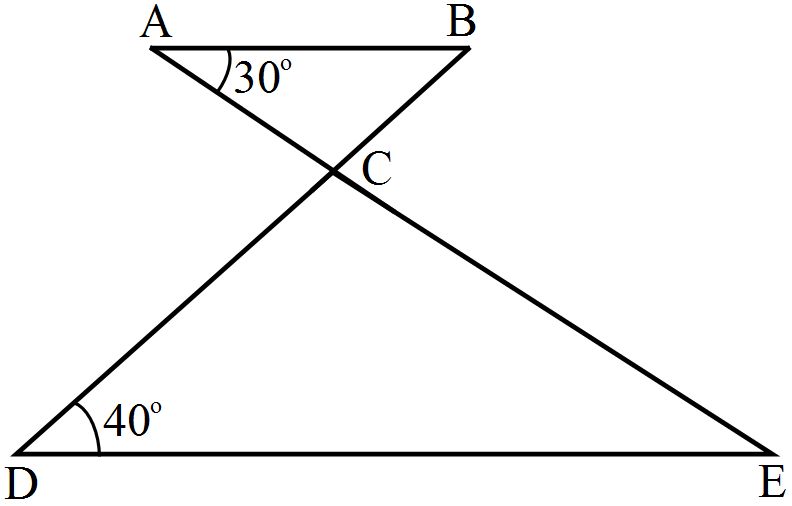
In Fig. AB || DE Find $\angle\text{ACD}.$