Question
Prove that: $\frac{a^{-1}}{\left(a^{-1}+b^{-1}\right)}+\frac{a^{-1}}{\left(a^{-1}-b^{-1}\right)}=\frac{2 b^2}{\left(b^2-a^2\right)}$

Answer

self

Need a full question paper?

Generate a complete, print-ready paper with questions like this in minutes — across 16+ boards, with answer keys.
Start Generating Free

Similar questions

The diagonals of a quadrilateral intersect each other at right angle. Prove that the figure obtained by joining the mid$-$points of the adjacent sides of the quadrilateral is a rectangle.
In a shooting competition a marksman receives $Rs. 50$ if he hits the mark and pays $Rs. 20$ if he misses it. He tried $Rs. 100$ shots and was paid $Rs. 100.$ How many times did he hit the mark?
The volume of a cuboid is $14400 cm^3$ and its height is 15 cm . The cross-section of the cuboid is a rectangle having its sides in the ratio $5: 3$. Find the perimeter of the cross-section.
Solve the following systems of equations by using the method of cross multiplication:
$\frac{10}{x+y}+\frac{2}{x-y}=4, \frac{15}{x+y}-\frac{5}{x-y}+2=0$, where $x \neq y$ and $x \neq-y$
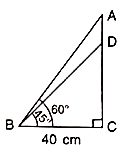
Find the length of $AD.$Given: $\angle ABC = 60^\circ.\angle DBC = 45^\circ$ and $BC = 40\ cm.$
Construct a frequency table from the following data:
Marks No. of students
less than $10$ $6$
less than$ 20$ $15$
less than $30$ $30$
less than $40$ $39$
less than $50$ $53$
less than $60$ $70$
In $\triangle ABC,$ the medians $BP$ and $CQ$ are produced up to points $M$ and $N$ respectively such that $BP = PM$ and $CQ = QN.$ Prove that:
  1. M, A, and N are collinear.
  2. A is the mid-point of MN.
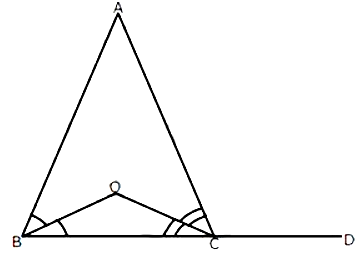
In the figure, given below, $A B=A C$.Prove that: $\angle B O C=\angle A C D$.
Draw a graph of each of the following equations: $x + y - 3 = 0$
In a triangle, the sum of two angles is $139^\circ $ and their difference is $5^\circ $; find each angle of the triangle.