Question
Prove that gravitational potential difference is the work done in carrying a unit mass from one point to another.

Answer

Gravitational potential at A $=-\frac{\text{GM}}{\text{r}_{\text{a}}}$ Gravitational potential at B $=-\frac{\text{GM}}{\text{r}_{\text{b}}}$ Difference in potential $=-\text{GM}\Big(\frac{1}{\text{r}_{\text{b}}}-\frac{1}{\text{r}_{\text{a}}}\Big)$ Work done in carrying a units mass from A to B is, $\text{W}=\int^\limits{\text{r}_{\text{b}}}_\limits{\text{r}_{\text{a}}}\frac{\text{GM}}{\text{x}^2}$ $\text{W}=-\text{GM}\Big|\frac{1}{\text{x}}\Big|^{\text{r}_{\text{b}}}_{\text{r}_{\text{a}}}=-\text{GM}\Big(\frac{1}{\text{r}_{\text{b}}}-\frac{1}{\text{r}_{\text{a}}}\Big)$ So, work done and gravitational potential difference are same.

Need a full question paper?

Generate a complete, print-ready paper with questions like this in minutes — across 16+ boards, with answer keys.
Start Generating Free

Similar questions

A coil having inductance $2.0H$ and resistance $20\Omega$ is connected to a battery of emf $4.0V.$ Find
  1. The current at the instant $0.20s$ after the connection is made.
  2. The magnetic field energy at this instant.
A $2$ in long string fixed at both ends is set into vibrations in its first overtone. The wave speed on the string is $200m/s$ and thee amplitude is $0.5\ cm.$
  1. Find the wavelength and the frequency.
  2. Write the equation giving the displacement of different points as a function of time. Choose the $X-$axis along the string with the origin at one end and $t = 0$ at the instant when the point $x = 50\ cm$ has reached its maximum displacement.
QUESTION Earth also moves in circular orbit around sun once every year with on orbital radius of $1.5 \times 10^{11} m$. What is the acceleration of earth (or any object on the surface of the earth) towards the centre of the sun? How does this acceleration compare with $g =9.8 m / s ^2$ ? $\Big(\text{Hint: acceleration}\frac{\text{V}^2}{\text{R}}=\frac{4\pi^2\text{R}}{\text{T}^2}\Big)$
A metre stick is held vertically with one end on a rough horizontal floor. It is gently allowed to fall on the floor. Assuming that the end at the floor does not slip, find the angular speed of the rod when it hits the floor.
A boy stands at 78.4m from a building and throws a ball which just enters a window 39.2m above the ground. Calculate the velocity of projection of the ball.
A man of mass $70kg$ stands on a weighing scale in a lift which is moving. Upwards with a uniform speed of $10 ms^{-1}$.
$2g$ of hydrogen is sealed in a vessel of volume $0.02m^3$ and is maintained at $300K$. Calculate the pressure in the vessel.
A vessel is filled with a gas at a pressure of $76cm$ of Hg at a certain temperature. The mass of the gas is increased by $50\%$ by introducing more gas in the vessel at the same temperature. Find out the resultant pressure of the gas.
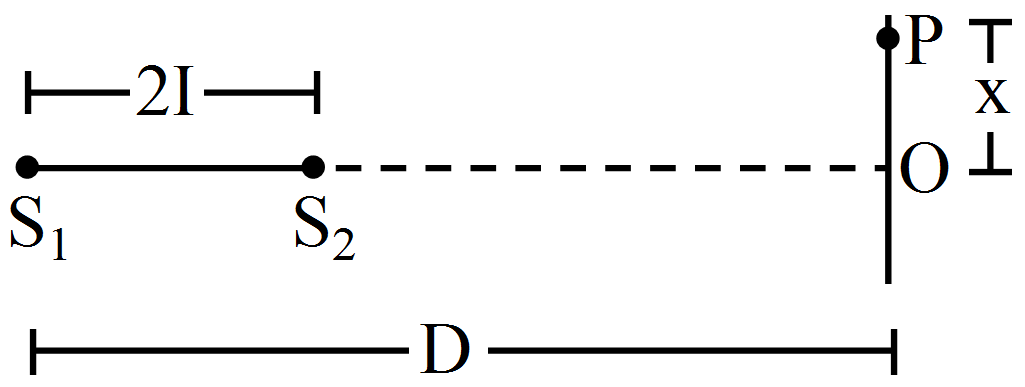
Two coherent narrow slits emitting sound of wavelength $\lambda$ in the same phase are placed parallel to each other at a small separation of $2\lambda.$ The sound is detected by moving a detector on the screen $\sum$ at a distance $\text{D}(>>\lambda)$ from the slit $S_1$ as shown in figure. Find the distance x such that the intensity at P is equal to the intensity at 0.
What is the temperature of the steel-copper junction in the steady state of the system shown in figure. The area of cross-section of steel rod is twice that of the copper rod, $\text{K}_\text{steel}= 50.2\text{ Js}^{-1} \text{m}^{-1}\text{K}^{-1}$