Question
Prove that:
$\sin^{-1}\frac{8}{17}+\sin^{-1}\frac{3}{5}=\tan^{-1}\frac{77}{36}$

Answer

$\text{Let}\sin^{-1}\frac{8}{17}=x.\text{Then}, \sin x=\frac{8}{17}$ $\Rightarrow\cos x=\sqrt{1-\left(\frac{8}{17}\right)^2}=\sqrt{\frac{225}{289}}=\frac{15}{17}.$ $\therefore\tan x=\frac{8}{15}\Rightarrow x=\tan^{-1}\frac{8}{15}$ $\therefore\sin^{-1}\frac{8}{17}=\tan^{-1}\frac{8}{15}\ \dots\dots(1)$ $\text{Now}, \text{let}\sin^{-1}\frac{3}{5}=y.\text{Then},\ \sin y=\frac{3}{5}$ $\Rightarrow\cos y=\sqrt{1-\left(\frac{3}{5}\right)^2}=\sqrt{\frac{16}{25}}=\frac{4}{5}.$ $\therefore\tan y=\frac{3}{4}\Rightarrow y=\tan^{-1}\frac{3}{4}$ $\therefore\sin^{-1}\frac{3}{5}=\tan^{-1}\frac{3}{4} \dots\dots(2)$ Now, we have: $\text{L.H.S.}=\sin^{-1}\frac{8}{17}+\sin^{-1}\frac{3}{5}$$=\tan^{-1}\frac{8}{15}+\tan^{-1}\frac{3}{4}$ [Using (1) and (2)]
$=\tan^{-1}\frac{\frac{8}{15}+\frac{3}{4}}{1-\frac{8}{15}\times\frac{3}{4}}$
$=\tan^{-1}\left(\frac{32+45}{60-24}\right)$ $\bigg[\tan^{-1}x+\tan^{-1}y=\tan^{-1}\frac{x+y}{1-xy}\bigg]$
$=\tan^{-1}\frac{77}{36}=\text{R.H.S.}$

Need a full question paper?

Generate a complete, print-ready paper with questions like this in minutes — across 16+ boards, with answer keys.
Start Generating Free

Similar questions

Prove that $\text{f(x)}=\begin{cases}\frac{\sin\text{x}}{\text{x}},&\text{x}<0\\\text{x}+1,&\text{x}\geq0\end{cases}$ is everywhere continuous.
Let $R$ be a relation on $N \times N$ defined by $(a, b) R(c,d) \Leftrightarrow a + d = b + c$ for all $( a , b ),( c , d ) \in N \times N .$ Show tha is an equivalence relation.
Find the equation of the plane through the line of intersection of the planes $x + y + z = 1$ and $2x + 3y + 4z = 5$ which is perpendicular to the plane $x - y + z = 0.$
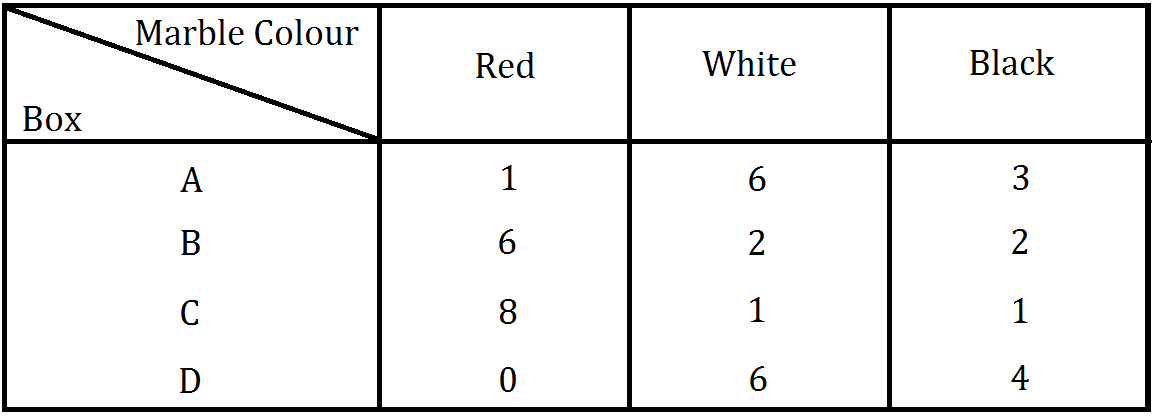
Suppose we have four boxes A, B, C, D containing coloured marbles as given below:
One of the boxes has been selected at random and a single marble is drawn from it. If the marble is red, what is the probability that it was drawn from,
  1. Box A?
  2. Box B?
  3. Box C?
If O is the origin and the coordinates of A are (a, b, c) Find the direction cosines of OA and the equation of the plane through A at right angles to OA.
Solve the following differential equation: $(2\text{x}-10\text{y}^3)\frac{\text{dx}}{\text{dy}}+\text{y}=0$
Maximize Z = 50x + 30y
Subject to
$2\text{x}+\text{y}\leq18$
$3\text{x}+2\text{y}\leq34$
$\text{x},\text{y}\geq0$
If $\text{f(x)}=\begin{cases}\text{ax}^2-\text{b}, & \text{if |x|}<1\\\frac{1}{|\text{x}|}, & \text{if |x|}\geq1\end{cases}$ is differentiable at x = 1, find a, b.
Differentiate the following functions with respect to x:
$\text{x}^{(\sin\text{x}-\cos\text{x})}+\frac{\text{x}^2-1}{\text{x}^2+1}$
Find the shortest distance between the following pairs of lines whose vector equation are:
$\vec{\text{r}}=\big(\hat{\text{i}}+\hat{\text{j}}\big)+\lambda\big(2\hat{\text{i}}-\hat{\text{j}}+\hat{\text{k}}\big)$ and $\vec{\text{r}}=2\hat{\text{i}}+\hat{\text{j}}-\hat{\text{k}}+\mu\big(3\hat{\text{i}}-5\hat{\text{j}}+2\hat{\text{k}}\big)$