Question
Prove that $\sqrt { 3 }$ is irrational.

Answer

Let us assume $\sqrt{ } 3$ be a rational, then as every rational can be represented in the form $p / q$
where $q \neq 0$ Let $\sqrt{ } 3=p / q$ where $p, q$ have no common factor.
Now squaring on both sides we get $3=p^2 / q^2 $
$\Rightarrow 3 \times q^2=p^2$ Which means 3 divides $p^2$ which implies $3$ divides $p$
Hence we can write $p=3 \times k$, where $k$ is some constant.
This gives $3 \times q^2=9 \times k^2 q^2=3 \times k^2$ Which means $3$ divides $q^2$ which implies 3 divides $q$.
$3$ divides $p$ and $q$ which means $3$ is a common factor for $p$ and $q .$
And this is a contradiction for our assumption that $p$ and $q$ have no common factor...
Hence we can say our assumption that $\sqrt{ } 3$ is rational is wrong...
And therefore $\sqrt{ } 3$ is an irrational...

Need a full question paper?

Generate a complete, print-ready paper with questions like this in minutes — across 16+ boards, with answer keys.
Start Generating Free

Similar questions

Show that the points $\text{O}(0, 0),\text{A}(3,\sqrt{3})$ and $\text{B}(3,-\sqrt{3})$ are the vertices of an equilateral triangle. Find the area of this triangle.
Write the formula for the area of a segment in a circle of radius r given that the sector angle is $\theta$ (in degrees).
Find the value of k for which the following systems of equations:
$5x - 3y = 0, 2x + ky = 0$
Has a nonzero solution.
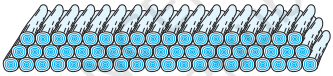
$200$ logs are stacked in the following manner: $20$ logs in the bottom row, $19$ in the next row, $18$ in the row next to it and so on $($see Fig.$)$. In how many rows are the $200$ logs placed and how many logs are in the top row$?$
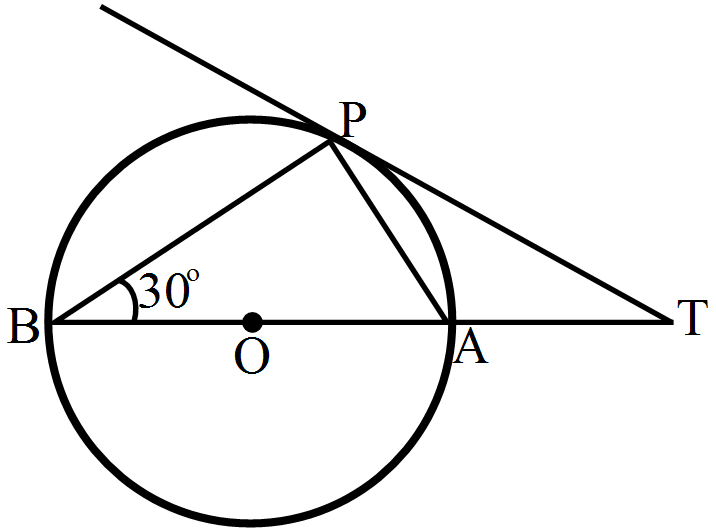
In the given figure, $O$ is the centre of the circle and $TP$ is the tangent to the circle from an external point $T.$ If $\angle\text{PBT} = 30^\circ,$prove that
$BA : AT = 2 : 1.$
Short-Answer Questions:
Write a rational number between $\sqrt3$ and $2.$
Find the value of $k$ for which the following systems of equations has unique solution:
$kx + 3y = (k - 3), 12x + ky = k$
Solve the following quadratic equations by factorization:
$\text{x}^2+\Big(\text{a}+\frac{1}{\text{a}}\Big)\text{x}+1=0$
If $\triangle\text{ABC}$ and $\triangle\text{DEF}$ are two triangles such that $\frac{\text{AB}}{\text{DE}}=\frac{\text{BC}}{\text{EF}}=\frac{\text{CA}}{\text{FD}}=\frac{3}{4},$ then write $\text{Area}(\triangle\text{ABC}):\text{Area}(\triangle\text{DEF.})$
ABCD is a trapezium in which AB || DC and its diagonals intersect each other at the point O. Show that $\frac{{AO}}{{BO}} = \frac{{CO}}{{DO}}$.