Question
Prove that sum and differences of two equal and perpendicular vectors will also be equal and perpendicular.

Answer


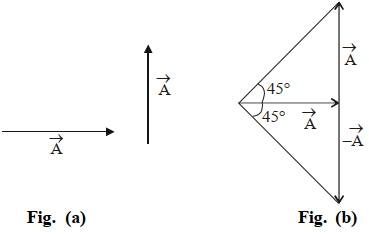
Image
$\begin{aligned}
R_1 & =\sqrt{A^2+A^2}=\sqrt{2} A \\
\tan \theta & =\frac{A}{A}=1 \quad \therefore \quad \theta=45^{\circ}
\end{aligned}$
Magnitude of $R _2$ :
$R_2=\sqrt{A^2+A^2}=\sqrt{2} A$
If $\vec{R}_2$ makes angle $\theta$ with vector $\vec{A}$ then,
$\tan \theta=\frac{A}{A}=1$
$\therefore \quad \theta=45^{\circ}$
It is clear that $\vec{R}_1$ and $\vec{R}_2$ are equal and perpendicular to each other.

Need a full question paper?

Generate a complete, print-ready paper with questions like this in minutes — across 16+ boards, with answer keys.
Start Generating Free

Similar questions

If the temperature of a substance is $-50^{\circ}\text C $ centigrade scale, then find its tempeature on (i) Fahrenheit and (ii) Kelvin scale.
The heat capacities of the source and the sink should be infinite. Why so?
Why do we need quantum theory?
Derive an expression for work done against gravity.
Give the dimensional formula for surface energy, moment of inertia, angular velocity and gravitational force.
The ratio of the coefficient of thermal conductivity of two different substances is 4: 3. If the thermal resistances of rods of equal thickness of these materials is to be kept the same, then what should be the ratio of their lengths?
In Exercise, let us take the position of mass when the spring is unstreched as x = 0, and the direction from left to right as the positive direction of x-axis. Give x as a function of time t for the oscillating mass if at the moment we start the stopwatch (t = 0), the mass is:At the maximum stretched position.
In what way do these functions for SHM differ from each other, in frequency, in amplitude or the initial phase?
A clock controlled by an oscillator becomes slow when taken from a field to a mountain. But the wrist watch controlled by the spring remains unaffected. Explain the reason for this difference in the behaviour of clocks.
The root-mean square (rms) speed of oxygen molecule ($O_2$) at a certain temperature T is v. If temperature is doubled and oxygen gas dissociates into atomic oxygen, what is the speed of atomic oxygen?
If a particle is accelerating, it is either speeding up or speeding down. Do you agree with this statement?