Question
Prove that $\tan^{-1}\frac{1}{4}+\tan^{-1}\frac{2}{9}=\sin^{-1}\frac{1}{\sqrt{5}}.$

Answer

We have, $\tan^{-1}\frac{1}{4}+\tan^{-1}\frac{2}{9}=\sin^{-1}\frac{1}{\sqrt{5}}$
LHS $=\tan^{-1}\frac{1}{4}+\tan^{-1}\frac{2}{9}$
$=\tan^{-1}\bigg(\frac{\frac{1}{4}+\frac{2}{9}}{1-\frac{1}{4}\times\frac{2}{9}}\bigg)$
$\Big[\because\ \tan^{-1}\text{x}+\tan^{-1}\text{y}=\tan^{-1}\Big(\frac{\text{x}+\text{y}}{1-\text{xy}}\Big)\Big]$
$=\tan^{-1}\Big(\frac{17}{34}\Big)$
$=\tan^{-1}\Big(\frac{1}{2}\Big)$
$=\sin^{-1}\begin{pmatrix}\frac{\frac{1}{2}}{\sqrt{1+\big(\frac{1}{2}\big)^2}}\end{pmatrix}$
$\Big[\because\ \tan^{-1}\text{x}=\sin^{-1}\Big(\frac{\text{x}}{\sqrt{1+\text{x}^2}}\Big)\Big]$
$=\sin^{-1}\Big(\frac{1}{\sqrt{5}}\Big)$
= RHS
Hence proved.

Need a full question paper?

Generate a complete, print-ready paper with questions like this in minutes — across 16+ boards, with answer keys.
Start Generating Free

Similar questions

Determine which of the following binary operations are associative and which are commutative:
* on Q defined by $\text{a}\ ^*\ \text{b}=\frac{\text{a}+\text{b}}{2}$ for all $\text{a, b}\in\text{Q}$
Write the direction cosines of the line whose cartesian equations are 6x -2 = 3y + 1 =2z - 4.
Evaluate the following integrals:
$\int\limits^\pi_0\cos\text{x}|\cos\text{x}|\text{dx}$
In a factory, which manufactures nuts, machines A, B and C manufacture respectively 25%, 35% and 40% of nuts. Of their outputs, 5, 4 and 2 per cent respectively are defective nuts. A nut is drawn at random from the product and is found to be defective. Find the probability that it is manufactured by machine B.
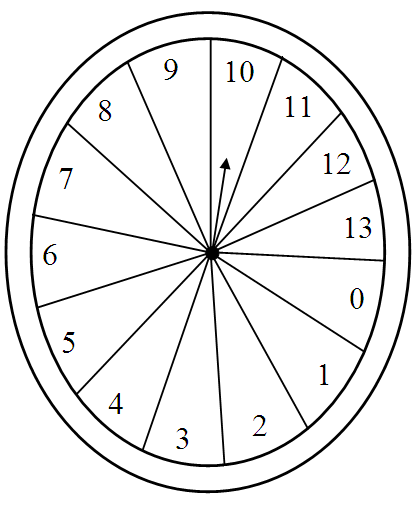
In roulette, Figure, the wheel has 13 numbers 0, 1, 2,...., 12 maked on equally spaced slots. A player sets Rs 10 on a given number. He recieves Rs 100 from the organiser of the game if the ball comes to rest in this slot; otherwise he gets nothing. If X denotes the players net gain/loss, Find E(X).
Write the value of $\tan^{-1}\text{x}+\tan^{-1}\Big(\frac{1}{\text{x}}\Big)$ for x > 0.
The probability of student A passing an examination is $\frac{2}{9}$ and of student B passing is $\frac{5}{9}$. Assuming the two events: 'A passes', 'B passes' as independent, find the probability of:
Only one of them passing the examination.
The probability of student A passing an examination is $\frac{2}{9}$ and of student B passing is $\frac{5}{9}$. Assuming the two events: 'A passes', 'B passes' as independent, find the probability of:
Only one of them passing the examination.
Write the following in the simplest form:
$\tan^{-1}\Big\{\text{x}+\sqrt{1+\text{x}^2}\Big\},\text{x}\in\text{R}$
Evaluate the following integrals:$\int\frac{\cos2\text{x}}{\sqrt{\sin^22\text{x}+8}}\text{ dx}$