Question
Prove that the centre of a circle touching two intersecting lines lies on the angle bisector of the lines.
Answer

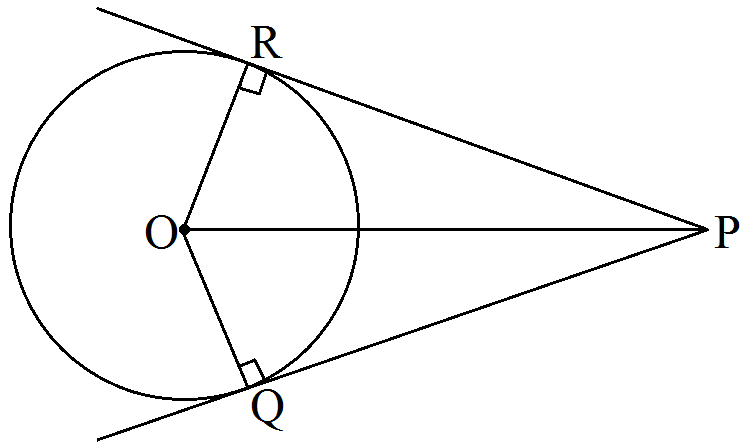
Given: Two tangents $PQ$ and $PR$ are drawn from an external point $P$ to a circle with centre $O.$
To prove: Centre of a circle touching two intersecting line s lies on the angle bisector of the lines.

Construction: Join $OR,$ and $OQ.$
In $\triangle\text{POR}\ \text{and}\ \triangle\text{PQO}$
$\angle\text{PRO}=\angle\text{PQO}=90^{\circ}[$ tangent at any point of a circle is perpendicular to the radius through the point of contact$]$
$OR = OQ [$radii of same circle$]$
Since, $OP$ is common.
$\triangle\text{PRO}\cong\triangle\text{PQO} [SAS]$
Hence, $\angle\text{RPO}=\angle\text{QPO} [by CPCT]$
Thus, $O$ lies on angle bisector of $PR$ and $PQ.$
Hence proved.

Need a full question paper?

Generate a complete, print-ready paper with questions like this in minutes — across 16+ boards, with answer keys.

Start Generating Free

Similar questions

Find the value of k for which root are real and equal in the following equations:
$9 x^2-24 x+k=0$
Write the value of $x$ for which $2x, x + 10$ and $3x + 2$ are in $A.P.$
The distribution below gives the weights of $30$ students of a class. Find the median weight of the students.
Weight(in kg) Number of students
$40-45$ $2$
$45-50$ $3$
$50-55$ $8$
$55-60$ $6$
$60-65$ $6$
$65-70$ $3$
$70-75$ $2$
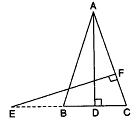
In the figure, $E$ is the point on side $CB$ produced on an isosceles triangle $ABC$ with $AB = AC.$ If $AD \bot BC$ and $EF \bot AC,$ prove that $\triangle ABD \sim \triangle ECF.$
A bag contains lemon-flavoured condies only. Hema takes out one condy without looking into the bag. What is the probability that she takes out
  1. An orange-flavoured candy$?$
  2. A lemon-flavoured candy$?$
Find the value of k for which the following system of equations has a unique solution:
$4x - 5y = k$
$2x - 3y = 12$
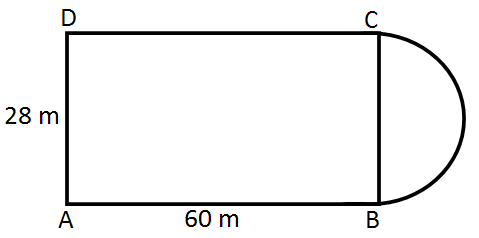
A plot is in the form of a rectangle $ABCD$ having semi-circle on $BC$ as shown in the following figure. If $AB = 60\ m$ and $BC = 28\ m,$ find the area of the plot.
What is the cumulative frequency of the modal class of the following distribution$?$
Class
$3-6$
$6-9$
$9-12$
$12-15$
$15-18$
$18-21$
$21-24$
Frequency
$7$
$13$
$10$
$23$
$4$
$21$
$16$
Prove that the area of a circular path of uniform width surrounding a circular region of radius r is $\pi\text{h}(2\text{r}+\text{h}).$
Two dice, one blue and one gray, are thrown at the same time. Find the following probabilities.
(i) Sum of the digits on dice is 13.
(ii) Same digit on both dice.
(iii) Product of digits on dice is even.