Question
Prove that the following number is irrational:$ \sqrt{5} - 2$

Answer

$\sqrt{5}-2$
Let $\sqrt{5}-2$ be a rational number.
$\Rightarrow \sqrt{5}-2=x$
Squaring on both the sides, we get
$(\sqrt{5}-2)^2=x^2$
$ \Rightarrow 5+4-2 \times 2 \times \sqrt{5}=x^2$
$ \Rightarrow 9-x^2=4 \sqrt{5}$
$ \Rightarrow \sqrt{5}=\frac{9-x^2}{4}$
Here, $\mathrm{x}$ is a rational number.
$\Rightarrow x^2$ is a rational number.
$\Rightarrow 9-x^2$ is a rational number.
$\Rightarrow \frac{9-x^2}{4}$ is also a rational number.
$\Rightarrow \sqrt{2}=\frac{9-x^2}{4}$ is a rational number
But $\sqrt{2}$ is an irrational number.
$\Rightarrow \sqrt{5}=\frac{9-x^2}{4}$ is an irrational number.
$\Rightarrow 9-x^2$ is an irrational number.
$\Rightarrow x^2$ is an irrational number.
$\Rightarrow x$ is an irrational number.
But we have assume that $\mathrm{x}$ is a rational number.
$\therefore$ we arrive at a contradiction.
So, our assumption that $\sqrt{5}-2$ is a rational number is wrong.
$\therefore \sqrt{5}-2$ is an irrational number.

Need a full question paper?

Generate a complete, print-ready paper with questions like this in minutes — across 16+ boards, with answer keys.
Start Generating Free

Similar questions

Factorise the following:$4xy - x^2 - 4y^2 + z^2$
Given universal set $=$$\left\{-6,-5 \frac{3}{4},-\sqrt{4},-\frac{3}{5},-\frac{3}{8}, 0, \frac{4}{5}, 1,1 \frac{2}{3}, \sqrt{8}, 3.01, \pi, 8.47\right\}$From the given set, find : set of rational numbers
Solve the following simultaneous equations :$3(2u + v) = 7uv;3(u + 3v) = 11uv$
If $AP$ bisects $\angle BAC$ and $M$ is any point on $AP,$ prove that the perpendiculars drawn from $M$ to $AB$ and $AC$ are equal.
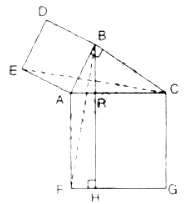
In the figure given alongside, squares $\text{ABDE}$ and $\text{AFGC}$ are drawn on the side $\text{AB}$ and the hypotenuse $\text{AC}$ of the right $\triangle \text{ABC}.$

If $\text{BH}$ is perpendicular to $\text{FG}$prove that :$(i) \ \triangle \text{EAC} \cong \triangle \text{BAF}.(ii)$ Area of the square $\text{ABDE}\Rightarrow $ Area of the rectangle $\text{ARHF}$.
In case of a parallelogram.prove that$:(i)$ The bisectors of any two adjacent angles intersect at $90^o.(ii)$The bisectors of the opposite angles are parallel to each other.
A copper wire when bent in the form of an equilateral triangle has an area of $121 \sqrt{3}$ $cm ^2$. If the same wire is bent into the form of a circle, find the area enclosed by the wire.
Find the actual lower and upper-class limits and also the class marks of the classes:$1.1 - 2.0, 2.1 -3.0$ and $3.1 - 4.0.$
Find the greatest and the smallest rational number among the following.$\frac{6}{7}, \frac{9}{14}$ and $\frac{23}{28}$
Express the following in terms of $\log 2$ and $\log 3: \log \frac{225}{16}-2 \log \frac{5}{9}+\log \left(\frac{2}{3}\right)^5$