Question
Prove that the given vectors are non-coplanar:
$\hat{\text{i}}+2\hat{\text{j}}+3\hat{\text{k}},\ 2\hat{\text{i}}+\hat{\text{j}}+3\hat{\text{k}}$ and $\hat{\text{i}}+\hat{\text{j}}+\hat{\text{k}}$
Answer

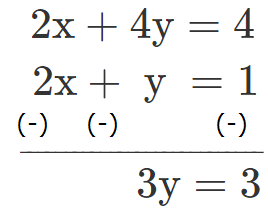
We know that, Three vectors are coplanar if any one of them vector can be expressed as the linear combination of the other two. Let, $\hat{\text{i}}+2\hat{\text{j}}+3\hat{\text{k}}\\=\text{x}\big(2\hat{\text{i}}+\hat{\text{j}}+3\hat{\text{k}}\big)+\text{y}\big(\hat{\text{i}}+\hat{\text{j}}+\hat{\text{k}}\big)$ $=2\text{x}\hat{\text{i}}+\text{x}\hat{\text{j}}+3\text{x}\hat{\text{k}}+\text{y}\hat{\text{i}}+\text{y}\hat{\text{j}}+\text{y}\hat{\text{k}}$ $\therefore\ \hat{\text{i}}+2\hat{\text{j}}+3\hat{\text{k}}\big)\\=\big(2\text{x}+\text{y}\big)\hat{\text{i}}+\big(\text{x}+2\text{y}\big)\hat{\text{j}}+\big(3\text{x}+\text{y}\big)\hat{\text{k}}$ comparing the coefficient of LHS and RHS, 2x + y = 1 .....(i) x + 2y = 2 .....(ii) 3x + y = 3 .....(iii) subtracting 2 × (ii) from equation (i),
$\text{y}=\frac{3}3$ $\text{y}=1$ Put the value of y in equation (i), $2\text{x}+\text{y}=1$ $2\text{x}+1=1$ $2\text{x}=1-1$ $2\text{x}=0$ $\text{x}=\frac{0}2$ $\text{x}=0$ Put the value of x and y in equation (iii), $3\text{x}+\text{y}=3$ $3(0)+1=3$ $0+1=3$ $1=3$ $\text{LHS}\neq\text{RHS}$ The value of x and y do not satisfy the equation (iii), Hence, vectors are non-coplanar.

Need a full question paper?

Generate a complete, print-ready paper with questions like this in minutes — across 16+ boards, with answer keys.

Start Generating Free