Question
Prove that the horizontal range is same when angle of projection is:
  1. Greater than $45^\circ$ by certain value.
  2. Less than $45^\circ$ by the same value.

Answer

The horizontal range of the projectile is given by $\text{R}=\frac{\text{u}^2\sin2\theta}{\text{g}}$
  1. If angle of projection $\theta=45^\circ+\alpha$ and $R = R_1$
then, $\text{R}_1=\frac{\text{u}^2\sin2(45^\circ+\alpha)}{\text{g}}=\frac{\text{u}^2}{\text{g}}\cos2\alpha\dots(\text{i})$
  1. If angle of projection $\theta=45^\circ-\alpha$ and $R = R_2$
$\therefore\ \text{R}_2=\frac{\text{u}^2\sin2(45^\circ-\alpha)}{\text{g}}=\frac{\text{u}^2}{\text{g}}\cos2\alpha\dots(\text{ii})$
Comparing eq. $(i)$ and $(ii),$ we have $R_1$ = $R_2$

Need a full question paper?

Generate a complete, print-ready paper with questions like this in minutes — across 16+ boards, with answer keys.
Start Generating Free

Similar questions

A bullet of $1 0 0$ grams moving with a velocity of $120 m / s$. It crosses a 20 cm thick wooden plank and hits the second target. If the wooden strap exerting an average resistance force of 1100 N then at what velocity will the bullet hit the second target?
State whether the statement given below is true or false giving reason in brief. A ring of mass 0.3kg and radius 0.1m and a solid cylinder of mass 0.4kg and of the same radius are given the same kinetic energy and released simultaneously on a flat horizontal surface such that they begin to roll as soon as released towards a wall which is at the same distance from the ring and cylinder. The rolling friction in both the cases is negligible. The cylinder will reach the wall first.
A body of mass 6kg is floating in a liquid with $\frac23$ of its volume inside the liquid. Find ratio between the density of the body and density of liquid. Take $g = 10m/ s^2$.
A brass plate having surface area $200cm^2$ on one side is electroplated with $0·10mm$ thick silver layers on both sides using a $15A$ current. Find the time taken to do the job. The specific gravity of silver is $10.5$ and its atomic weight is $107.9 g/mol$.
The bob of a vibrating simple pendulum is made of ice. How will the period of swing change when the ice starts melting?
Find the dimensions of :
  1. Electric dipole moment $p$.
  2. Magnetic dipole moment $M$.
The defining equations are $p = q.d$ and $M = IA$, where $d$ is distance, $A$ is area, $q$ is charge and $I$ is current.
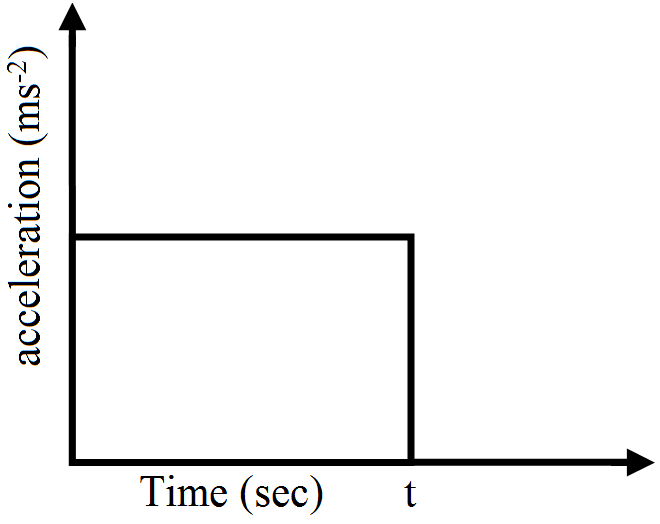
The acceleration-time graph for a body is shown in the figure below. Plot the corresponding velocity-time graph.
Even when earth receives solar energy, why is it not getting warmed up continuously?
Explain your answers.
What is the amplitude of a point 0.375m away from one end?
Two voltameters, one having a solution of silver salt and the other of a trivalent$-$metal salt, are connected in series and a current of $2A$ is maintained for $1.50$ hours. It is found that $1.00g$ of the trivalent$-$metal is deposited.
  1. What is the atomic weight of the trivalent metal?
  2. How much silver is deposited during this period? Atomic weight of silver is $107.9 g/mole$.