Question
Prove that the medians of a triangle are concurrent.

Answer

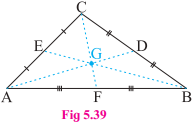
Let A, B and C be vertices of a triangle. Let D, E and F be the mid-points of the sides $\mathrm{BC}, \mathrm{AC}$ and $\mathrm{AB}$ respectively. Let $\bar{a}, \bar{b}, \bar{c}, \bar{d}, \bar{e}$ and $\bar{f}$ be position vectors of points $\mathrm{A}, \mathrm{B}$, $\mathrm{C}, \mathrm{D}, \mathrm{E}$ and $\mathrm{F}$ respectively.
Therefore, by mid-point formula,
$\therefore \bar{d}=\frac{\bar{b}+\bar{c}}{2}, \bar{e}=\frac{\bar{a}+\bar{c}}{2}$ and $\bar{f}=\frac{\bar{a}+\bar{b}}{2}$
$\therefore 2 \bar{d}=\bar{a}+\bar{c}, 2 \bar{e}=\bar{a}+\bar{c}$ and $2 \bar{f}=\bar{a}+\bar{b}$
$\therefore 2 \bar{d}+\bar{a}=\bar{a}+\bar{b}+\bar{c}$, similarly $2 \bar{e}+\bar{b}=2 \bar{f}+\bar{c}=\bar{a}+\bar{b}+\bar{c}$
$\therefore \frac{2 \bar{d}+\bar{a}}{3}=\frac{2 \bar{e}+\bar{b}}{3}=\frac{2 \bar{f}+\bar{c}}{3}=\frac{\bar{a}+\bar{b}+\bar{c}}{3}=\bar{g}$ (say)
Then we have $\bar{g}=\frac{\bar{a}+\bar{b}+\bar{c}}{3}=\frac{(2) \bar{d}+(1) \bar{a}}{2+1}=\frac{(2) \bar{e}+(1) \bar{b}}{2+1}=\frac{(2) \bar{f}+(1) \bar{c}}{2+1}$
If $\mathrm{G}$ is the point whose position vector is $\bar{g}$, then from the above equation it is clear that the point $\mathrm{G}$ lies on the medians $\mathrm{AD}, \mathrm{BE}, \mathrm{CF}$ and it divides each of the medians $\mathrm{AD}, \mathrm{BE}, \mathrm{CF}$ internally in the ratio $2: 1$.
Therefore, three medians are concurrent.

Image

Need a full question paper?

Generate a complete, print-ready paper with questions like this in minutes — across 16+ boards, with answer keys.
Start Generating Free

Similar questions

Solve the following initial value problems:
$\frac{\text{dy}}{\text{dx}}=\frac{\text{y}(\text{x}+2\text{y})}{\text{x}(2\text{x}+\text{y})},\text{y}(1)=2$
Find the equation of the perpendicular drawn from the point P(-1, 3, 2) to the line $\vec{\text{r}}=\big(2\hat{\text{j}}+3\hat{\text{k}}\big)+\lambda\big(2\hat{\text{i}}+\hat{\text{j}}+3\hat{\text{k}}\big).$ Also, find the coordinates of the foot of the perpendicular from P.
A manufacturer has three machine operators $A, B$ and $C$. The first operator A produces $1 \%$ defective items, whereas the other two operators B and C produce $5 \%$ and $7 \%$ defective items respectively. A is on the job for $50 \%$ of the time, $B$ on the job for $30 \%$ of the time and C on the job for $20 \%$ of the time. A defective item is produced. What is the probability that it was produced by $A$?
Evaluate the following intregals:
$\int\frac{2\text{x}+1}{(\text{x}+2)(\text{x}-3)^2}\text{ dx}$
Find the angle between the following pairs of lines:$\frac{\text{x}-2}{3}=\frac{\text{y}+3}{-2},\text{z}=5$ and $\frac{\text{x}+1}{1}=\frac{2\text{y}-3}{3}=\frac{\text{z}-5}{2}$
Solve the following differential equation
$\text{xy}(\text{y}+1)\text{dy}=(\text{x}^2+1)\text{dx}$
Evaluate the following definite integrals:$\int_{0}^\limits{1}\frac{1-\text{x}}{1+\text{x}}\text{ dx}$
Show that the four points A, B, C, D with position vectors $\vec{\text{a}},\ \vec{\text{b}},\ \vec{\text{c}},\ \vec{\text{d}}$ respectively such that $3\vec{\text{a}}-2\vec{\text{b}}+5\vec{\text{c}}-6\vec{\text{d}}=0$, are coplanar. Also, find the position vector of the point of intersection of the line segments AC and BD.
Solve the following differential equation
$\text{x}(\text{x}^{2} - 1)\frac{\text{dy}}{\text{dx}} = 1, \text{y}(2) = 0$
If the lines $\frac{\text{x}-1}{-3}=\frac{\text{y}-2}{-2\text{k}}=\frac{\text{z}-3}{2}$ and $\frac{\text{x}-1}{\text{k}}=\frac{\text{y}-2}{1}=\frac{\text{z}-3}{5}$ are perpendicular, find the value of k and, hence find the equation of the plane containing these lines.