Question
Prove that the root mean square velocity of a molecule is absolute, is directly proportional to the square root of temperature and the mean kinetic energy is directly proportional to absolute temperature.

Answer

SELF

Need a full question paper?

Generate a complete, print-ready paper with questions like this in minutes — across 16+ boards, with answer keys.
Start Generating Free

Similar questions

Find the change in the internal energy of 2kg of water as it is heated from $0^\circ C$ to $4^\circ C$. The specific heat capacity of water is $4200Jkg^{-1} K^{-1}$ and its densities at $0^\circ C$ and $4^\circ C$ are $999.9kgm^{-3}$ and $1000kgm^{-3}$ respectively. Atmospheric pressure = $10^{-6}Pa$.
The friction coefficient between a road and the tyre of a vehicle is $\frac{4}{3}.$ Find the maximum incline the road may have so that once hard brakes are applied and the wheel starts skidding, the vehicle going down at a speed of 36km/hr is stopped within 5m.
A train, standing in a station-yard, blows a whistle of frequency $400Hz$ in still air. The wind starts blowing in the direction from the yard to the station with a speed of $10m s^{–1}$. What are the frequency, wavelength, and speed of sound for an observer standing on the station’s platform? Is the situation exactly identical to the case when the air is still and the observer runs towards the yard at a speed of $10m s^{–1}$? The speed of sound in still air can be taken as $340m s^{–1}$.
A man standing in front of a mountain at a certain distance beats a drum at regular intervals. The drumming rate is gradually increased, and he finds that the echo is not heard distinctly, when the rate becomes 40 per minute. He then moves nearer to the mountain by 90 metres, and finds what the echo is again not heard when the drumming rates becomes 60 per minute. Calculate
  1. The distance between the mountain and the initial position of the man.
  2. The velocity of sound.
State and explain Newton's law of cooling. Calculate the increase in the temperature of water which falls from a height of $100m$. Assume that $90\%$ of the energy due to fall is converted into heat and is retained by water. $J = 4.2J/ Cal^{-1}$.
A star 2.5 times the mass of the sun and collapsed to a size of 12 km rotates with a speed of 1.2 rev . per second. (Extremely compact stars of this kind are known as neutron stars. Certain stellar objects called pulsars belong to this category). Will an object placed on its equator remain stuck to its surface due to gravity? (mass of the sun $=2 \times$ $\left.10^{30} \mathrm{~kg}\right)$.
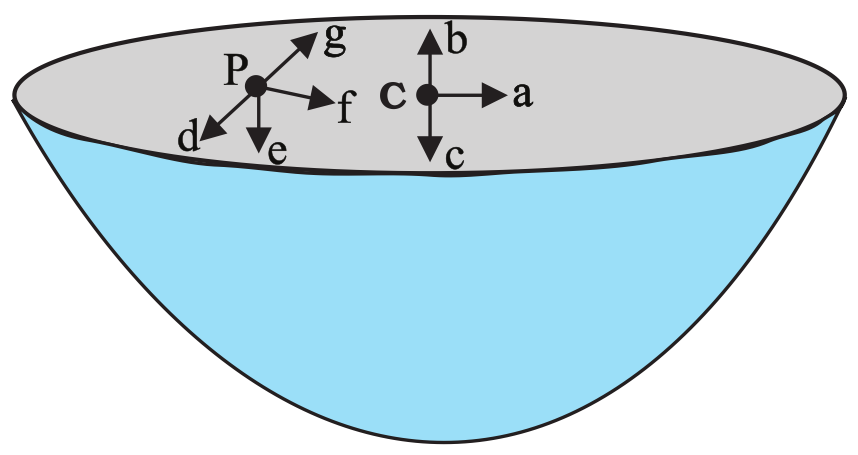
In the following two exercises, choose the correct answer from among the given ones: The gravitational intensity at the centre of a hemispherical shell of uniform mass density has the direction indicated by the arrow (see Fig.) (i) a, (ii) b, (iii) c, (iv) 0.
An object falling through a fluid is observed to have acceleration given by a = g - bv where g = gravitational acceleration and b is constant. After a long time of release, it is observed to fall with constant speed. What must be the value of constant speed?
An equilateral triangle ABC is formed by two Cu rods AB and BC and one Al rod. It is heated in such a way that temperature of each rod increases by $\Delta\text{T}$. Find change in the angle ABC. $[$Coeff. of linear expansion for 1 Cu is $\alpha_1$ Coeff. of linear expansion for 2Al is $\alpha_2]$
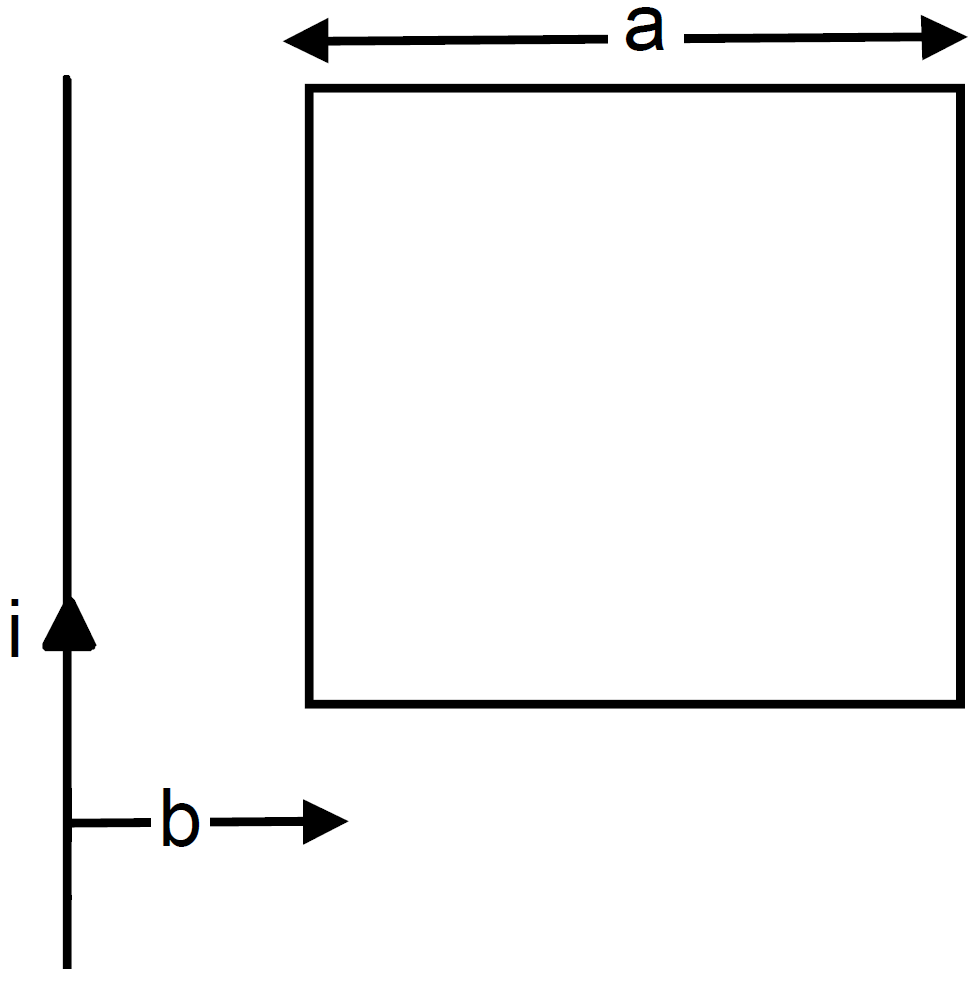
Find the mutual inductance between the straight wire and the square loop of figure.