Question
Prove that two lines that are respectively perpendicular to two intersecting lines intersect each other. [Hint: Use proof by contradiction].

Answer

Given: Let lines $l$ and $m$ are two intersecting lines. Again, let n and p be another two lines which are perpendicular to the intersecting lines meet at point $D.$
To prove: Two lines $n$ and $p$ intersecting at a point.
Proof: Let us consider lines $n$ and $p$ are not intersecting, then it means they are parallel to each other i.e., $n || p.....(1)$ Since, lines $n$ and $p$ are perpendicular to $m$ and $l$ respectively.
​​​​​​​But from equation $(1), n || p,$ it implies that $l$ and $m.$ It is a contradiction.
Thus, our assumption is wrong.
Hence, lines $n$ and $p$ intersect at a point.

Need a full question paper?

Generate a complete, print-ready paper with questions like this in minutes — across 16+ boards, with answer keys.

Start Generating Free

Similar questions

Aarushi was driving a car with uniform speed of $60\ km/ h.$ Draw distance$-$time graph. From the graph, find the distance travelled by Aarushi in:
$i. 2\frac{1}{2}$  Hours
$ii. \frac{1}{2}$ Hour
The factors of $8a^3 + b^3 - 6ab + 1$ are:
The length of the sides of a triangle are in the ratio $3 : 4 : 5$ and its perimeter is $144 \ cm.$ Find the area of the triangle and the height corresponding to the longest side
The diagonals of a cyclic quadrilateral are at right angles. Prove that the perpendicular from the point of their intersection on any side when produced backwards, bisects the opposite side.
$ABCD$ is a trapezium in which $AB\ ||\ CD, AB = 16\ cm$ and $DC = 24\ cm$. If $E$ and $F$ are respectively the midpoints of $AD$ and $BC$, prove that $\text{ar(ABFE)}=\frac{9}{11}\text{ar(EFCD)}.$
Simplify the following: $\Big(\text{x}+\frac{2}{\text{x}}\Big)^3+\Big(\text{x}-\frac{2}{\text{x}}\Big)^3$
Draw a histogram for the frequency distribution of the following date:
Class interval
$8-13$
$13-18$
$18-23$
$23-28$
28-33
33-38
38-43
Frequency
$320$
$780$
$160$
$540$
260
100
80
The volume of a right circular cone is $9856\text{ }c{{m}^{3}}$. If the diameter of the base if $28 \ cm$, find:
$i.$ Height of the cone
$ii.$ Slant height of the cone
$iii.$ surface area of the cone.
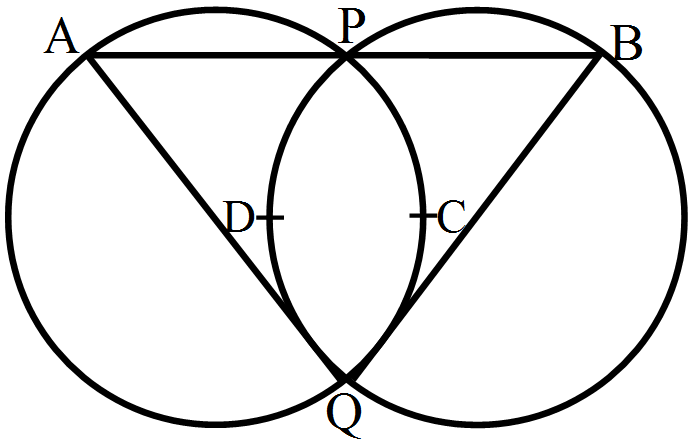
Two equal circles intersect in $P$ and $Q$. A straight line through $P$ meets the circles in $A$ and $B$. Prove that $QA = QB$.
The diagonals of a quadrilateral $ABCD$ are equal. Prove that the quadrilateral formed by joining the midpoints of its sides is a rhombus.