Question
Prove the following identities:
$\frac{1+\cos\theta+\sin\theta}{1+\cos\theta-\sin\theta}=\frac{1+\sin\theta}{\cos\theta}$

Answer

$\text{LHS}=\frac{1+\cos\theta+\sin\theta}{1+\cos\theta-\sin\theta}$
On dividing numerator and denominator of LHS $\cos^\theta,$
We, get
$\text{LHS}=\frac{\sec\theta+1+\tan\theta}{\sec\theta+1-\tan\theta}$
$=\frac{(\sec\theta+\tan\theta)+\big(\sec^2\theta-\tan^2\theta\big)}{1+\sec\theta-\tan\theta}$
Writing 1 $=\big(\sec^2\theta-\tan^2\theta\big)$
$=\frac{(\sec\theta+\tan\theta)+(\sec\theta+\tan\theta)(\sec\theta-\tan\theta)}{(1+\sec\theta-\tan\theta)}$
$=\frac{(\sec\theta+\tan\theta)(\sec\theta+\tan\theta)(\sec\theta-\tan\theta)}{(1+\sec\theta-\tan\theta)}$
$=(\sec\theta+\tan\theta)=\Big(\frac{1}{\cos\theta}+\frac{\sin\theta}{\cos\theta}\Big)$
$=\Big(\frac{1+\sin\theta}{\cos\theta}\Big)$
$=\text{R.H.S.}$
$\therefore\text{L.H.S.}=\text{R.H.S.}$

Need a full question paper?

Generate a complete, print-ready paper with questions like this in minutes — across 16+ boards, with answer keys.
Start Generating Free

Similar questions

ABCD is a square. F is the mid-point of AB. BE is one third of BC. If the area of $\triangle\text{FBE}=108\text{cm}^2,$ find the length of AC.
Solve for x:$\left(\frac{2 x}{x-5}\right)^2+5\left(\frac{2 x}{x-5}\right)-24=0, x \neq 5$
The angle of elevation of the top of vertical tower from a point on the ground is 60°. From another poin 10m vertically above the first, its angle of elevation is 30°. Find the height of the tower.
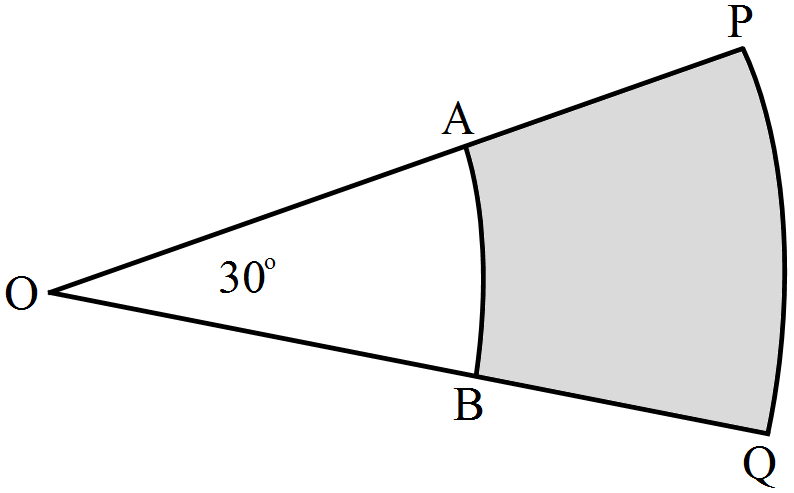
In the given figure, PQ and AB are respectively the arcs of two concentric circles of radii 7cm and 3.5cm with centre 0. If $\angle\text{POQ}=30^\circ,$ find the area of the shaded region.
5 chairs and 4 tables together cost ₹ 5,600, while 4 chairs and 3 tables together cost ₹ 4,340. Find the cost of a chair and that of a table.
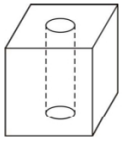
In Figure, from a solid cube of side $7 \ cm,$ a cylinder of radius $2.1 \ cm$ and height $7 \ cm$ is scooped out. Find the total surface area of the remaining solid.
Image
Solve the following systems of equations by using the method of cross multiplication:
$\frac{\text{a}}{\text{x}}-\frac{\text{b}}{\text{y}}=0$
$\frac{\text{ab}^2}{\text{x}}+\frac{\text{a}^2\text{b}}{\text{y}}=\text{a}^2+\text{b}^2,$ where $\text{x}\neq0$ and $\text{y}\neq0$
The sum of two numbers is 16. The sum of their reciprocals is $\frac{1}{3}.$ Find the numbers.
Draw a right triangle ABC in which AB = 6cm, BC = 8cm and $\angle\text{B}=90^\circ.$ Draw BD perpendicular from B on AC and draw a circle passing through the points B, C and D. Construct tangents from A to this circle.
Peter throws two different dice together and finds the product of the two numbers obtained. Rina throws a die squares the number obtained. Who has the better chance to get the number 25?