Question
Prove the following identities:
$\Bigg\{\frac{1}{\big(\sec^2\theta-\cos^2\theta\big)}+\frac{1}{\big(\text{cosec}^2\theta-\sin^2\theta\big)}\Bigg\}\big(\sin^2\theta\cos^2\theta\big)$
$=\frac{1-\sin^2\theta\cos^2\theta}{2+\sin^2\theta\cos^2\theta}$
Answer

$\text{LHS}=\Bigg\{\frac{1}{\big(\sec^2\theta-\cos^2\theta\big)}+\frac{1}{\big(\text{cosec}^2\theta-\sin^2\theta\big)}\Bigg\}\big(\sin^2\theta\cos^2\theta\big)$
$=\Bigg\{\frac{1}{\frac{1}{\cos^2\theta}-\cos^2\theta}+\frac{1}{\frac{1}{\sin^2\theta}-\sin^2\theta}\Bigg\}\times\sin^2\theta\cos^2\theta$
$=\Bigg\{\frac{\sin^2\theta\cos^2\times\cos^2\theta}{\big(1-\cos^4\theta\big)}+\frac{\sin^4\theta\cos^2\theta\sin^2\theta}{1-\sin^4\theta}\Bigg\}$
$=\Bigg\{\frac{\sin^2\theta\times\cos^4\theta}{\big(1-\cos^2\theta\big)\big(1-\cos^2\theta\big)}+\frac{\sin^4\theta\cos^2\theta}{1-\sin^2\theta\big(1+\sin^2\theta\big)}\Bigg\}$
$=\Bigg\{\frac{\cos^4\theta}{\big(1+\cos^2\theta\big)}+\frac{\sin^4\theta}{1+\sin^2\theta}\Bigg\}$
$=\frac{\cos^4\theta+\cos^4\theta\sin^2\theta+\sin^4\theta+\sin^4\theta\cos^2\theta}{\big(1+\cos^2\theta\big)\big(1+\sin^2\theta\big)}$
$=\frac{\cos^4\theta+\sin^4\theta+\cos^2\theta\sin^2\theta\big(\cos^2\theta+\sin^2\theta\big)}{1+\sin^2\theta+\cos^2\theta+\cos^2\theta+\sin^2\theta}$ $\Big[\because\text{a}^2+\text{b}^2=(\text{a}+\text{b})^2-2\text{ab}\Big]$
$=\frac{1-\cos^2\theta\sin^2\theta}{2+\cos^2\theta\sin^2\theta}$
$=\text{R.H.S}$
$\therefore\ \text{R.H.S.}=\text{L.H.S.}$

Need a full question paper?

Generate a complete, print-ready paper with questions like this in minutes — across 16+ boards, with answer keys.

Start Generating Free

Similar questions

The hypotenuse of a right-angled triangle is 20 metres. If the difference between the length of the other sides be 4 metres, find the other sides.
If (3y - 1), (3y + 5) and (5y + 1) are three consecutive terms of an AP then find the value of y.
In an AP, it is given that $S_5+S_7=167$ and $S_{10}=235$, then find the $A P$, where $S_n$ denotes the sum of its first $n$ terms.
If (-2, 3), (4, -3) and (4, 5) are the mid-points of the sides of a triangle, find the coordinates of its centroid.
At a fete, cards bearing numbers 1 to 1000, one number on one card, are put in a box. Each player selects one card at random and that card is not replaced. If the selected card has a perfect square greater than 500, the player wins a prize. What is the probability that:
  1. The first player wins a prize?
  2. The second player wins a prize, if the first has won?
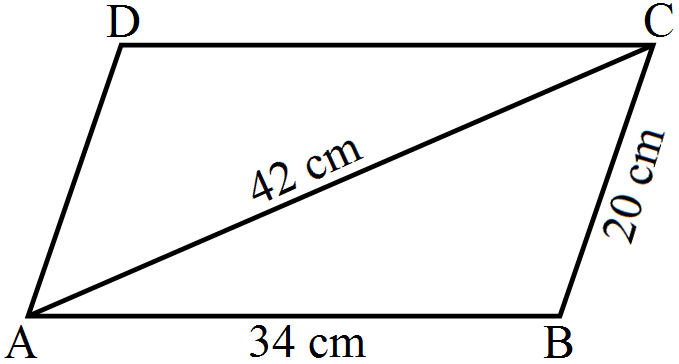
The adjacent sides of a parallelogram ABCD measure 34cm and 20cm, and the diagonal AC measures 42cm. Find the area of the parallelogram.
Find the area of $\triangle\text{ABC}$ with A(1, -4) and midpoints of sides through A being (2, -1) and (0, -1).
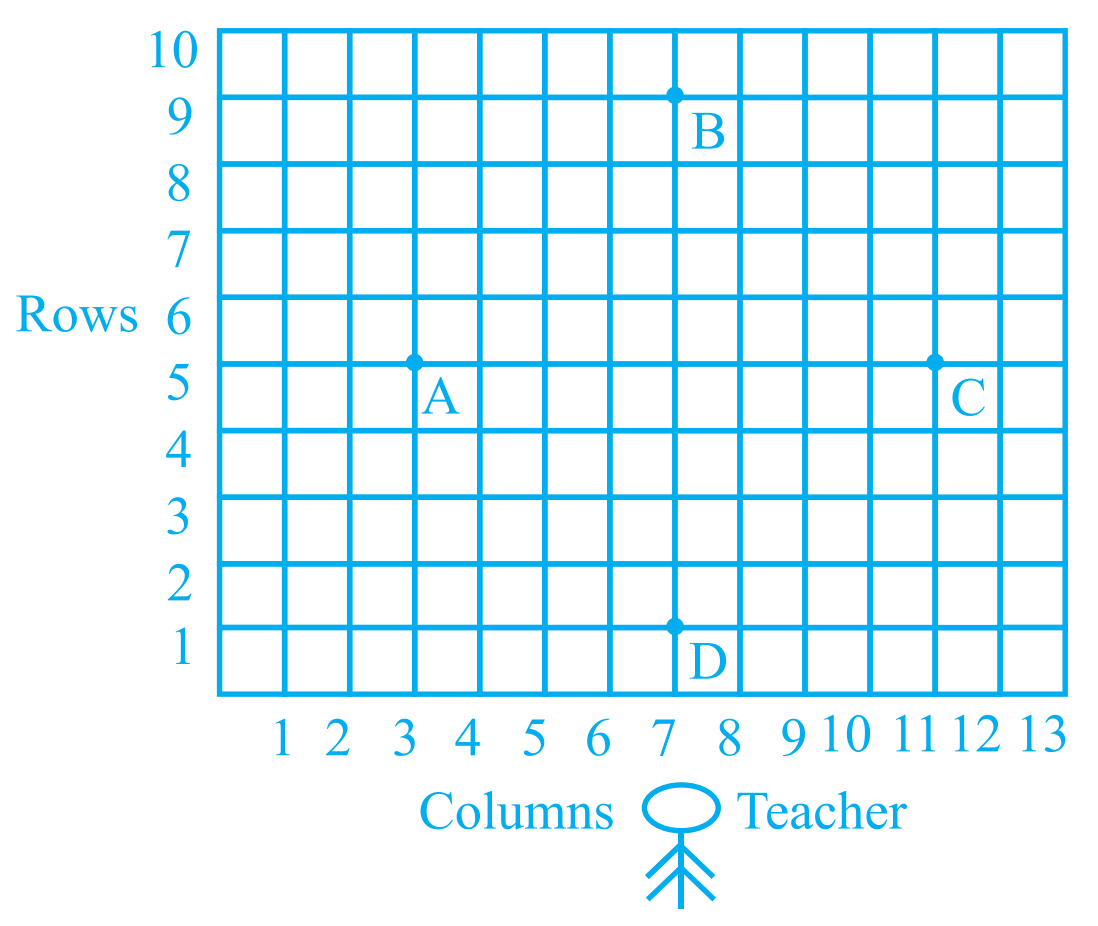
Students of a school are standing in rows and columns in their playground for a drill practice. A, B, C and D are the positions of four students as shown in Is it possible to place Jaspal in the drill in such a way that he is equidistant from each of the four students A, B, C and D? If so, what should be his position?
If $(\tan\theta+\sin\theta)=\text{m}$ and $(\tan\theta-\sin\theta)=\text{n},$ prove that $\big(\text{m}^2-\text{n}^2\big)^2=16\text{mn}.$
If $\text{D}\Big(\frac{-1}{2},\frac{5}{2}\Big),$ E(7, 3) and $\text{F}\Big(\frac{7}{2},\frac{7}{2}\Big)$ are the mid-points of sides of ∆ABC, find the area of ∆ABC.