Question
Prove the following.
If $\tan\text{A}=\frac{3}{4},$ then $\sin\text{A}\cos\text{A}=\frac{12}{25}$
Answer


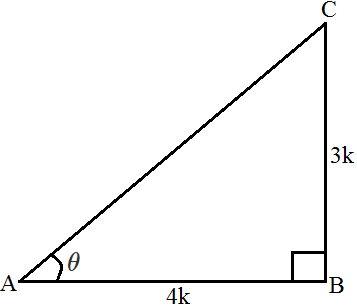
Given, $\tan\text{A}=\frac{3}{4}=\frac{\text{P}}{\text{B}}=\frac{\text{perpendicular}}{\text{Base}}$
Let $P = 3k$ and $B = 4k$
By pythagoras theorem,
$H^2 = P^2 + B^2 = (3k)^2 + (4k)^2$
$= 9k^2 + 16k^2 = 25k^2$
$\Rightarrow H = 5k$ [since, side cannot be negative]
$\therefore\ \sin\text{A}=\frac{\text{P}}{\text{H}}=\frac{3\text{k}}{5\text{k}}=\frac{3}{5}\text{ and }\cos\text{A}=\frac{\text{B}}{\text{H}}=\frac{4\text{k}}{5\text{k}}=\frac{4}{5}$
Now, $\sin\text{A}\cos\text{A}=\frac{3}{5}\cdot\frac{4}{5}=\frac{12}{25}$
Hence proved.

Need a full question paper?

Generate a complete, print-ready paper with questions like this in minutes — across 16+ boards, with answer keys.
Start Generating Free

Similar questions

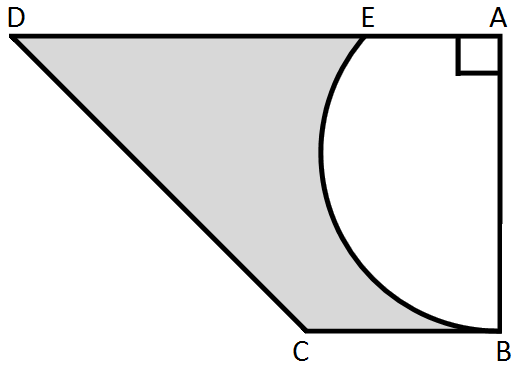
In the following figure, $ABCD$ is a trapezium of area $24.5cm^2$​​​​​​​, If $\text{AD}||\text{BC}, \angle\text{DAB} = 90^\circ$$AD = 10\ cm, BC = 4\ cm$ and $ABE$ is quadrant of a circle, then find the area of the shaded region.
Write the sequence with $n^{th}$​​​​​​​ term:
$a_n = 5 + 2n.$
Show the all of the above sequences form $A.P.$
Prove that:
$\frac{\cos(90^\circ-\theta)}{1+\sin(90^\circ-\theta)}+\frac{1+\sin(90^\circ-\theta)}{\cos(90^\circ-\theta)}=2\text{cosec }\theta$
Draw a right triangle ABC in which $A B=6 cm$, $B C=8 cm$ and $\angle B=90^{\circ}$. Draw $B D$ perpendicular from $B$ on $A C$ and draw a circle passing through the points $B, C$ and $D$. Construct tangents from $A$ to this circle.
Find the values of a and b for which the following system of equations has infinitely many solutions:
$2x + 3y - 7 = 0$
$(a - 1)x + (a + 1)y = (3a - 1)$
If the point $A(0,2)$ is equidistant from the points $B(3, p)$ and $C(p, 5)$, find $p$. Also, find the length of $A B$.
Very-Short and Short-Answer Questions:
Write the value of k for which the system of equations 3x + ky = 0, 2x - y = 0 has a unique solution.
The sum of three numbers in $A.P$. is $12$ and the sum of their cubes is $288$. Find the numbers.
The diameter of a copper sphere is 18cm. The sphere is melted and is drawn into a long wire of uniform circular cross-section. If the length of the wire is 108m, find its diameter.
Find the value of k for which the following systems of equations has unique solution:
$2x + 3y - 5 = 0, kx - 6y - 8 = 0$