Question
Prove the following statement, “For Elevation which exceed or fall short of 45° by equal amount, the range is equal.”

Answer

At 45°, the projectile has maximum range.
At $(45^\circ-\theta)$ the range is,
$\text{R}_1=\frac{\text{u}^2\sin[2(45^\circ-\theta)]}{\text{g}}$
$=\frac{\text{u}^2\sin(90^\circ-2\theta)}{\text{g}}=\frac{\text{u}^2\cos2\theta}{\text{g}}$
At $(45^\circ+\theta)$ the range is,
$\text{R}_2=\frac{\text{u}^2\sin[2(45^\circ+\theta)]}{\text{g}}$
$=\frac{\text{u}^2\sin(90^\circ+2\theta)}{\text{g}}=\frac{\text{u}^2\cos2\theta}{\text{g}}$
$\text{R}_1=\text{R}_2$

Need a full question paper?

Generate a complete, print-ready paper with questions like this in minutes — across 16+ boards, with answer keys.
Start Generating Free

Similar questions

If water in one flask and castor oil in other are violently shaken and kept on a table, which will come to rest earlier?
The charge on a proton is +1.6 × 10-19C and that on an electron is -1.6 × 10-19C. Does it mean that the electron has a charge 3.2 × 10-19C less than the charge of a proton?
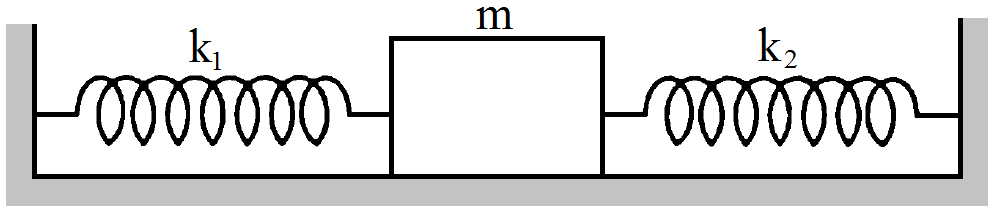
A block of mass m is attached to two unstretched springs of spring constants k1 and k2 as shown in figure. The block is displaced towards right through a distance x and is released. Find the speed of the block as it passes through the mean position shown.

Answer the following:
A screw gauge has a pitch of 1.0mm and 200 divisions on the circular scale. Do you think it is possible to increase the accuracy of the screw gauge arbitrarily by increasing the number of divisions on the circular scale ?
In the figure, the blocks are in contact with each other $m_1=3 kg, m_2=1 kg$. A horizontal force $F = 4 \mathrm { N }$. How much force can be applied :(i) On $m_1$ from the right side,
(ii) On $m_2$ from the left side? What will be the contact force between the two blocks?
In a coal fire, the pockets formed by coals appear brighter than the coals themselves. Is the temperature of such a pocket higher than the surface temperature of a glowing coal?
Two pendulum of length 1.00 and 1.1025 meters start vibrating simultaneously. After how many oscillations will they start oscillating together again ?
A planet moving around the sun is a good illustration of the law of conservation of energy. Explain.
Two cylinders A and B of radii r and 2r are soldered co-axially. The free end of A is clamped and the free end of B is twisted by an angle $\phi.$ Find twist at the junction taking the material of two cylinders to be same and of equal length.
Whether the diffraction effects from a slit will be more clearly visible or less clearly, if the slit-width is increased?