Question
Prove the following trigonometric identities.
$\Big(\frac{1}{\sec^2\theta-\cos^2\theta}+\frac{1}{\text{cosec}^2\theta-\sin^2\theta}\Big)\sin^2\theta\cos^2\theta=\frac{1-\sin^2\theta\cos^2\theta}{2+\sin^2\theta\cos^2\theta}$
Answer

$\text{L.H.S}=\Big(\frac{1}{\sec^2\theta-\cos^2\theta}+\frac{1}{\text{cosec}^2\theta-\sin^2\theta}\Big)\sin^2\theta\cos^2\theta$
$\Rightarrow \bigg[\frac{1}{\frac{1}{\cos^2\theta}-\cos^2\theta}+\frac{1}{\text{cosec}^2\theta-\sin^2\theta}\bigg]\sin^2\theta\cos^2\theta$
$=\Bigg[\frac{1}{\frac{1-\cos^4\theta}{\cos^2\theta}}+\frac{1}{\frac{1-\sin^4\theta}{\sin^2\theta}}\Bigg]\sin^2\theta\cos^2\theta$
$=\Big[\frac{\cos^2\theta}{1-\cos^4\theta}+\frac{\sin^2\theta}{1-\sin^4\theta}\Big]\sin^2\theta\cos^2\theta$
$=\Big[\frac{\cos^2\theta}{\cos^2\theta+\sin^2\theta-\cos^4\theta}+\frac{\sin^2}{\cos^2\theta+\sin^2\theta-\sin^4\theta}\Big]\sin^2\theta\cos^2\theta$
$=\Big[\frac{\cos^2\theta}{\cos^2\theta(1-\cos^2\theta)+\sin^2\theta}+\frac{\sin^2}{\sin^2\theta(1-\sin^2\theta)+\cos^2\theta}\Big]\sin^2\theta\cos^2\theta$
$=\Big[\frac{\cos^2\theta}{\cos^2\theta\sin^2\theta+\sin^2\theta}+\frac{\sin^2\theta}{\sin^2\theta\cos^2\theta+\cos^2\theta}\Big]\sin^2\theta\cos^2\theta$
$=\bigg[\frac{\cos^2\theta}{\sin^2\theta(\cos^2\theta+1)}+\frac{\sin^2\theta}{\cos^2\theta(\sin^2\theta+1)}\bigg]\sin^2\theta\cos^2\theta$
$=\bigg[\frac{\cos^4\theta(1+\sin^2\theta)+\sin^4\theta(1+\cos^2\theta)}{\sin^2\theta\cos^2\theta(1+\cos^2\theta)(1+\sin^2\theta)}\bigg]\sin^2\theta\cos^2\theta$
$=\frac{\cos^4\theta(1+\sin^2\theta)+\sin^4\theta(1+\cos^2\theta)}{(1+\cos^2\theta)(1+\sin^2\theta)}$
$=\frac{\cos^4\theta+\cos^4\theta\sin^2\theta+\sin^4\theta+\sin^4\theta\cos^2\theta}{1+\sin^2\theta+\cos^2\theta+\cos^2\theta\sin^2\theta}$
$=\frac{1-2\sin^2\theta\cos^2\theta+\sin^2\theta\cos^2\theta(\cos^2\theta+\sin^2\theta)}{1+1+\cos^2\theta\sin^2\theta}$
$(\because\ \cos^2\theta+\sin^2\theta=1)$
$=\frac{1-\sin^2\theta\cos^2\theta}{2+\sin^2\theta\cos^2\theta}=\text{R.H.S}$
$\therefore\ \text{L.H.S}=\text{R.H.S}$

Need a full question paper?

Generate a complete, print-ready paper with questions like this in minutes — across 16+ boards, with answer keys.

Start Generating Free

Similar questions

The height of a cone is 20cm. A small cone is cut off from the top by a plane parallel to the base. If its volume be $\frac{1}{125}$ of the volume of the original cone, determine at what height above the base the section is made.
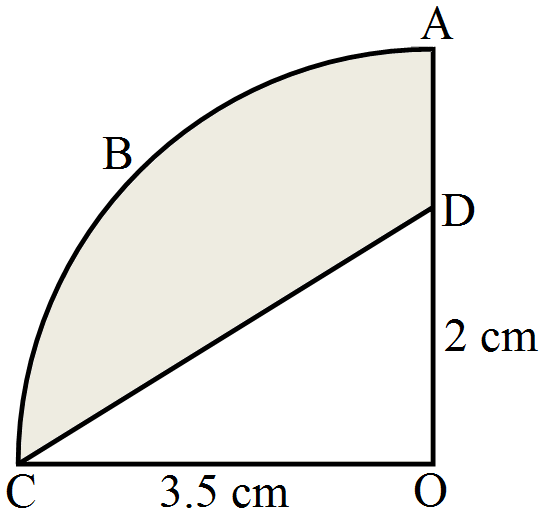
In the given figure, OABC is a quadrant of a circle with centre O and radius 3.5cm. If OD = 2cm, find the area of the shaded region.
With the vertices A, B and C of a tringle ABC as centres, arcs are drawn with radii 5cm each as shown in the given figure. If AB = 14cm, BC = 48cm and CA = 50cm then find the area of the shaded region. $\big[\text{Use }\pi=3.14\big]$
Draw two tangents to a circle of radius 3.5cm from a point P at a distance of 6.2cm from its centre.
Find the area of $\triangle\text{ABC}$ whose vertices are:
A(1, 2), B(-2, 3) and C(-3, -4)
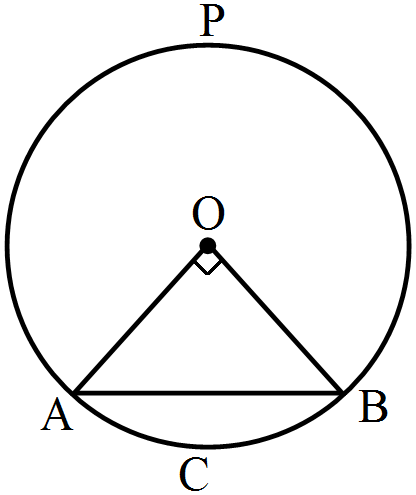
Find the area of the major segment APB of a circle of radius 35cm and $\angle\text{AOB}=90^\circ$ as shown in the given figure.
Solve graphically the following system of linear equation. Also find the coordinates of the points where the lines meet axis of y.
3x + y - 5 = 0,
2x - y - 5 = 0.
Find the zeroes of the following polynomials by factorisation method and verify the relations between the zeroes and the coefficients of the polynomials:
$2\text{x}^2 +\frac{7}{2}\text{x}+\frac{3}{4}$.
A container in the shape of a frustum of a cone having diameters of its two circular faces as 35cm and 30cm and vertical height 14cm, is completely filled with oil. If each $cm^3$​​​​​​​ of oil has mass 1.2g, then find the cost of oil in the container if it costs Rs. 40 per kg.