Question
Prove the following trigonometric identities.
$\frac{1+\cos\text{A}}{\sin\text{A}}=\frac{\sin\text{A}}{1-\cos\text{A}}$

Answer

We need to prove $\frac{1+\cos\text{A}}{\sin\text{A}}=\frac{\sin\text{A}}{1-\cos\text{A}}$
Now, multiplying the numerator and denominator of L.H.S by $1-\cos\text{A}$, we get
$\frac{1+\cos\text{A}}{\sin\text{A}}=\frac{1+\cos\text{A}}{\sin\text{A}}\times\frac{1-\cos\text{A}}{1-\cos\text{A}}$
Further using the identity $a^2 - b^2 = (a + b)(a - b)$, we get
$\text{L.H.S}=\frac{1+\cos\text{A}}{\sin\text{A}}\times\frac{1-\cos\text{A}}{1-\cos\text{A}}=\frac{1-\cos^2\text{A}}{\sin\text{A}(1-\cos\text{A})}$
$=\frac{\sin^2\text{A}}{\sin\text{A}(1-\cos\text{A})} \ (\text{using} \sin^2\theta+\cos^2\theta=1)$
$=\frac{\sin\text{A}}{1-\cos\text{A}}=\text{R.H.S}$
$\therefore\ \text{L.H.S}=\text{R.H.S}$

Need a full question paper?

Generate a complete, print-ready paper with questions like this in minutes — across 16+ boards, with answer keys.
Start Generating Free

Similar questions

Prove the following trigonometric identities.
$\frac{1+\cos\theta+\sin\theta}{1+\cos\theta-\sin\theta}=\frac{1+\sin\theta}{\cos\theta}$
Two brands of chocolates are available in packs of $24$ and $15$ respectively. If I need to buy an equal number of chocolates of both kinds, what is the least number of boxes of each kind I would need to buy?
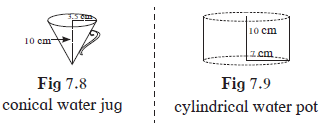
Observe the measures of pots in figure 7.8 and 7.9. How many jugs of water can the cylindrical pot hold?
Prepare Business to consumer (B2C) tax invoice using given information. Write the name
of the supplier, address, state, date of invoice number, GSTIN etc. as per your choice.
Perform the following activities:
Supplier: M/s. ........................... Address: ......................................
State : ............... Date : ............. Invoice No.: .......................GSTIN: ...........................
Particulars : (i) Rate of mobile battery – Rs. 300, Rate of GST 12%, HSN 8507,
(ii) Rate of Headphone – Rs. 700, Rate of GST 18%, HSN 8518, 1.

Image
If $\sec\theta=\frac{17}{8},$ verify that $\frac{\big(3-4\sin^2\theta\big)}{\big(4\cos^2\theta-3\big)}=\frac{\big(3-\tan^2\theta\big)}{\big(1-3\tan^2\theta\big)}.$
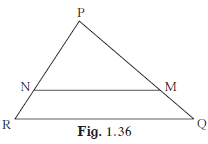
In Δ PQR, PM = 15, PQ = 25, PR = 20, NR = 8. State whether line NM is parallel to side RQ. Give reason.
Find:$n^{th}$ term of the A.P. $13, 8, 3, -2, ....$
Solve the following quadratic equation:$\text{x}^2+2\sqrt{2}\text{x}-6=0$
$3 \sin \theta-4 \cos \theta=0$, then find the values of all trigonometric ratios.