Question
Prove the following trigonometric identities.
$\frac{\cos\theta}{1+\sin\theta}=\frac{1-\sin\theta}{\cos\theta}$

Answer

$\text{L.H.S}=\frac{\cos\theta}{1+\sin\theta}$
$=\frac{\cos\theta}{(1+\sin\theta)}\times\frac{1-\sin\theta}{1-\sin\theta}$
$=\frac{(1-\sin\theta)\cos\theta}{1-\sin^2\theta}$
$=\frac{(1-\sin\theta)\cos\theta}{\cos^2\theta}$
$=\frac{(1-\sin\theta)}{\cos\theta}$
$=\text{R.H.S}$
$\therefore\ \text{L.H.S}=\text{R.H.S}$

Need a full question paper?

Generate a complete, print-ready paper with questions like this in minutes — across 16+ boards, with answer keys.
Start Generating Free

Similar questions

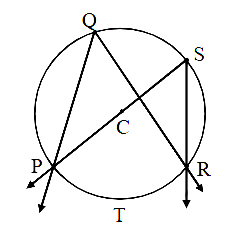
Prove that angles inscribed in the same arc are congruent.

Given: In a circle with center $C, \angle P Q R$ and $\angle P S R$ are inscribed in same arc PQR. Arc PTR is intercepted by the angles.
To prove: $\angle P Q R \cong \angle P S R$.
Proof:
$ m \angle PQR =\frac{1}{2} \times[ m (\operatorname{arc} PTR )]$
$m \angle \square=\frac{1}{2} \times[ m (\operatorname{arc} PTR )] \ldots . . . \text { (ii) } \square$
$m \angle \square= m \angle PSR \quad \ldots . . .[ By \text { (i) and (ii) }]$
$\therefore \angle PQR \cong \angle PSR $
In the adjoining figure BP ⊥ AC, CQ ⊥ AB, A – P- C, A- Q- B , then prove that △ APB and △ AQC are similar.
Find the fourth term from the end in an A.P. $– 11, – 8, – 5, . . ., 49.$
In a class, there are 18 girls and 16 boys. The class teacher wants to choose one pupil for class monitor. What she does, she writes the name of each pupil on a card and puts them into a basket and mixes thoroughly. A child is asked to pick one card from the basket. What is the probability that the name written on the card is:
  1. The name of a girl.
  2. The name of a boy.
For the A.P. $-3, -7, -11$,…, can we find $a_{30} - a_{20}$_ without actually finding $a_{30}$_ and $a_{20}$​​​​​​​_? Give reasons for your answer.
Determine the nature of the root of the following quadratic equation:
$3\text{x}^2-2\sqrt{6}\text{x}+2=0$
In $\triangle A B C, A P$ is a median. If $A P=7, A B^2+A C^2$ $=260$, find $B C$.
If $\text{cosec}^2\theta(1+\cos\theta)(1-\cos\theta)=\lambda,$ then find is the value of $\lambda$.
If point $(x, y)$ is equidistant from points $(7,1)$ and $(3,5)$, show that $y=x-2$.
State whether the following are true or false. Justify your answer.
$\sin\theta=\frac{4}{3}$ for some angle $\theta.$