Question
Prove the following trigonometric identities.
If $\text{T}_\text{n}=\sin^\text{n}\theta+\cos^\text{n}\theta,$ porve that $\frac{\text{T}_3-\text{T}_5}{\text{T}_1}=\frac{\text{T}_5-\text{T}_7}{\text{T}_3}.$
Answer

In the given question, we are given $\text{T}_\text{n}=\sin^\text{n}\theta+\cos^\text{n}\theta$
We need to prove $\frac{\text{T}_3-\text{T}_5}{\text{T}_1}=\frac{\text{T}_5-\text{T}_7}{\text{T}_3}$
Here L.H.S is
$\text{L.H.S}=\frac{\text{T}_3-\text{T}_5}{\text{T}_1}=\frac{(\sin^3\theta+\cos^3\theta)-(\sin^5\theta+\cos^5\theta)}{(\sin\theta+\cos\theta)}$
Now, solving the L.H.S, we get
$\frac{(\sin^3\theta+\cos^3\theta)-(\sin^5\theta+\cos^5\theta)}{(\sin\theta+\cos\theta)}=\frac{\sin^3\theta-\sin^3\theta+\cos^3\theta-\cos^3\theta}{\sin\theta+\cos\theta}$
$=\frac{\sin^3\theta(1-\sin^2\theta)+\cos^3\theta(1-\cos^2\theta)}{\sin\theta+\cos\theta}$
Further using the property $\sin^2\theta+\cos^2\theta=1,$ we get
$\cos^2\theta=1-\sin^2\theta$
$\sin^2\theta=1-\cos^2\theta$
$=\frac{\sin^3\theta(1-\sin^2\theta)+\cos^3\theta(1-\cos^2\theta)}{\sin\theta+\cos\theta}=\frac{\sin^3\theta\cos^2\theta+\cos^3\theta\sin^2\theta}{\sin\theta+\cos\theta}$
$=\frac{\sin^2\theta\cos^2\theta(\sin\theta+\cos\theta)}{\sin\theta+\cos\theta}$
$=\sin^2\theta\cos^2\theta$
Now, solving the R.H.S, we get
$\text{R.H.S}=\frac{\text{T}_5-\text{T}_7}{\text{T}_3}=\frac{(\sin^5\theta+\cos^5\theta)-(\sin^7\theta+\cos^7\theta)}{(\sin^3\theta+\cos^3\theta)}$
So,
$\frac{(\sin^5\theta+\cos^5\theta)-(\sin^7\theta+\cos^7\theta)}{(\sin^3\theta+\cos^3\theta)}=\frac{\sin^5\theta-\sin^7\theta+\cos^5\theta-\cos^7\theta}{\sin^3\theta+\cos^3\theta}$
$=\frac{\sin^5\theta(1-\sin^2\theta)+\cos^5\theta(1-\cos^2\theta)}{\sin^3\theta+\cos^3\theta}$
Furhter using the property $\sin^2\theta+\cos^2\theta=1,$ we get,
$\text{cos}^2\theta=1-\sin^2\theta$
$\sin^2\theta=1-\cos^2\theta$
So,
$=\frac{\sin^5\theta(1-\sin^2\theta)+\cos^5\theta(1-\cos^2\theta)}{\sin^3\theta+\cos^3\theta}=\frac{\sin^5\theta\cos^2\theta+\cos^5\theta\sin^2\theta}{\sin^3\theta+\cos^3\theta}$
$=\frac{\sin^2\theta\cos^2\theta(\sin^3\theta+\cos^3\theta)}{\sin^3\theta+\cos^3\theta}$
$=\sin^2\theta\cos^2\theta$
$\therefore\ \text{L.H.S}=\text{R.H.S}$

Need a full question paper?

Generate a complete, print-ready paper with questions like this in minutes — across 16+ boards, with answer keys.

Start Generating Free

Similar questions

Ajay sharma repays the borrowed amount of ₹ 3,25,000 by paying ₹ 30500 in the first month and then decreases the payment by ₹ 1500 every month. How long will it take to clear his amount?
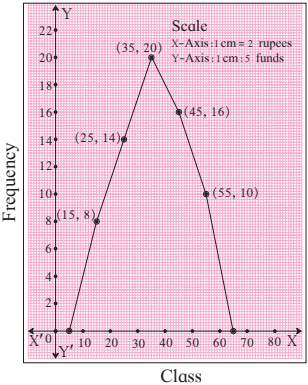
Answer the following questions based on the frequency polygon given in the adjacent figure.
(1) Write frequency of the class 50-60.
(2) State the class whose frequency is 14.
(3) State the class whose class mark is 55.
(4) Write the class in which the frequency is maximum.
(5) Write the classes whose frequencies are zero.

Image

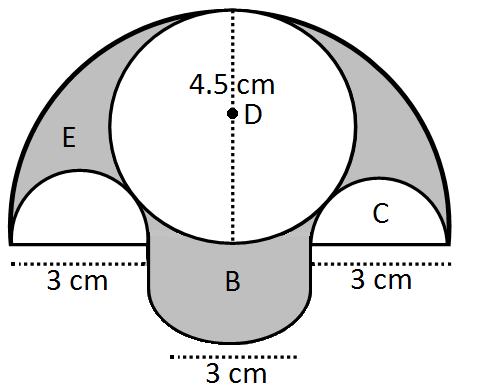
In the following figure, there are three semicircles, A, B and C having diameter $3\ cm$ each, and another semicircle E having a circle D with diameter $4.5\ cm$ are shown. Calculate:
The area of the shaded region.
The cost of painting the shaded region at the rate of $25$ paise per cm$^2$ , to the nearest rupee.
Find the roots of the following equations, if they exist, by applying the quadratic formula:$\sqrt2\text{x}^2+7\text{x}+5\sqrt2=0$
What is the probability than an ordinary year has 53 Sundays?
Solve the following quadratic equations by factorization:
$\frac{4}{\text{x}}-3=\frac{5}{2\text{x}+3},$ $\text{x}\neq-0,-\frac{3}{2}$
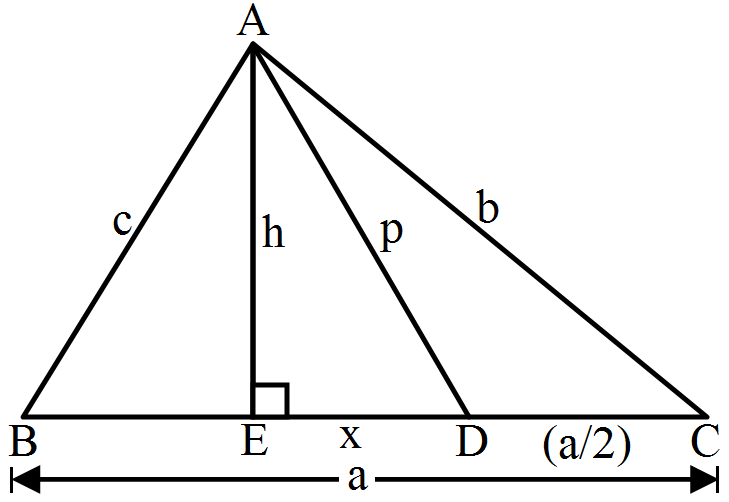
In the given figure, D is the midpoint of side BC and $\text{AE}\perp\text{BC}.$ If BC = a, AC = b, AB = c, ED = x, AD = p and AE = h, prove that.
$(\text{b}^2+\text{c}^2)=2\text{p}^2+\frac{1}{2}\text{a}^2$
$AD$ is an altitude of an equilateral triangle $ABC.$ On $AD$ as base, another equilateral triangle $ADE$ is constructed.
Prove that Area $(\triangle\text{ADE)}$ : Area $(\triangle\text{ABC)} = 3 : 4.$
Roohi travels 300km to her home partly by train and partly by bus. She takes 4 hours if she travels 60km by train and the remaining by bus. If she travels 100km by train and the remaining by bus, she takes 10 minutes longer. Find the speed of the train and the bus separately.
A rectangular plot measures $125\ m$ by $78\ m$. It has gravel path 3m wide all around on the outside. Find the area of the path and the cost of gravelling it at $₹\ 75\ per\ m^2.$