Question
Prove using vector: the quadrilateral obtained by joining mid-points of adjacent sides of a rectangle is a rhombus.
Answer


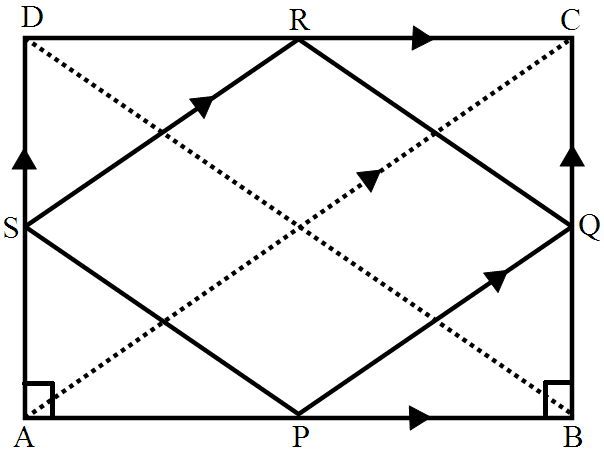
ABCD is a rectangle. Let P, Q, R and S be the mid-points of the sides AB, BC, CD and DA, respectively.Now,
$\vec{\text{PQ}} = \vec{\text{PB}} + \vec{\text{BQ}} = \frac{1}{2}\vec{\text{AB}} + \frac{1}{2}\vec{\text{BC}}$
$=\frac{1}{2}\big(\vec{\text{AB}}+\vec{\text{BC}}\big)=\frac{1}{2}\vec{\text{AC}}\dots(1)$
$\vec{\text{SR}} = \vec{\text{SD}} + \vec{\text{DR}} = \frac{1}{2}\vec{\text{AD}} + \frac{1}{2}\vec{\text{DC}}$
$=\frac{1}{2}\big(\vec{\text{AD}}+\vec{\text{DC}}\big)=\frac{1}{2}\vec{\text{AC}}\dots(2)$
From (1) and (2), we have
$\vec{\text{PQ}} = \vec{\text{SR}}$
So, the sides PQ and SR are equal and parallel. Thus, PQRS is a parallelogram.
Now,
$\big|\vec{\text{PQ}}\big|^{2}=\vec{\text{PQ}}.\vec{\text{PQ}}$
$\Rightarrow \big|\text{PQ}\big|^{2}=\big(\vec{\text{PB}} + \vec{\text{BQ}}\big).\big(\vec{\text{PB}} + \vec{\text{BQ}}\big)$
$\Rightarrow \big|\vec{\text{PQ}}\big|^2= \big|\vec{\text{PB}}\big|^{2} + 2\vec{\text{PB}}.\vec{\text{BQ}} + \big|\vec{\text{BQ}}\big|^{2}$
$\Rightarrow \big|\vec{\text{PQ}}\big|^2 = \big|\vec{\text{PB}}\big|^{2} + 0 + \big|\vec{\text{BQ}}\big|^2 $ $\big(\vec{\text{PB}} \perp \vec{\text{BQ}}\big)$
$\Rightarrow \big|\vec{\text{PQ}}\big|^{2} = \big|\vec{\text{PB}}\big|^{2} + \big|\vec{\text{BQ}}\big|^{2}\dots(3)$
Also,
$\big|\vec{\text{PS}}\big|^{2} = \vec{\text{PS}}.\vec{\text{PS}}$
$\Rightarrow\big|\vec{\text{PS}}\big|^{2} = \big(\vec{\text{PA}} + \vec{\text{AS}}\big).\big(\vec{\text{PA}} + \vec{\text{AS}}\big)$
$\Rightarrow \big|\vec{\text{PS}}\big|^{2} = \big|\vec{\text{PA}}\big|^{2}+ 2\vec{\text{PA}}.\vec{\text{AS}} + \big|\vec{\text{AS}}\big|^{2}$
$\Rightarrow \big|\vec{\text{PS}}\big|^{2} = \big|\vec{\text{PB}}\big|^{2} + 0 + \big|\vec{\text{BQ}}\big|^{2}$ $\big(\vec{\text{PA}} \perp \vec{\text{AS}}\big)$
$\Rightarrow \big|\vec{\text{PS}}\big|^{2} = \big|\vec{\text{PB}}\big|^{2} + \big|\vec{\text{BQ}}\big|^{2}\dots(4)$
From (3) and (4), we have
$\big|\vec{\text{PQ}}\big|^{2} = \big|\vec{\text{PS}}\big|^{2}$
$\Rightarrow \big|\vec{\text{PQ}}\big| = \big|\vec{\text{PS}}\big|$
So, the adjacent sides of the parallelogram are equal. Hence, PQRS is a rhombus.

Need a full question paper?

Generate a complete, print-ready paper with questions like this in minutes — across 16+ boards, with answer keys.

Start Generating Free

Similar questions

Find the maximum and minimum of the following functions:

$y=5 x^3+2 x^2-3 x$

Prove that:
$\begin{vmatrix}\text{a}&\text{a}+\text{b}&\text{a}+2\text{b} \\\text{a}+2\text{b}&\text{a}&\text{a}+\text{b}\\\text{a}+\text{b}&\text{a}+2\text{b}&\text{a} \end{vmatrix}=9(\text{a}+\text{b})\text{b}^2$
A small firm manufactures necklaces and bracelets. The total number of necklaces and bracelets that it can handle per day is at most 24. It takes one hour to make a bracelet and half an hour to make a necklace. The maximum number of hours available per day is 16. If the profit on a necklace is Rs. 100 and that on a bracelet is Rs. 300. Formulate on L.P.P. for finding how many of each should be produced daily to maximize the profit?
It is being given that at least one of each must be produced.
How should we choose two numbers, each greater than or equal to −2, whose sum so that the sum of the first and the cube of the second is minimum?
Find the equation of the line passing through the points $\hat{\text{i}}+\hat{\text{j}}-3\hat{\text{k}}$ and perpendicular to the lines $\vec{\text{r}}=\hat{\text{i}}+\lambda\big(2\hat{\text{i}}+\hat{\text{j}}-3\hat{\text{k}}\big)$ and $\vec{\text{r}}=\big(2\hat{\text{i}}+\hat{\text{j}}-\hat{\text{k}}\big)+\mu\big(\hat{\text{i}}+\hat{\text{j}}+\hat{\text{k}}\big).$
Find $\frac{\text{dy}}{\text{dx}}$ in the following cases:
$y^3 - 3xy^2 = x^3 + 3x^2y$
Examine the continuity of the function
$\text{f}\text{(x)}=\begin{cases}3\text{x}-2 &, \text{ if x} \leq 0\\\text{x}+1 &, \text{ if x} > 0\end{cases}\text{at x}=0$
Also sketch the graph of this function.
Let C be a curve defined parametrically as $\text{x}=\text{a}\cos^3\theta,\text{y}=\text{a}\sin^3\theta,0\leq\theta\leq\frac{\pi}{2}.$ Determine a point P on C, where the tangent to C is parallel to the chord joining the points (a, 0) and (0, a).
Write the following in the simplest form:
$\tan^{-1}\sqrt{\frac{\text{x}}{\text{a}+\sqrt{\text{a}^2-\text{x}^2}}},-\text{a}<\text{x}<\text{a}$
Using differentials, find the approximate values of the following:
$\log_\text{e}10.01$ it being given that $\log_{10}=0.4343$