Question
Putting $x=4$ in the expansion of $(2+\sqrt{x})^{5}$ verify both side.

Answer

$\text{LHS = RHS}$

Need a full question paper?

Generate a complete, print-ready paper with questions like this in minutes — across 16+ boards, with answer keys.
Start Generating Free

Similar questions

Represent the following data in an appropriate table. $800$ candidates appeared for a public examination. Of these candidates, the number of boys exceeded number of girls by $20 \%$ of the total candidates. The number of candidates passed exceeded the number of candidates failed by $420$ . The number of boys failed were $130$ .
Expand: $\left(\frac{\sqrt{x}}{3}+\frac{3}{\sqrt{x}}\right)^6$
The data on quantity of wheat sold (in $\ kg$ ) in a grocery shop during $30$ days are as follows.Prepare a frequency distribution such that class length is $50$ and one of the classes is $250-299$.
$150,290,245,260,100,180,275,390,320,75,140$, $249,195,255,340,190,300,90,295,230,135,250$,$375,165,280,130,330,270,200,240 .$
Answer the following questions on the basis of frequency distribution:
$(1)$ Find the least possible sale of wheat of $20 \%$ days with more sale.
$(2)$ What is the expected sale of $5$ days in the fourth class?
$(3)$ Obtain the boundary points of fifth class.
$(4)$ Find the most possible sale of wheat of $20 \%$ days with less sale.
$(5)$ State the lower limit and upper limit of third class.
Find the values of the following using binomial expansion: $(\sqrt{2}-3)^{5}-(\sqrt{2}+3)^{5}$
The mean and $S.d$. of $9$ observations are respectively $0$ and $2$. In the calculation, if two observations were taken $- 2$ and $3$, instead of $- 5$ and $4$, then find the true values of mean and $S.d.$
Discuss the method of collecting primary data by direct inquiry.

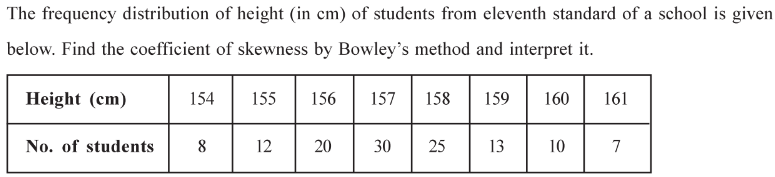
Image

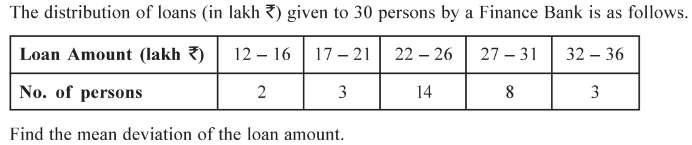
Image
Expand the following: $\left(\sqrt{x}+\frac{1}{\sqrt{x}}\right)^{4}$
The information of number of accidents in $10$ days on a particular road is given below. Find the mean and standard deviation of number of accidents per day. Find the percentage of days having the number of accidents lying between the limits $\bar{x} \perp s$.
