MCQ
${p_x}$ orbital can accommodate
  • A
    $4$  electrons
  • B
    $6 $ electrons
  • C
    $2$  electrons with parallel spins
  • $2 $ electrons with opposite spins

Answer

Correct option: D.
$2 $ electrons with opposite spins
d
(d) Each orbital may have two electrons with opposite spin.

Need a full question paper?

Generate a complete, print-ready paper with questions like this in minutes — across 16+ boards, with answer keys.

Start Generating Free

Similar questions

What is the molar solubility of $Mn(OH)_2$ $(K_{sp} = 4.5\times10^{-14})$ in a buffer solution contain equal moles of $NH_4^+$ and $NH_3$ $(K_b = 1.8\times10^{-5})$ ?
For the reaction:

$I ^{-}+ ClO _3^{-}+ H _2 SO _4 \longrightarrow Cl ^{-}+ HSO _4^{-}+ I _2$

The correct statement(s) in the balanced equation is/are:

$(A)$ Stoichiometric coefficient of $HSO _4^{-}$is 6 .

$(B)$ lodide is oxidized.

$(C)$ Sulphur is reduced.

$(D)$ $H _2 O$ is one of the products.
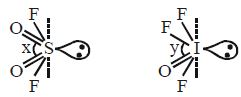
A nanopeptide contains …….. peptide linkages
Compare $x$ and $y$ bond angles for the above given molecules
Gasoline is a mixture of alkanes with the number of carbon atoms
A solution of $( -)-1 -$ chloro ${-1}-$ phenylethane in toluene racemises slowly in the presence of a small amount of $SbCl_5,$ due to the formation of :
The treatment of $CH_3MgX$ with $CH_3C \equiv C-H$ produces
Match each coordination compound in List $-I$ with an appropriate pair of characteristics from List $-II$ and select the correct answer using the code given below the lists. $\{en$ $= H_2NCH_2CH_2NH_2$, atomic numbers : $Ti = 22; Cr = 24; Co = 27; Pt = 78$ $ \}$
  List$-I$   List$-II$
$(P)$ $[Cr(NH_3)_4Cl_2]Cl$ $(1)$ Paramagnetic and exhibits ionisation isomerism
$(Q)$ $[Ti(H_2O)_5Cl](NO_3)_2$ $(2)$ Diamagnetic and exhibits cis-trans isomerism
$(R)$ $[Pt(en)(NH_3)Cl]NO_3$ $(3)$ Paramagnetic and exhibits cis-trans isomerism
$(S)$ $[Co(NH_3)_4(NO_3)_2]NO_3$ $(4)$ Diamagnetic and exhibits ionisation isomerism
The wavelength of the electron emitted by a metal sheet of work function $4\,eV$ when photons from $EMR$ of wavelength $124\,nm$ strike the metal plate ........... $\mathrm{nm}$
Which of the following element does not belong to the family of elements indicated