MCQ
$Q ^{+}$is the set of all positive rational numbers with the binary operation * defined by $a^ * b=\frac{ ab }{2} \forall a , b \in Q ^{+}$. The inverse of an element $a \in Q ^{+}$ is:
  • A
    $\text{a}$
  • B
    $\frac{1}{\text{a}}$
  • C
    $\frac{2}{\text{a}}$
  • $\frac{4}{\text{a}}$

Answer

Correct option: D.
$\frac{4}{\text{a}}$
Let e be the identity element in $Q^+$ with respect to $*$ such that
$a^ * e = a = e^ * a, \forall\text{ a}\in\text{Q}^+$
$a^ * e = a$ and $e^ * a = a, \forall\text{ a}\in\text{Q}^+$
$\frac{\text{ae}}2=\text{a}$ and $\frac{\text{ea}}2=\text{a}$, $\forall\text{ a}\in\text{Q}^+$
$\text{e}=2\in\text{Q}^+, \forall\text{ a}\in\text{Q}^+$
Thus$, 2$ is the identity element in $Q^+$ with respect to $*.$
Let $\text{ a}\in\text{Q}^+$ and $\text{ b}\in\text{Q}^+$ be the inverse of $a.$
Then,
$a^ * e = a = e^ * a$
$a^ * b = e$ and $b^ * a = e$
$\frac{\text{ab}}2=2$ and $\frac{\text{ba}}2=2$
$\text{b}=\frac{4}{\text{a}}\in\text{Q}^+$
Thus, $\frac{4}{\text{a}}$ is the inverse of $\text{ a}\in\text{Q}^+$.

Need a full question paper?

Generate a complete, print-ready paper with questions like this in minutes — across 16+ boards, with answer keys.

Start Generating Free

Similar questions

The length and foot of the perpendicular from the point $(2, -1, 5)$ to the line $\frac{{x - 11}}{{10}} = \frac{{y + 2}}{{ - 4}} = \frac{{z + 8}}{{ - 11}}$ are
If the binary operation $\times$ is defind on the set $Q +$ of all positive rational numbers by $\text{a}\times\text{b}=\frac{\text{ab}}{4}.$ Then, $3\times\Big(\frac{1}{5}\times\frac{1}{2}\Big)$ is equal to:
If points $\text{A}(60\hat{\text{i}}+3\hat{\text{j}}),\ \text{B}(40\hat{\text{i}}-8\hat{\text{j}})$ and $\text{C}(\text{a}\hat{\text{i}}+52\hat{\text{j}})$ are collinear, then a is equal to,
If the order of matrices $A$ and $B$ are $3 \times 2$ and $2 \times 1$ respectively, then find the order of matrix $($if possible$)\ AB :$
The direction cosines of the straight linegiven by the planes $x = 0$ and $z = 0$ are:
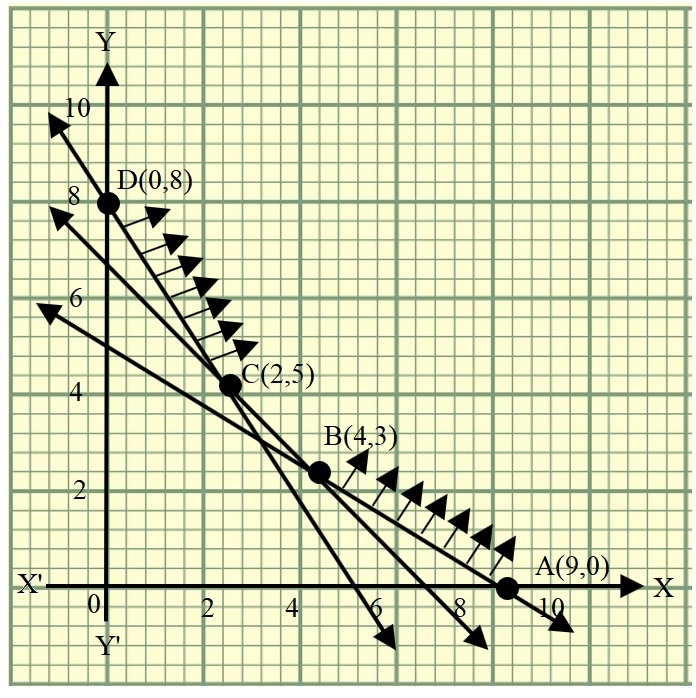
Feasible region (shaded) for a LPP is shown in the given figure. Minimum of z = 4x + 3y occurs at the point.
Let $\psi_1:[0, \infty) \rightarrow R , \psi_2:[0, \infty) \rightarrow R , f:[0, \infty) \rightarrow R$ and $g :[0, \infty) \rightarrow R$ be functions such that

$f(0)=g(0)=0$

$\Psi_1( x )= e ^{- x }+ x , \quad x \geq 0$

$\Psi_2( x )= x ^2-2 x -2 e ^{- x }+2, x \geq 0$

$f( x )=\int_{- x }^{ x }\left(| t |- t ^2\right) e ^{- t ^2} dt , x >0$

and

$g(x)=\int_0^{x^2} \sqrt{t} e^{-t} d t, x>0$

($1$) Which of the following statements is $TRUE$ ?

$(A)$ $f(\sqrt{\ln 3})+ g (\sqrt{\ln 3})=\frac{1}{3}$

$(B)$ For every $x>1$, there exists an $\alpha \in(1, x)$ such that $\psi_1(x)=1+\alpha x$

$(C)$ For every $x>0$, there exists a $\beta \in(0, x)$ such that $\psi_2(x)=2 x\left(\psi_1(\beta)-1\right)$

$(D)$ $f$ is an increasing function on the interval $\left[0, \frac{3}{2}\right]$

($2$) Which of the following statements is $TRUE$ ?

$(A)$ $\psi_1$ (x) $\leq 1$, for all $x>0$

$(B)$ $\psi_2(x) \leq 0$, for all $x>0$

$(C)$ $f( x ) \geq 1- e ^{- x ^2}-\frac{2}{3} x ^3+\frac{2}{5} x ^5$, for all $x \in\left(0, \frac{1}{2}\right)$

$(D)$ $g(x) \leq \frac{2}{3} x^3-\frac{2}{5} x^5+\frac{1}{7} x^7$, for all $x \in\left(0, \frac{1}{2}\right)$
Evaluate$:\ \int(2\tan\text{x}-3\cot\text{x})^2\text{dx}.$
If f : $R$ $\rightarrow$  $R$ such that $f(x)$ = $5x - 3cosx - 4sinx$,then function $f(x)$ is
Let $\omega$ be a complex cube root of unity with $\omega \neq 1$ and $P=\left[p_j\right]$ be a $n \times n$ matrix with $p_{i j}=\omega^{i+j}$. Then $P ^2 \neq 0$, when $n =$

$(A)$ $57$ $(B)$ $55$ $(C)$ $58$ $(D)$ $56$