MCQ
Quality of a musical note depends on
  • Harmonics present
  • B
    Amplitude of the wave
  • C
    Fundamental frequency
  • D
    Velocity of sound in the medium

Answer

Correct option: A.
Harmonics present
a
(a)The quality of sound depends upon the number of harmonics present. Due to different number of harmonics present in two sounds, the shape of the resultant wave is also different.

Need a full question paper?

Generate a complete, print-ready paper with questions like this in minutes — across 16+ boards, with answer keys.
Start Generating Free

Similar questions

For a periodic motion represented by the equation $Y=\sin \omega t+\cos \omega t$ The amplitude of the motion is 
Which of the following sources gives best monochromatic light?
  1. A candle.
  2. A bulb.
  3. A mercury tube.
  4. A laser.
A cannon ball is fired with a velocity $200\, m/sec$ at an angle of $60^o$ with the horizontal. At the highest point of its flight it explodes into $3$ equal fragments, one going vertically upwards with a velocity $100\, m/sec$, the second one falling vertically downwards with a velocity $100\, m/sec$. The third fragment will be moving with a velocity
A $1\, kg$ stone at the end of $1\, m$ long string is whirled in a vertical circle at constant speed of $4\, m/s$. The tension in the string is $6\, N$ when the stone is at $(g = 10\, m/s^2)$
Two trains along the same straight rails moving with constant speed $60\, km/hr$ and $30\, km/hr$ respectively towards each other. If at time $t = 0$, the distance between them is $90\, km$, the time when they collide is ......... $hr$
A system is given $300$ calories of heat and it does $600$ joules of work. How much does the internal energy of the system change in this process? $( J =4.18$ $Joules / cal )$ (in joule)
When light propagates in vacuum there is an electric field and a magnetic field. These fields:
  1. Are constant in time.
  2. Have zero average value.
  3. Are perpendicular to the direction of propagation of light.
  4. Are mutually perpendicular.
The driver of a car travelling at velocity $v$ suddenly see a broad wall in front of him at a distance $d$. He should
The velocities of $A$ and $B$ are $\vec{v}_A=2 \hat{i}+4 \hat{j}$ and $\vec{v}_B=3 \hat{i}-7 \hat{j}$ Velocity of $B$ as observed by $A$ is ..........
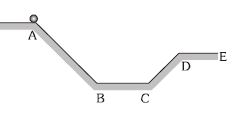
In the picture shown, a ball standing from rest rolls down a ramp $AB$, goes along at the horizontal bottom $BC$, and then backs up a smaller ramp $CD$, thereafter rolls on horizontal plane $DE$. Ignore friction and air resistance.Which of the following figure shows variation in speed with time ?