MCQ
Quantisation of charge implies:
- ACharge cannot be destroyed.
- BCharge exists on particles.
- CThere is a minimum permissible charge on a particle.
- DCharge, which is a fraction of a coulomb is not possible.
Generate a complete, print-ready paper with questions like this in minutes — across 16+ boards, with answer keys.
An electromagnetic wave, going through vacuum is described by . Which of the following is independent of wavelength
| (a) k | (b) w | (c) k/w | (d) kw |
The wavelength of  X-rays produced by an X-ray tube is 0.76 Å. The atomic number of the anode material of the tube is
| (a) 20 | (b) 60 | (c) 40 | (d) 80 |
A non-planar loop of conducting wire carrying a current I is placed as shown in the figure. Each of the straight sections of the loop is of length 2a. The magnetic field due to this loop at the point P (a,0,a) points in the direction
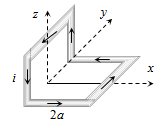
|
(a) |
(b) |
(c) |
(d) |
A 60 watt bulb is hung over the center of a table 4 m × 4 m at a height of 3 m. The ratio of the intensities of illumination at a point on the centre of the edge and on the corner of the table is
|
(a) |
(b) 2 / 1 |
(c) 17 / 13 |
(d) 5 / 4 |
In the above question, the power lost in the cable during transmission is
|
(a) 12.5 kW |
(b) 6.25 kW |
(c) 25 kW |
(d) 3.15 kW |


