Question
Quantisation of charge was experimentally demonstrated by:

Answer

  1. Millikan’s oil drop experiment.

Need a full question paper?

Generate a complete, print-ready paper with questions like this in minutes — across 16+ boards, with answer keys.
Start Generating Free

Similar questions

In hard X-rays :
A piece of fuse wire melts when a current of 15 ampere flows through it. With this current, if it dissipates 22.5 W, the resistance of fuse wire will be(a) Zero(b) 10 Ω(c) 1 Ω(d) 0.10 Ω
       
A charge moves in a circle perpendicular to a magnetic field. The time period of revolution is independent of(a) Magnetic field(b) Charge(c) Mass of the particle(d) Velocity of the particle
   
   
Two capacitors of $3\ pF$ and $6\ pF$ are connected in series and a potential difference of $5000 V$ is applied across the combination. They are then disconnected and reconnected in parallel. The potential between the plates is
When a wire loop is rotated in a magnetic field, the direction of induced $\text{e.m.f.}$ changes once in each
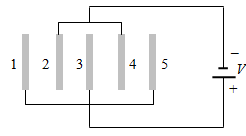
Five identical plates each of area $A$ are joined as shown in the figure. The distance between the plates is $d$. The plates are connected to a potential difference of $V$ volts. The charge on plates $1$ and $4$ will be
Energy required to remove an electron from aluminium surface is $4.2\ eV.$ If light of wavelength $2000 \mathring A $ falls on the surface, the velocity of the fastest electron ejected from the surface will be
Refer to the arrangement of charges in Fig. and a Gaussian surface of radius R with Q at the centre. Then:
In a transformer, number of turns in the primary are 140 and that in the secondary are 280. If current in primary is 4A then that in the secondary is
A lamp whose resistance is $280 \Omega$ is joined with an ac source of 200 V . The peak value of current flowing in the lamp is :