MCQ
Quantity that is not affected by magnetic field is:
  • A
    Moving charge
  • B
    Change in magnetic flux
  • C
    Current flowing in conductor
  • Stationary charge

Answer

Correct option: D.
Stationary charge

Magnetic field is the magnetic effect of electric currents andmagnetic materials.
The magnetic field at any given point is specified by both a direction and a magnitude $($or strength$)$; as such it is represented by a vector field.
As magnetic field has both magnitude as well as direction so it is a vector quantity.When charges are stationary, their electric fields do not affect magnets.
But, when charges move, they produce magnetic fields that exert forces on other magnets.
When there is relative motion, a connection between electric and magnetic fields emerges$-$each affects the other.
Quantity that is not affected by magnetic field is Stationary charge.

Need a full question paper?

Generate a complete, print-ready paper with questions like this in minutes — across 16+ boards, with answer keys.
Start Generating Free

Similar questions

Assertion : A transistor is a voltage-operating device.
Reason : Base current is greater than the collector current.
Two parallel wires are carrying electric currents of equal magnitude and in the same direction. They exert
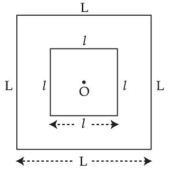
A small square loop of wire of side $l$ is placed inside a large square loop of wire $L(L \gg l)$. Both loops are coplanar and their centres coincide at point $O$ as shown in figure. The mutual inductance of the system is.
Two point sources $P$ and $Q$ are $24\,cm $ apart. Where should a convex lens of focal length $9\, cm$ be placed in between them so that the images of both sources are formed at the same place?
Match the List $I$ with the List $II$ from the combinations shown
$(I)$ Presbiopia $(A)$ Sphero-cylindrical lens
$(II)$ Hypermetropia $(B)$ Convex lens of proper power may be used close to the eye
$(III)$ Astigmatism $(C)$ Concave lens of suitable focal length
$(IV)$ Myopia $(D)$ Bifocal lens of suitable focal length
$.......$ And $.......$ led to understanding of atomic structures:
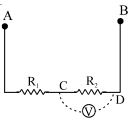
Resistances $R_1$ and $R_2$ each $60\,\Omega$ are connected in series as shown in figure. The Potential difference between $A$ and $B$ is kept $120$ volt. Then what ............. $V$ will be the reading of voltmeter connected between the point $C$ and $D$ if resistance of voltmeter is $120\,\Omega .$
The horizontal component of the earth's magnetic field is 0.22 Gauss and total magnetic field is 0.4 Gauss. The angle of dip. is
The hysteresis cycle for the material of permanent magnet is:
Two lenses have focal lengths $f_1$ and $f_2$ and their dispersive powers are $\omega_1$ and $\omega_2$ respectively. They will together form an achromatic combination if