Question
Quantity that remains unchanged in a transformer is
|
(a) Voltage |
(b) Current |
(c) Frequency |
(d) None of the above |
Quantity that remains unchanged in a transformer is
|
(a) Voltage |
(b) Current |
(c) Frequency |
(d) None of the above |
(c) Frequency
Generate a complete, print-ready paper with questions like this in minutes — across 16+ boards, with answer keys.
An elastic circular wire of length l carries a current I. It is placed in a uniform magnetic field  (Out of paper) such that its plane is perpendicular to the direction of . The wire will experience
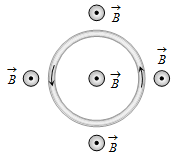
|
(a) No force |
(b) A stretching force |
|
(c) A compressive force |
(d) A torque |
In a transistor circuit shown here the base current is 35 mA. The value of the resistor Rb is

| (a) 123.5 kW | (b) 257 kW | (c) 380.05 kW | (d) None of these |
Three observers A, B and C measure the speed of light coming from a source to be  and
and  . The observer A moves towards the source, the observer C moves away from the source with the same speed. The observer B stays stationary. the surrounding space is vacuum every where. Then
(a) 
|
(b) 
|
(c) 
|
(d) 
|
There are two equipotential surface as shown in figure. The distance between them is r. The charge of –q coulomb is taken from the surface A to B, the resultant work done will be

|
(a) |
(b) |
(c) |
(d) |
Consider the following two statements A and B and identify the correct choice given in the answers
(A) Duddells thermo-galvanometer is suitable to measure direct current only
(B) Thermopile can measure temperature differences of the order of 
|
(a) Both A and B are true |
(b) Both A and B are false |
|
(c) A is true but B is false |
(d) A is false but B is true |
When a metal surface is illuminated by light of wavelengths 400 nm and 250 nm, the maximum velocities of the photoelectrons ejected are v and 2v respectively. The work function of the metal is (h = Planck’s constant, c = velocity of light in air)
|
(a) 2hc |
(b) |
(c) |
(d) 0.5 |


