Question
Radioactive isotopes are produced in a nuclear physics experiment at a constant rate $\frac{\text{dN}}{\text{dt}}=\text{R}.$ An inductor of inductance 100mH, a resistor of resistance $100\Omega$ and a battery are connected to form a series circuit. The circuit is switched on at the instant the production of radioactive isotope starts. It is found that $\frac{\text{i}}{\text{N}}$ remains constant in time where i is the current in the circuit at time t and N is the number of active nuclei at time t. Find the half-life of the isotope.
Answer

$\text{R}=100\Omega;\text{ L}=100\text{mH}$
After time t, $\text{i = i}_0\Big(1-\text{e}^{\frac{-\text{t}}{\text{Lr}}}\Big)\text{ N = N}_0\big(\text{e}^{-\lambda\text{t}}\big)$
$\frac{\text{i}}{\text{N}}=\frac{\text{i}_0\big(1-\text{e}^{-\frac{\text{tR}}{\text{L}}}\big)}{\text{N}_0\text{e}^{-\lambda\text{t}}}\frac{\text{i}}{\text{N}}$ is constant i.e. independent of time.
Coefficients of t are equal $-\frac{\text{R}}{\text{L}}=-\lambda\Rightarrow\frac{\text{R}}{\text{L}}=\frac{0.693}{\text{t}_{\frac{1}{2}}}$
$=\text{t}_{\frac{1}{2}}=0.693\times10^{-3}=6.93\times10^{-4}\text{sec}.$

Need a full question paper?

Generate a complete, print-ready paper with questions like this in minutes — across 16+ boards, with answer keys.

Start Generating Free

Similar questions

Do all the thermocouples have a neutral temperature?
The following data was recorded for values of object distance and the corresponding values of image distance in the experiment on study of real image formation by a convex lens of power +5D. One of these observations is incorrect. Identify this observation and give reason for your choice:
S .No
Object distance (cm)
Image distance (cm)
1
25
97
2
30
61
3
35
37
4
45
35
5
50
32
6
55
30
Draw the graph of binding energy per nucleon against atomic mass number and draw conclusion of the graph.
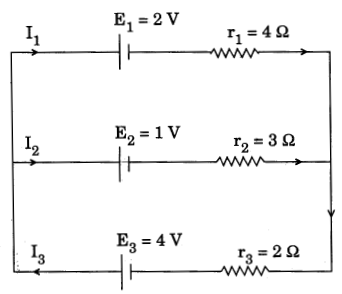
State Kirchhoff’s rules. Use these rules to write the expressions for the currents $I_1, I_2$ and $I_3$ in the circuit diagram shown.
Write relation between $B , H , I , \chi$ and $\mu$.
The ends of a metre stick a.re maintained at $100^\circ C$ and $0^\circ C.$ One end of a rod is maintained at $25^\circ C.$ Where should its other end be touched on the metre stick so that there is no heat current in the rod in steady state?
When a photon is emitted by a hydrogen atom, the photon carries a momentum with it.
$(a)$ Calculate the momentum carries by the photon when a hydrogen atom emits light of wavelength $656.3\ nm.$
$(b)$ With what speed does the atom recoil during this transition? Take the mass of the hydrogen atom $= 1.67 \times 10^{-27}kg.$
$(c)$ Find the kinetic energy of recoil of the atom.
Find the binding energy per nucleon of $\text{ }^{197}_{79}\text{Au}$ if its atomic mass is $196.96u.$
Obtain the answers $(a)$ to $(b)$ in Exercise $7.13$ if the circuit is connected to a high frequency supply $(240V, 10kHz).$ Hence, explain the statement that at very high frequency, an inductor in a circuit nearly amounts to an open circuit. How does an inductor behave in a dc circuit after the steady state?
Three equal charges, $2.0 \times 10^{-6}C$ each, are held fixed at the three corners of an equilateral triangle of side $5\ cm.$ Find the Coulomb force experienced by one of the charges due to the rest two.