Question
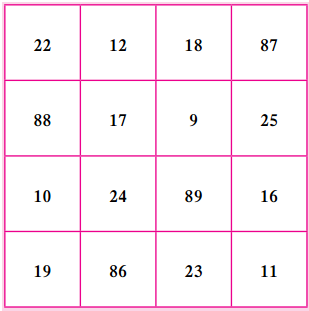
Ramanujan’s Magic square.
Image

  • Add the four numbers in the rows, the columns and along the diagonals of this square.
  • What is the sum?
  • Is it the same every time?
  • What is the peculiarity?
  • Look at the numbers in the first row, 22 – 12 – 1887. Find out why this date is special.

Obtain and read a biography of the great Indian mathematician Srinivasa Ramanujan.
Answer

Sum of the numbers in each row:
i. 22 + 12 + 18 + 87 = 139
ii. 88 + 17 + 9 + 25 = 139
iii. 10 + 24 + 89 + 16 = 139
iv. 19 + 86 + 23 + 11 = 139

Sum of the numbers along the diagonals:
i. 22 + 17 + 89 + 11 = 139
ii. 87 + 9 + 24 + 19 = 139

Sum of the numbers in each column:
i. 22 + 88 + 10 + 19 = 139
ii. 12 + 17 + 24 + 86 = 139
iii. 18 + 9 + 89 + 23 = 139
iv. 87 + 25 + 16 + 11 = 139

∴ We observe that the sum of the numbers in each of the rows, the columns and along each diagonal remains the same every time. The numbers in the first row 22 – 12 – 1887 is the birth date of Srinivasa Ramanujan.

Need a full question paper?

Generate a complete, print-ready paper with questions like this in minutes — across 16+ boards, with answer keys.

Start Generating Free

Similar questions

(1) $6 \frac{1}{3}+2 \frac{1}{3}$
(2) $1 \frac{1}{4}+3 \frac{1}{2}$
(3) $5 \frac{1}{5}+2 \frac{1}{7}$
(4) $3 \frac{1}{5}+2 \frac{1}{3}$
Draw a line segment AB of length 8cm. At each end of this line segment, draw a line perpendicular to AB. Are these two lines parallel?
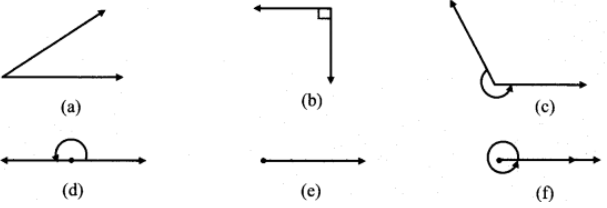
Look at the figures below and write the type of each of the angles:

Image

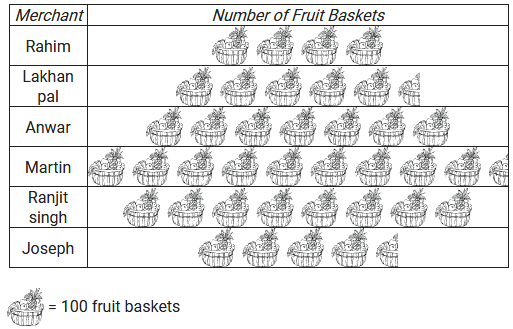
In a village six fruit merchants sold the following number of fruit baskets in particular season:

Observe the above pictograph and answer the following questions.
  1. Which merchant sold the maximum number of baskets?
  2. How many fruit baskets ware sold by answer?
  3. The merchants who have sold 600 or more number of baskets are planning to buy a godown for the next season. Can you name them?
i. $3 \frac{1}{3}-1 \frac{1}{4}$
ii. $5 \frac{1}{2}-3 \frac{1}{3}$
iii. $7 \frac{1}{8}-6 \frac{1}{10}$
iv. $7 \frac{1}{2}-3 \frac{1}{5}$
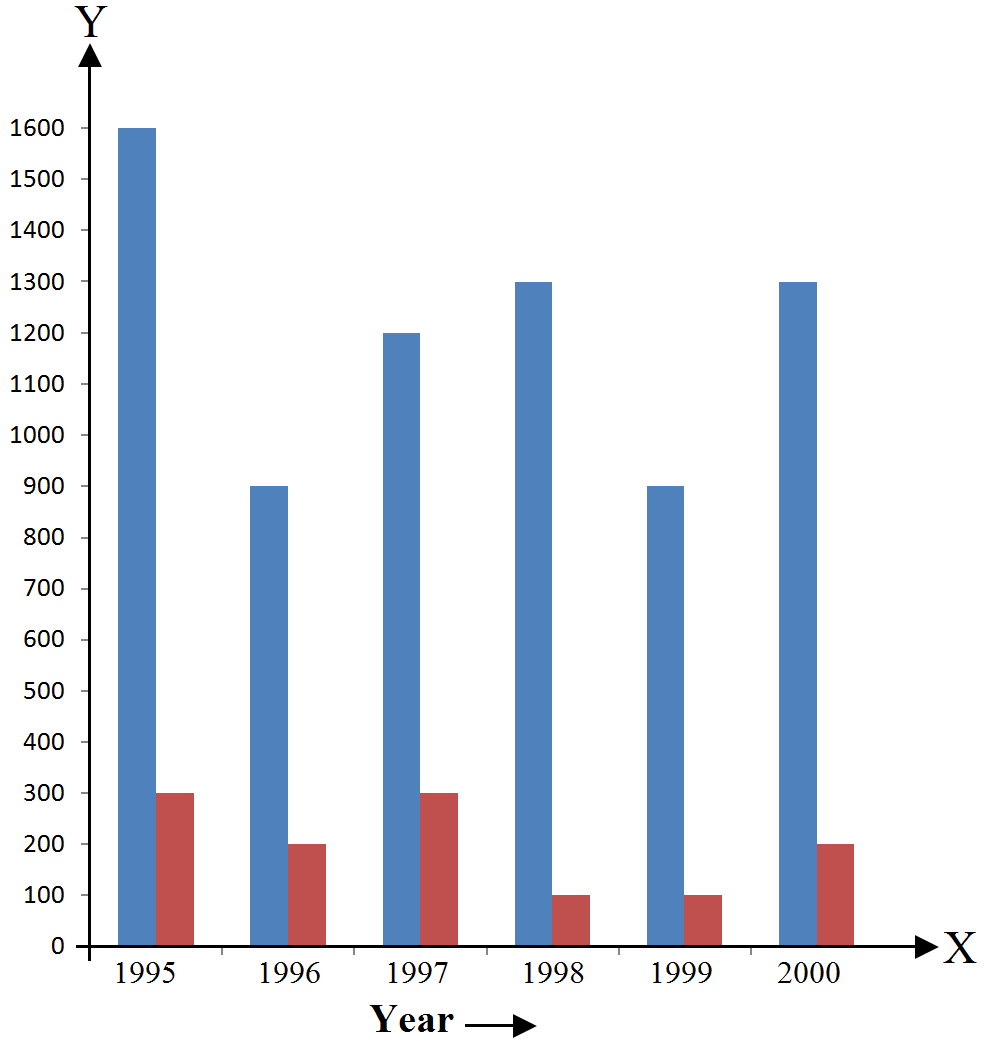
The following bar graph shows the number of persons killed in industrial accidents in a country for some years.

Read the bar graph and choose the correct alternative in each of the following:
  1. The year which shows the maximum percentage increase in the number of persons killed in coal mines over the precending year is:
  1. 1996
  2. 1997
  3. 1999
  4. 2000
  1. The year which shows the maximum decrease in the number of persons killed in industrial accidents over the precending year is:
  1. 1996
  2. 1997
  3. 1998
  4. 1999
  1. The year in which the maximum number of persons were killed in industrial accidents other than those killed in coal mines is:
  1. 1995
  2. 1997
  3. 1998
  4. 1999
Add:
  1. 8 + 6
  2. 9 + (-3)
  3. 5 + (-6)
  4. – 7 + 2
  5. – 8 + 0
  6. – 5 + (-2)
Write each of the following as a Hindu-Arabic numeral:
S.No.
Roman numeral
i
XXVII
ii
XXXIV
iii
XLV
iv
LIV
v
LXXIV
vi
XCI
vii
XCVI
viii
CXI
ix
CLIV
x
CCXXIV
xi
CCCLXV
xii
CDXIV
xiii
CDLXIV
xiv
DVI
xv
DCCLXVI
The table below gives the number of children who took part in the various items of the talent show as part of the annual school gathering. Make a bar graph to show this data.
(Scale: On Y-axis, 1 cm = 4 children)
ProgrammeTheaterDanceVocal musicInstrumental musicOne-act plays
Number of Children24401684
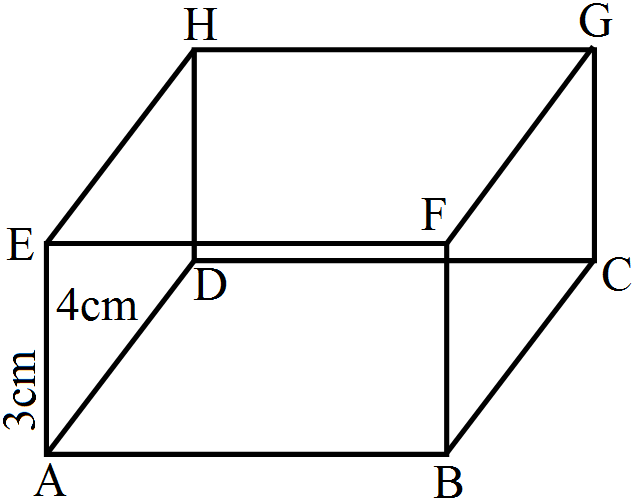
The dimensions of a cuboid with vertices A, B, C, D, E, F, G and H are as shown:


i. Which edges are of length 4 cm ? Which edges are of length 5 cm ?
ii. Which faces have area equal to $20 cm^2$ ?
iii. Which faces have the largest area? What is this largest area?
iv. Which faces have a diagonal equal to 5 cm ?
v . What is the area of the base of this cuboid?
vi. Do all the lateral faces have the same area?