MCQ
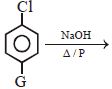
Rate of reaction is maximum if $G$ is
  • A
    $-OCH_3$
  • B
    $-CH_3$
  • $-NO_2$
  • D
    $-H$

Answer

Correct option: C.
$-NO_2$
c
The given reaction is a nucleophilic substitution reaction. This will be more favored is the electron density of the ring is reduced by some electron withdrawing group. Hence, the rate of given reaction is maximum if $G$ is $NO _2$.

Need a full question paper?

Generate a complete, print-ready paper with questions like this in minutes — across 16+ boards, with answer keys.

Start Generating Free

Similar questions

$CH \equiv CH\mathop {\xrightarrow{{Ni{{(CN)}_2}}}X}\limits_{{\text{Pressure}}} $ Here $X$ in the reaction
Which of the following is not a noble gas?
Which law states that if two elements can combine to form more than one compound, the masses of one element that combine with a fixed mass of other element, are in the ratio of small whole numbers?
Which branch of chemistry is a cost effective approach which involves reduction in material, energy consumption and waste generation?
At $1\, atm$ pressure $\Delta S = 75\, J/K \times mol$ and $\Delta H = 30\, KJ/mol$ . The temperature of reaction at equilibrium is.......$K$
Which of the following configuration follows the Hund's rule
When $ 4 \,g$  of iron is burnt to ferric oxide at constant pressure, $29.28\, kJ $ of heat is evolved. What is the enthalpy of formation of ferric oxide ......$kJ$ (At. Wt. of $Fe = 56$ )
Which will undergo reaction with ammoniacal $AgN{O_3}$
Find enthalpy of neutralisation of $NH_4OH$ and $HCN$ in aqueous solution if enthalpy of ionisa tion of $NH_4OH$ and $HCN$ are $7 \ kJ/mol$ and $8\  kJ/mol$. also enthalpy of ionisation of $H_2O$ is $57. 3\  kJ/mole$.......$ kJ/mol$
${H_2}{O_{\left( g \right)}} + {C_{\left( s \right)}} \to C{O_{\left( g \right)}} + {H_2}\left( g \right)\,;\,\Delta H = 100\,kJ$

$C{O_{\left( g \right)}} + \frac{1}{2}{O_{2\left( g \right)}} \to C{O_{2\left( g \right)}}\,;\,\Delta H =  - 300\,kJ$

${H_2}_{\left( g \right)} + \frac{1}{2}{O_2}_{\left( g \right)} \to {H_2}{O_{\left( g \right)}}\,;\,\Delta H =  - 250\,kJ$

$C_{(s)} + O_{2(g)} \to  CO_{2(g)} ; \Delta H = -x\, kJ$

The value of $x$ will be