MCQ
Ray optics is valid when characteristic dimensions are:
  • A
    Of the same order as the wavelength of light
  • B
    Much smaller than the wavelength of light
  • Much larger than the wavelength of light
  • D
    Of the order of 1mm

Answer

Correct option: C.
Much larger than the wavelength of light

Ray optics is valid when characteristics dimensions are larger than the wavelength of the light, so that rectilinear property of light can be used.

Need a full question paper?

Generate a complete, print-ready paper with questions like this in minutes — across 16+ boards, with answer keys.
Start Generating Free

Similar questions

The forbidden energy gap for germanium crystal at $0 K$ is:
A capacitor of capacity ${C_1}$ is charged upto $V$ volt and then connected to an uncharged capacitor of capacity ${C_2}$. Then final potential difference across each will be
Which one of the following statements is correct
In Balmer series of emission spectrum of hydrogen, first four lines with different wavelength $\text{H}\alpha $ $ \text{H}\beta$ $\text{H}\gamma$ and $\text{H}\delta$ are obtained. Which line has maximum frequency out of these?
A coil of self inductance 50 henry is joined to the terminals of a battery of e.m.f. 2 volts through a resistance of 10 ohm and a steady current is flowing through the circuit. If the battery is now disconnected, the time in which the current will decay to 1/e of its steady value is
If microwaves, $X$ rays, infrared, gamma rays, ultraviolet, radio waves and visible parts of the electromagnetic spectrum by are denoted $M, X, I, G, U, R$ and $V$ then which of the following is the arrangement in ascending order of wavelength ?
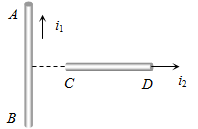
An infinitely long, straight conductor AB is fixed and a current is passed through it. Another movable straight wire CD of finite length and carrying current is held perpendicular to it and released. Neglect weight of the wire
If $q$ is the charge per unit area on the surface of a conductor, then the electric field intensity at a point on the surface is
A series $LCR$ circuit containing a resistance of $120\,\Omega $ has resonance frequency $4\times10^5\, rad\, s^{-1}$. The voltages, at resonance, across resistance and inductance are $60\,V$ and $40\,V$ respectively. The values of $L$ and $C$ respectively are
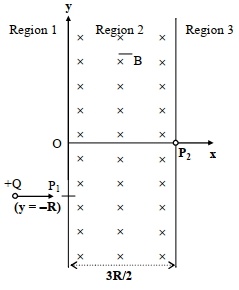
A uniform magnetic field $B$ exists in the region between $x=0$ and $x=\frac{3 R}{2}$ (region $2$ in the figure) pointing normally into the plane of the paper. A particle with charge $+Q$ and momentum $p$ directed along $x$-axis enters region $2$ from region $1$ at point $P_1(y=-R)$. Which of the following option(s) is/are correct?

$[A$ For $B>\frac{2}{3} \frac{p}{QR}$, the particle will re-enter region $1$

$[B]$ For $B=\frac{8}{13} \frac{\mathrm{p}}{QR}$, the particle will enter region $3$ through the point $P_2$ on $\mathrm{x}$-axis

$[C]$ When the particle re-enters region 1 through the longest possible path in region $2$ , the magnitude of the change in its linear momentum between point $P_1$ and the farthest point from $y$-axis is $p / \sqrt{2}$

$[D]$ For a fixed $B$, particles of same charge $Q$ and same velocity $v$, the distance between the point $P_1$ and the point of re-entry into region $1$ is inversely proportional to the mass of the particle