Question
Read the following and answer any four questions from $(i)$ to $(v)$ given below:
Embryo develops at the micropylar end of the embryo sac, where the zygote is situated. Most zygotes divided only after certain amount of endosperm is formed. The early stages of embryo development are similar in both monocotyledons and dicotyledons. The zygote gives rise to the proembryo and subsequently to the globular heart-shaped and mature embryo. A typical dicotyledonous embryo consists of an embryonal axis and two cotyledons. Embryo of monocotyledons possess only one cotyledon.
  1. True embryo develops as a result of fusion of:
  1. Two polar nuclei of embryo sac.
  2. An egg cell and a male gamete.
  3. Synergid and male gamete.
  4. A male gamete and antipodals.
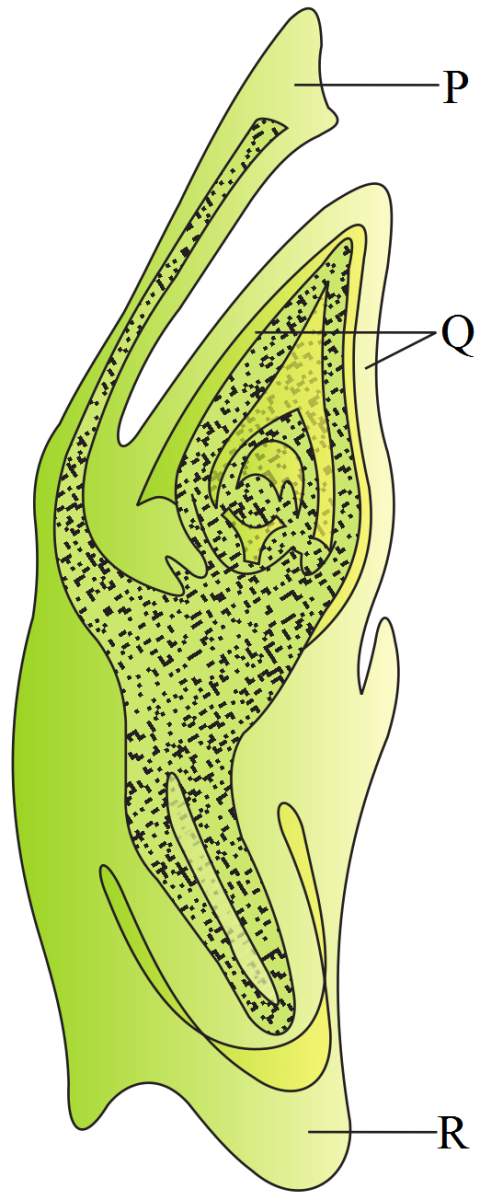
  1. Refer to the given diagram of the embryo of an angiospermous plant with parts labelled $P, Q$ and $R$. Select the correct statement$(s)$ regarding this.
  1. Part $'P\ '$ supplies nutrition to the developing embryo.
  2. Part $'Q\ '$ is the protective sheath of radicle and root cap.
  3. Part $'R\ '$ is the protective sheath of shoot apex and leaf primordia.
  4. The embryo shown in the diagram is present in members of Family Poaceae.
  1. $(IV)$ only.
  2. $(II)$ and $(III)$ only.
  3. $(I)$ and $(IV)$ only.
  4. $(I), (II), (III)$ and $(IV).$
  1. Which of the given statements are true?
  1. During the development of a dicot embryo, heart$-$shaped embryo is followed by globular embryo.
  2. The part of embryonal axis above the level of cotyledons is epicotyl, while the part below the level of cotyledons is hypocotyl.
  3. Monocot seeds possess a single cotyledon, represented by scutellum.
  1. $(I)$ and $(II).$
  2. $(II)$ and $(III).$
  3. $(I)$ and $(III).$
  4. $(I), (II)$ and $(III).$
  1. Consider the following parts of an embryonal axis of a dicot seed.
  1. Hypocotyl.
  2. Epicotyl.
  3. Radicle.
  4. Plumule.
In which of the following the above parts are correctly arranged from top to base?
  1. $(III) \rightarrow (I) \rightarrow (II) \rightarrow (IV).$
  2. $(II) \rightarrow (I) \rightarrow (III) \rightarrow (IV).$
  3. $(IV) \rightarrow (II) \rightarrow (I) \rightarrow (III).$
  4. $(III) \rightarrow (IV) \rightarrow (II) \rightarrow (I).$
  1. In grass family, the cotyledon, is called:
  1. Epiblast.
  2. Plumule.
  3. Scutellum.
  4. Perisperm.

Answer

  1. (b) An egg cell and a male gamete.
​​​​​​​​​​​​​​​​​​​​​​​​​​​​​​​​​​​​​​​​​​​​​​​​​Explanation:

In double fertilisation, out of the two male gametes, one fuses with egg or oosphere to perform generative fertilisation. Generative fertilisation is also called syngamy or true fertilisation. It gives rise to a diploid zygote or oospore.
  1. (c) $(I)$ and $(IV)$ only.
  2. (b) $(II)$ and $(III).$
​​​​​​​​​​​​​​​​​​​​​​​​​​​​​​​​​​​​​​​​​​​​​​​​​​​​​​​​​​​​​​​​​​​​​​Explanation:

During the development of dicot embryo, initially the dicot embryo is globular and undifferentiated. Early embryo with radial symmetry is called proembryo. It is transformed into embryo with the development of radicle, plumule and cotyledons. Two cotyledons differentiate from the sides with a faint plumule in the center. At this time the embryo becomes heart-shaped.
  1. (c)$ (IV) \rightarrow (II) \rightarrow (I) \rightarrow (III).$
  2. (c) Scutellum.
​​​​​​​​​​​​​​​​​​​​​​​​​​​​​​​​​​​​​​​​​​​​​​​​​​​​​​​​​​​​​​​​​​​​​​​​​​​​​Explanation:

In the grass family, the cotyledon is called scutellum that is situated towards one side $($lateral$)$ of the embryonal axis.

Need a full question paper?

Generate a complete, print-ready paper with questions like this in minutes — across 16+ boards, with answer keys.

Start Generating Free

Similar questions

For question two statements are given $-$ one labelled Assertion and the other labelled Reason. Select the correct answer to these questions from the codes $(a), (b), (c)$ and $(d)$ as given below.
Assertion : Aerenchyma is present in the leaves and petioles ofhydrophytes.
Reason : Aerenchyma imparts buoyancy to the hydrophytes.
For two statements are given$-$one labelled Assertion and the other labelled Reason. Select the correct answer to these questions from the codes $(a), (b), (c)$ and $(d)$ as given below.
Assertion: Megaspore mother cell undergoes meiotic division.
Reason: All four megaspores form female gametophyte.
For two statements are given$-$one labelled Assertion and the other labelled Reason. Select the correct answer to these questions from the codes $(a), (b), (c)$ and $(d)$ as given below.
Assertion: Allogamy includes both geitonogamy and xenogamy.
Reason: Allogamy needs abiotic or biotic external agencies for pollination.
For two statements are given$-$one labelled Assertion and the other labelled Reason. Select the correct answer to these questions from the codes $(a), (b), (c)$ and $(d)$ as given below.
Assertion: Self-sterility inhibits self$-$pollination.
Reason: Dichogamy is the condition in which only self$-$pollination occurs.
For question two statements are given$-$one labelled Assertion and the other labelled Reason. Select the correct answer to these questions from the codes $(a), (b), (c)$ and $(d)$ as given below.
Assertion: Emigration is outward movement of some individuals from local population.
Reason: Emigration is caused by occurrence of deficiencies and calamities.
For question two statements are given $-$ one labelled Assertion and the other labelled Reason. Select the correct answer to these questions from the codes $(a), (b), (c)$ and $(d)$ as given below.
Assertion : Heliophytes, generally have low photosynthetic, respiratory and metabolic activities.
Reason : This is an adaptation of heliophytes to high intensity of light.
For question two statements are given$-$one labelled Assertion and the other labelled Reason. Select the correct answer to these questions from the codes $(a), (b), (c)$ and $(d)$ as given below.
Assertion: The rate of extinction of organisms have increased in recent years.
Reason: Human activities like deforestation, industrialisation, etc., have destroyed the natural habitat of plants and animals.
For question two statements are given $-$ one labelled Assertion and the other labelled Reason. Select the correct answer to these questions from the codes $(a), (b), (c)$ and $(d)$ as given below.
Assertion : Indiscriminate exploitation ofeconomically important wild plants may lead to their extinction.
Reason : Non $-$ conservation of their germplasm is responsible for this.
Human insulin is being commercially produced from transgenic species of $...........$
For question, two statements are given-one labelled Assertion and the other labelled Reason. Select the correct answer to these questions from the codes $(a), (b), (c)$ and $(d)$ as given below.
Assertion : Passive immunity is of short life span.
Reason: Passive immunization is promptly available.