Question
Read the following and answer any four questions from (i) to (v) given below:

Mutation explains the relationship between gene and DNA. The effects of large deletions and rearrangement in a segment of DNA results in loss or gain of gene and its function. Insertion or deletion of one or two bases changes the reading frame from the point of insertion or deletion. A classical example of point mutation is a change of single base pair in the gene for beta globin chain that results in change of amino acid residue glutamate to valine and results into a diseased condition called sickle cell anaemia.

  1. A mutation is a change produced by an alteration in the genetic mechanism and.
  1. May arise spontaneously.
  2. Is always induced by the environment.
  3. Is never advantageous.
  4. Is not inherited.
  1. The DNA code for glutamic acid is CTC or CTT. The code for valine is CAA or CAT. In sickle cell haemoglobin, valine is present instead of glutamic acid.

Assuming a single base pair substitution has occurred, what is the mRNA code in the affected mutant?

  1. CUU
  2. GAA
  3. GAG
  4. GUA
  1. A mutation involving the substitution of one nitrogenous base for another has altered the base sequence of a DNA molecule, coding for four amino acids, as shown below.

Normal A-G-C-A-T-G-G-A-T-C-C-T

Mutant A-G-C-A-T-G-C-A-T-C-C-T

The table shows six codons and the corresponding amino acids into which each is translated.

mRNA codon
Amino acid
AAG
Lysine
CUA
Leucine
GGA
Glycine
GUA
Valine
UAC
Tyrosine
UCG
Serine
The mutation has changed the amino acid.

  1. Leucine to valine.
  2. Lysine to glycine.
  3. Serine to leucine.
  4. Tyrosine to lysine.
  1. Assertion : Insertion or deletion of three or its multiple bases, insert or delete one or multiple codons and so one or multiple amino acids.

Reason: Reading frame remains unaltered with insertion or deletion of three or its multiple bases.

  1. Both assertion and reason are true, and reason is the correct explanation of assertion.
  2. Both assertion and reason are true, but reason is not the correct explanation of assertion.
  3. Assertion is true, but reason is false.
  4. Both assertion and reason are false.
  1. Part of the amino acid sequences in normal and sickle cell haemoglobin are shown.
Normal haemoglobin Sickle cell haemoglobin
Thr-Pro-Glu-Glu Thr-Pro-Val-Glu
mRNA codons for these amino acids are

Glutamine (Glu) GAA GAG

Praline (Pro) CCU CCC

Threonine (Thr) ACU ACC

Valine (Val) GUA GUG

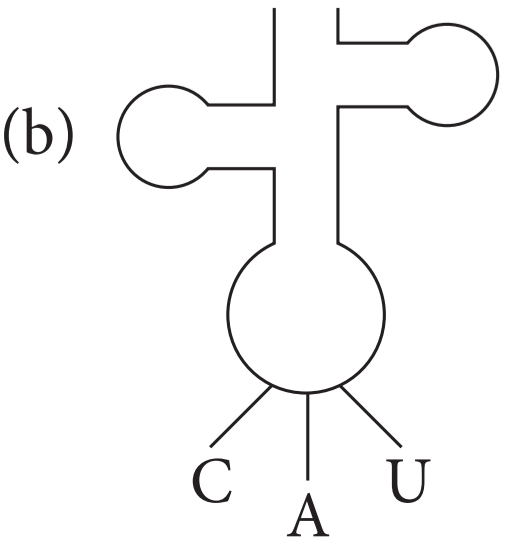
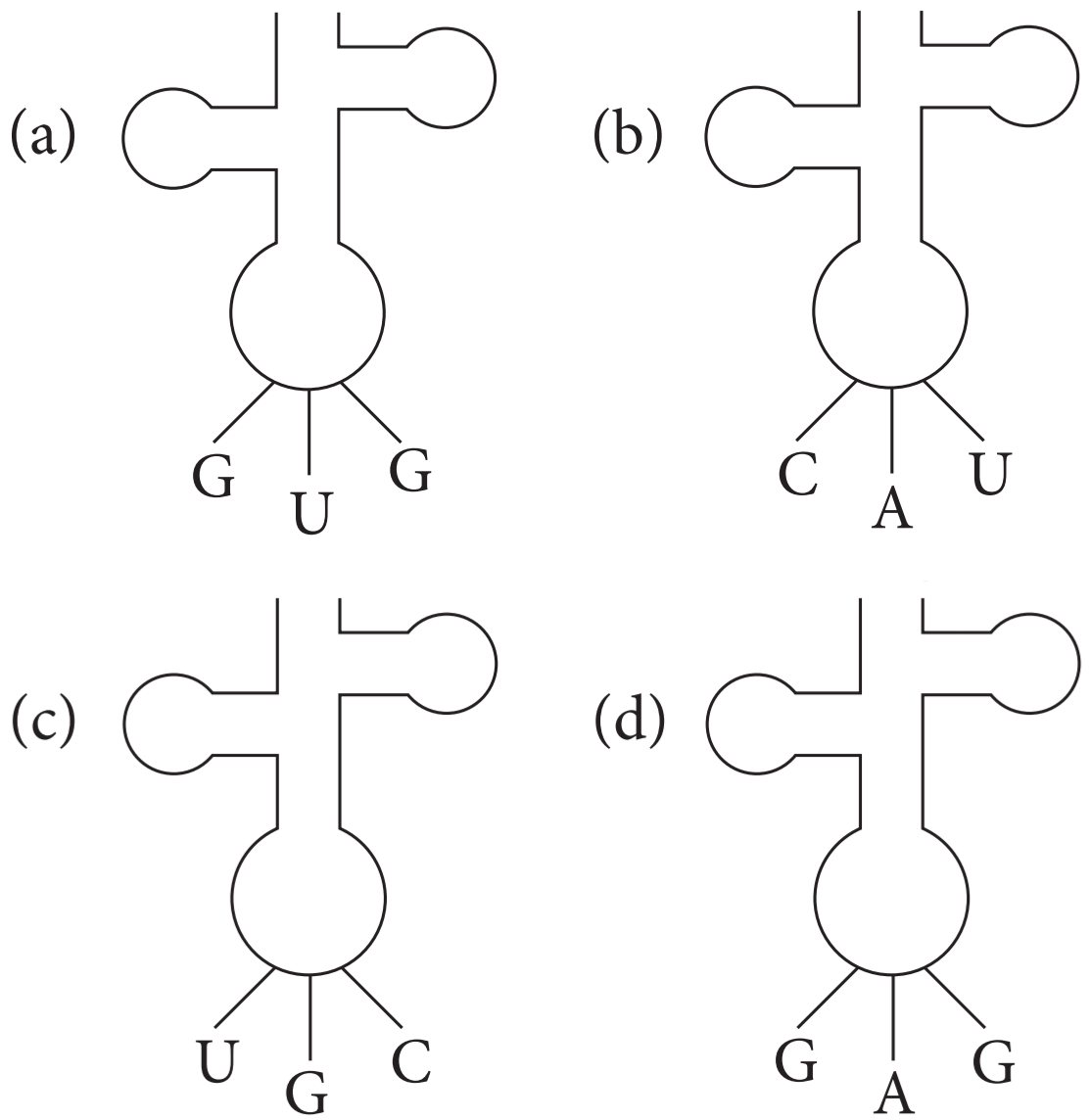
Which transfer RNA molecule is involved in the formation of this part of the sickle cell haemoglobin?
Answer

  1. (a) May arise spontaneously.

Explanation:

A mutation is a change in the DNA that changes the physiological effect of the DNA on the cell. Such phenomenon may be caused by radiation, chemical carcinogens, or may occur spontaneously.

  1. (d) GUA

Explanation:

Since a single base pair substitution has caused this mutation, the original codon for glutamic acid must have been CTT, and the mutant codon is CAT. The mRNA code for this mutant is hence GUA, i.e., complementary to CAT.

  1. (a) Leucine to valine.

Explanation:

The segment coding for GAT on the normal DNA molecule has been transcribed into CUA in the mRNA molecule, therefore the mutant DNA strand CAT will be transcribed into GUA on the mRNA molecule. This implies a change from the amino acid leucine to valine.

  1. (b) Both assertion and reason are true, but reason is not the correct explanation of assertion.
  2. (b) 

Explanation:

CAU in tRNA is the only one that can compliment the valine in the sickle cell haemoglobin.

Need a full question paper?

Generate a complete, print-ready paper with questions like this in minutes — across 16+ boards, with answer keys.

Start Generating Free

Similar questions

Read the following text carefully and answer the questions that follow:
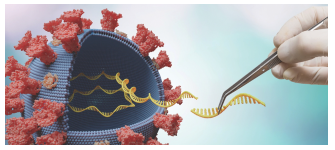
A pathogen is defined as an organism causing disease to its host, with the severity of the disease symptoms referred to as virulence. Pathogens are taxonomically widely diverse and comprise viruses and bacteria as well as unicellular and multicellular eukaryotes. The immune system of a person is suppressed. He was found positive for a pathogen in the diagnostic test ELISA.
Image
i. Name the disease, the patient is suffering from. (1)
ii. Which pathogen is identified by ELISA test? (1)
iii. Which cells of the body are attacked by the pathogen? (2)
OR
Suggest preventive measures of the infection. (2)
Explain exponential growth equation with well labeled diagram.###Explain exponential growth.
Read the following and answer any four questions from (i) to (v) given below:

Unlike animals, plants cannot runaway for their defence, therefore, they have evolved an astonishing variety of morphological and chemical defences against herbivores. Thorns are the most common morphological means of defence. Many plants produce and store chemicals that make the herbivore sick when they are eaten, inhibit feeding or digestion, disrupt its reproduction or even kill it. Some plants produce highly poisonous chemicals and that is why no cattle or goats browse on those plants. A wide variety of chemical substances that we extract from plants on a conunercial scale are produced by them actually as defence against grazers and browsers.

  1. Why you never see cattle or goats browsing on weed Calotropisl?
  1. It produces highly poisonous tannins.
  2. It produces quinine which is bitter in taste.
  3. It produces poisonous cardiac glycosides.
  4. It bears prickles.


  1. What could be the possible reason for invasive growth of the prickly pear cactus introduced in Australia?
  1. Absence of predators.
  2. New mycorrhizal association.
  3. Abundant water availability.
  4. All of these.
  1. Which of the following is most likely to sick by consuming chemicals produced by plants?
  1. Frog
  2. Goat
  3. Human
  4. Pigeon
  1. Plant evolve variety of morphological and chemical defences against.
  1. Prey
  2. Predator
  3. Commenal
  4. Mutualist
  1. Assertion: Some plant functions as predator in nature.

Reason: Phytoph ago us insects feed on plant sap.

  1. Both assertion and reason are true and reason is the correct explanation of assertion.
  2. Both assertion and reason are true but reason is not the correct explanation of assertion.
  3. Assertion is true but reason is false.
  4. Both assertion and reason are false.
Read the following and answer any four questions from (i) to (v) given below:

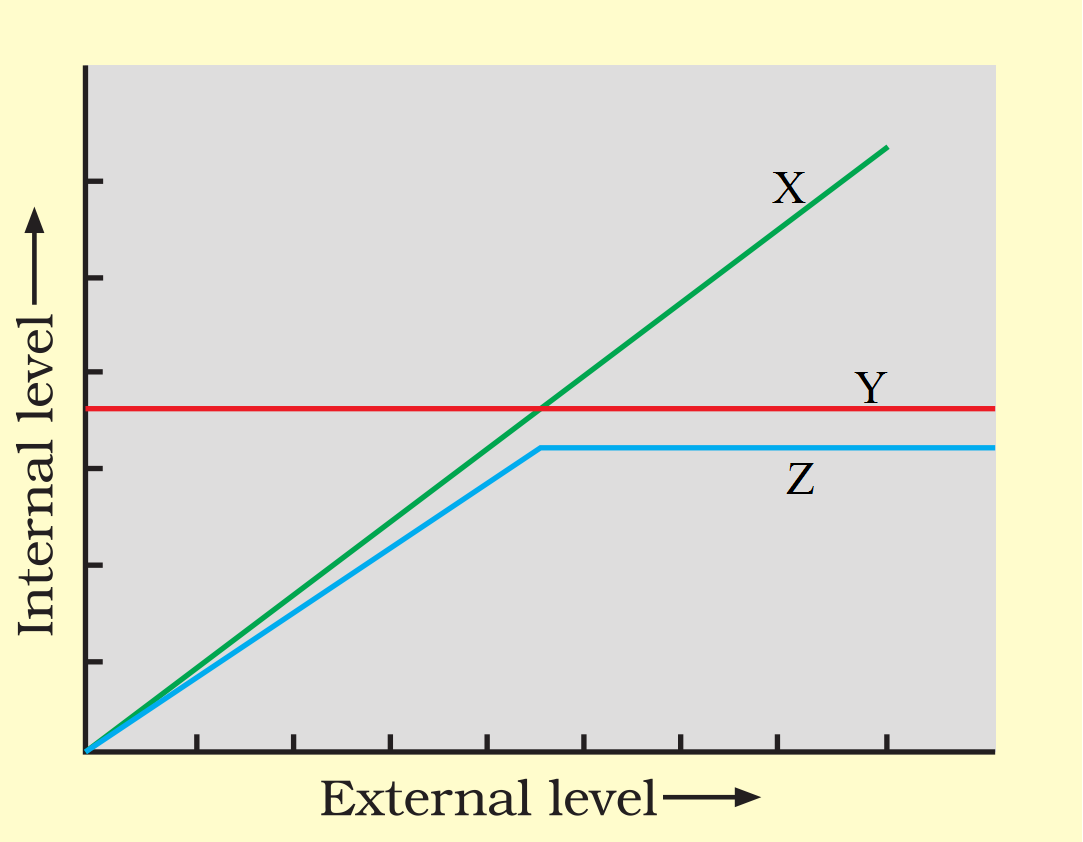
A desert lizard (an ectotherm) and a mouse (an endotherm) are placed inside a chamber at 15ºC and their body temperature [T(L) for the lizard and T(M) for the mouse] and metabolic rates [M(L) for lizard and M(M) for the mouse] are monitored.

  1. Which of the following is correct regardingT(L), M(L), T(M) and M(M)?
  1. T(L) and M(L) will fall while T(M) and M(M) will increase.
  2. T(L) and M(L) will increase while T(M) and M(M) will fall.
  3. T(L) and M(L) will fall, T(M) will remain same and M(M) will increase.
  4. T(L) and M(L) will remain same, T(M) and M(M) will decrease.
  1. It can be said that some animals in their evolutionary development preferred to be ectotherms than endotherms. Which of the following can be the best suited reason for it?
  1. The metabolic reactions of these organisms can occur at a very wide range of temperature.
  2. Maintaining homeostasis is an energetically expensive process.
  3. The enzymes of these organisms are functional at high temperatures.
  4. Both (b) and (c).
  1. Organisms that can maintain a constant internal temperature are called.
  1. Homoeothermic
  2. Poikilothermic
  3. Oligothennic
  4. Heterothennic
  1. An animal that survives at temperature of 10ºC and 40ºC both can be placed under the category of:
  1. Ectotherm.
  2. Endotherm.
  3. Modifiers.
  4. Migratory organisms.
  1. Study the graph carefully and select the correct option.

  1. X could be desert lizard.
  2. Y could be mouse.
  3. Z could be desert lizard.
  4. Both (a) and (b).
Read the following and answer any four questions from (i) to (v) given below:

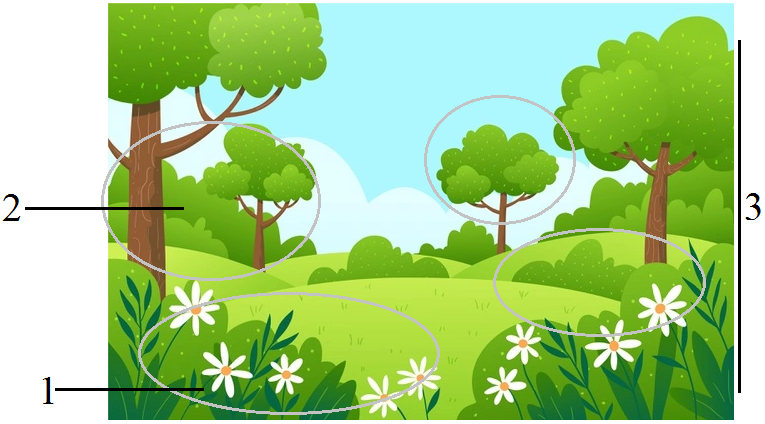
Ecosystem diversity is the variety of forms in the ecosystem due to diversity of niches, trophic levels and ecological processes like nutrient recycling, food webs, energy flow, etc. Study the given figure.

  1. Identify different types of diversity denoted by 1, 2 and 3 in the given figure.
 
1
2
3
(a)
Alpha diversity
Beta diversity
Gamma diversity
(b)
Gamma diversity
Alpha diversity
Beta diversity
(c)
Gamma diversity
Beta diversity
Alpha diversity
(d)
Beta diversity
Alpha diversity
Gamma diversity
  1. Alpha diversity is biodiversity present.
  1. Within conununity.
  2. Between conununities.
  3. In ranges of communities.
  4. None of these.
  1. Diversity represented by diversity of habitats over a total landscape area is:
  1. $\alpha-\text{diversity}$

  2. $\gamma-\text{diversity}$

  3. $\beta-\text{diversity}$

  4. $\delta-\text{diversity}$

  1. Concept of three types of ecological diversity was given by:
  1. Elton
  2. Odum
  3. Edward Wilson
  4. Whittaker
  1. The diversity of organisms sharing the same habitat or conununity is termed as:
  1. Alpha diversity.
  2. beta diversity.
  3. gamma diversity.
  4. delta diversity.
Read the following and answer any four questions from (i) to (v) given below:

Reerna, Jai and Ankit are suffering from autoimmune diseases of adrenal cortex, joints and thyroid gland, respectively. Their immune system failed to recognise self and non-self and started destroying their body's own proteins. They are seeking proper medical help for their conditions but their condition cannot be cured completely.

Based on the above information, answer the following questions.

  1. Select the option that correctly identifies autoimmune diseases of Reema, Jai and Ankit.
S no.
Reema
Jai
Ankit
(a)
Diabetes
Grave's disease
Rheumatic fever
(b)
Pernicious anaemia
Multiple sclerosis
Myasthenia gravis
(c)
Addison's disease
Rheumatoid arthritis
Hashismoto's thyroiditis
(d)
Systemic lupus erythematosus
Severe combined immunodeficiency disease
AIDS
  1. Reema's autoimmune condition is characterised by
  1. Undersecretion of insulin.
  2. Destruction of RB Cs and low RB C count.
  3. Undersecretion of adrenal cortex hormones.
  4. Low production of intrinsic factor required for absorption of B12
  1. What do you think is the major cause of Jai's condition?
  1. Deterioration of myelin sheath around nerve cells, leading to loss of precise muscle control
  2. Destruction of heart cells, leading to weakening of entire heart wall.
  3. Destruction of beta cells, leading to undersecretion of insulin.
  4. Deposition of immune complexes of IgM, IgG and complement in joints thereby inflaming joints, destroying articular cartilage and fusing bones.
  1. How do you think Ankit's condition got diagnosed?
  1. Low level of thyroid hormone and elevated levels of TSH in Ankit's blood.
  2. Presence of antibodies against thyroid pen oxidase (TPO antibodies) in Ankit's blood.
  3. Elevated erythrocyte sedimentation rate (ESR), reduced C-reactive protein (CRP) in Ankit.
  4. Both (a) and (b)
  1. Assertion: Immunosuppressive drugs often reduce the severity of autoimmune disorders.

Reason: Monoclonal antibodies have been successfully used in the treatment of autoimmune disease.

  1. Both assertion and reason are true, and reason is the correct explanation of assertion.
  2. Both assertion and reason are true, but reason is not the correct explanation of assertion.
  3. Assertion is true, but reason is false.
  4. Both assertion and reason are false.
What is oogenesis? Give a brief account of oogenesis.###Define or Characterise: (i) Primary oocyte. (ii) Primary follicle. (iii) Secondary follicle. (iv) Tertiary follicle. (v) Antrum. (vi) Secondary oocyte. (vii) Graafian follicle.
Read the following and answer any four questions from (i) to (v) given below:

Growth of a population with time shows specific and predictable patterns. Two types of growth pattern of population are exponential and logistic growth. When resources in the habitat are unlimited each species has the ability to realise fully its innate potential to grow in number. Then the population grows in exponential fashion. When the resources are limited growth curve shows an initial slow rate and then it accelerates and finally slows giving the growth curve which is sigmoid.

  1. Which of the following statement is incorrect?
  1. Exponential growth occurs in organism such as lemmings.
  2. Logistic growth is more realistic.
  3. Exponential growth has two phases lag and log.
  4. ln logistic growth, population passes well beyond the carrying capacity of ecosystem.
  1. Which of the following equations correctly represents the exponential population growth curve?
  1. $\text{dN}/\text{dt}=\text{rN}$

  2. $\text{dN}/\text{dt}=\text{rN}\Big(\frac{\text{K-N}}{\text{K}}\Big)$

  3. $\text{N}_\text{t}=\text{N}_\text{o}\text{e}^\text{rt}$

  4. Both (a) and (c).
  1. Which of the following equations correctly represents Verhulst-Pearl logistic growth?
  1. $\text{dN}/\text{dt}=\text{rN}\Big(\frac{\text{K-N}}{\text{K}}\Big)$

  2. $\text{dN}/\text{dt}=\frac{\text{rN}}{\text{K}}$

  3. $\text{dN}/\text{dt}=\frac{\text{N}(\text{K}-\text{N})}{\text{K}}$

  4. $\text{dN}/\text{dt}=\frac{\text{r}(\text{K}-\text{N})}{\text{K}}$

  1. The population growth is generally described by the following equation:

$\frac{\text{dN}}{\text{dt}}=\text{rN}\Big(\frac{\text{K}-\text{N}}{\text{K}}\Big)$

What does 'r' represent in the given equation?

  1. Population density at time 't'.
  2. Intrinsic rate of natural increase.
  3. Carrying capacity.
  4. The base of natural logarithm.
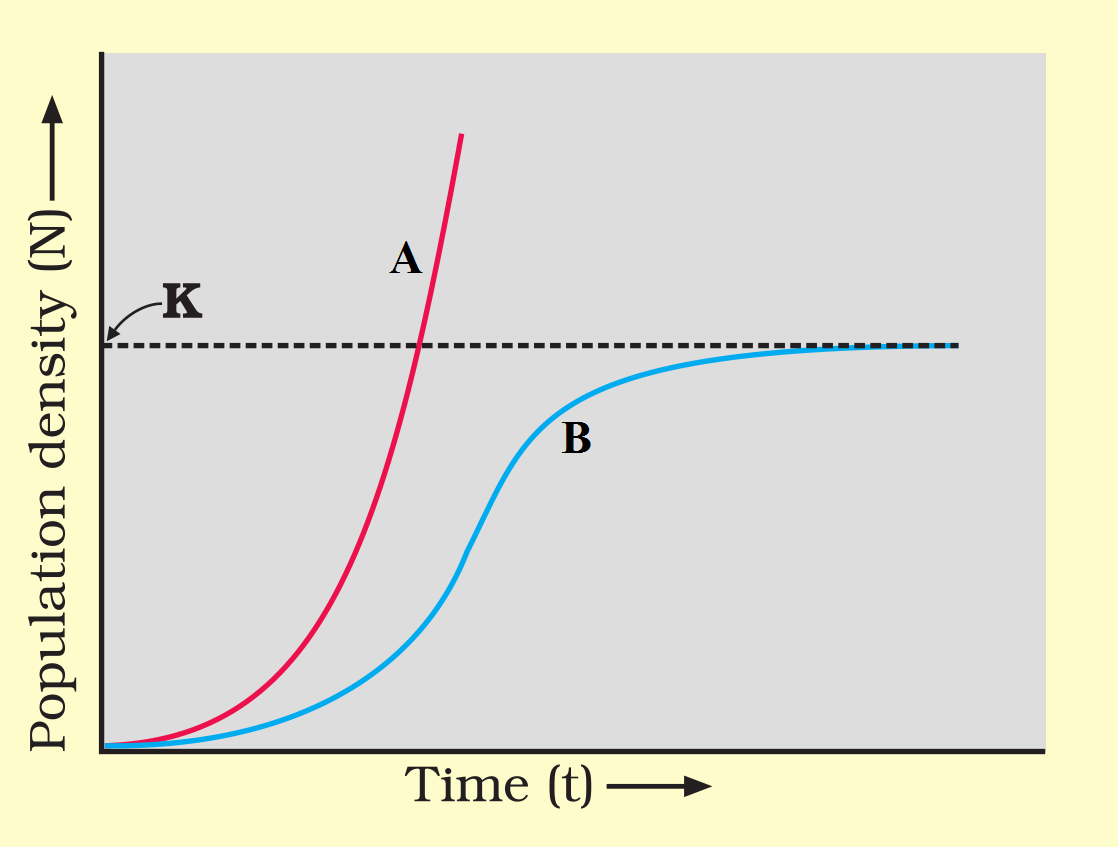
  1. Study the population growth curves (A and B) in the given graph and select the incorrect option.

  1. Curve 'A: shows exponential growth, represented by equation $\frac{\text{dN}}{\text{dt}}=\text{rN}$.

  2. Curve 'B' shows logistic growth, represented by equation $\frac{\text{dN}}{\text{dt}}=\text{rN}\Big(\frac{\text{K}-\text{N}}{\text{K}}\Big)$

  3. Exponential growth curve is considered as more realistic than the logistic growth curve.
  4. Curve 'A' can also be represented by equation $\text{N}_\text{t}=\text{N}_\text{o}\text{e}^\text{rt}$.

Loss of habitat and fragmentation leads to loss in biodiversity. Explain with example.
Explain co-dominance in humans with the help of example.