Question
Read the following and answer any three questions from (i) to (iv).As neutral atom carbon has electronic configuration $\text{K}\ \ \ \text{L}\\2\ \ \ \ 4$ To gain inert gas configuration carbon can either donate 4 valence electrons (helium gas configuration) or gain 4 electrons (neon gas configuration), but it cannot do so. To acquire inert gas configuration carbon can only share its 4 valence electrons with other atoms forming covalent bonds. A covalent bond can be defined as a chemical bond formed between two atoms by mutual sharing of valence electrons so that each atom acquires the stable electronic configuration of the nearest noble gas. The concept of covalent bonds was given by Langmuir and Lewis to explain bonding in non-ionic compounds. The covalent bonds are of three types. If each atom contributes one electron, the covalent bond formed is called a single covalent bond and is represented by a single line (-) and if each atom contributes two electrons, the covalent bond formed is called a double bond and is represented by a double line (=) and if each atom contributes three electrons, the covalent bond formed is called a triple bond and is represented by a triple line $(\equiv).$
  1. Which compounds do not contain a double bond?
     
  2. Write compounds which contains a triple bond?
     
  3. Which molecules has all its atoms joined together by double covalent bond? Give two example.

    OR
  4. A) Langmuir and Lewis has given which concept?

    B) Explain three types of covalent bonds?

Answer

  1. (b) II and III only
Explanation:
Both $NH_3$ and HCI have single bonds.
  1. (a) $N_2$
Explanation:
$\text{N}\equiv\text{N}$
  1. (a) Single.
  1. (c) Carbon dioxide.
  1. (c)

Explanation:
In chlorine molecule, both chlorine atoms contribute one electron and thus share single electron pair to form single covalent bond. As shared pair is shared by both atoms, they acquire inert gas configuration of argon atom in valence shell.

Need a full question paper?

Generate a complete, print-ready paper with questions like this in minutes — across 16+ boards, with answer keys.

Start Generating Free

Similar questions

Read the following and answer any three questions from (i) to (iv).The electrical energy consumed by an electrical appliance is given by the product of its power rating and the time for which it is used. The SI unit of electrical energy is Joule. Actually, Joule represents a very small quantity of energy, and therefore it is inconvenient to use where a large quantity of energy is involved. So for commercial purposes we use a bigger unit of electrical energy which is called kilowatt-hour. 1 kilowatt-hour is equal to $3.6 × 10^6$ joules of electrical energy.
  1. The energy dissipated by the heater is E. When the time of operating the heater is doubled, the energy dissipated will?
     
  2. The power of a lamp is 60W. The energy consumed in 1 minute will?
     
  3. The electrical refrigerator rated 400W operates 8 hours a day. The cost of electrical energy is ₹ 5 per kWh. Find the cost of running the refrigerator for one day?
    OR
  4. Calculate the energy transformed by a 5A current flowing through a resistor of $2\Omega$ for 30 minutes?
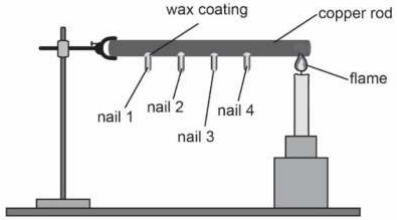
Riya wants to ind out how metal conducts heat.
She attaches four nails on a copper rod with wax.
Riya heats one end of the copper rod with a lame.

Image
1. Which nail will fall last?
A. Nail 1
B. Nail 2
C. Nail 3
D. Nail 4
2. What should Riya keep the same in her activity?
A. Length of the nails
B. Material of the nails
C. Thickness of wax coatings
D. Distance between the nails

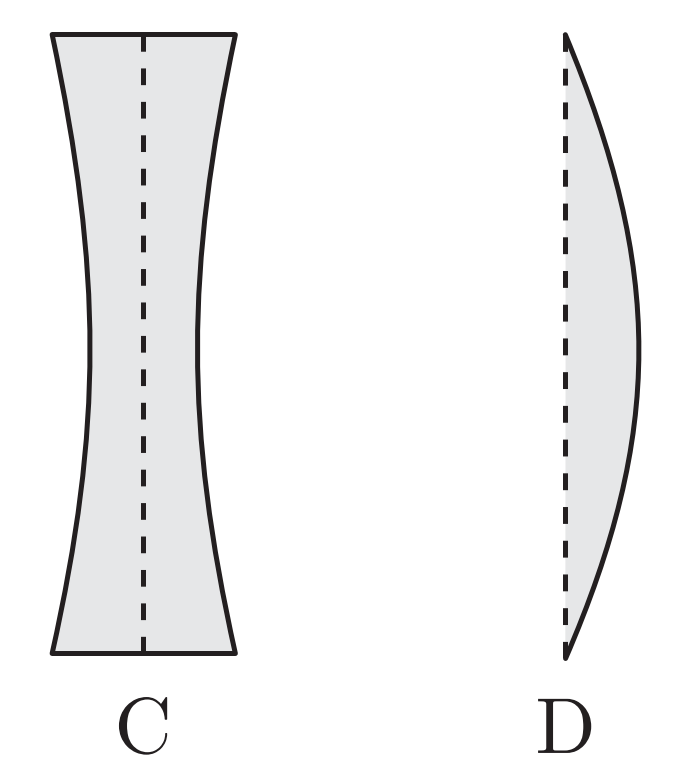
Lenses are objects made of transparent materials such as glass or clear plastic that has curved surfaces. Diverging lenses are thicker at their edges than at their centres and makes light rays passing through them spread out. Converging lenses are thicker in their middle than at this edges and make light rays passing through them focus at a point. These are used in spectacles to help people with poor vision see better. The converging lenses magnify by bending the rays of light that pass through them to meet at a point called focus. Thicker the converging lens is at its centre, the more its magnifies and closer the focus is to the lens.
(i) Ravi uses two lenses $A$ and $B$ of same size and same material as shown. $P _1$ and $P _2$ are the powers of $A$ and B. An object is kept at the same distance from the lens between $F$ and $2 F$ of each lens on the principal axis in turn. Let $I_1$ and $I_2$ be the image formed by two lenses respectively. What is the relation of image distances of both lens?
(ii) Write down the relation between the power of lens of both lenses ?
(iii) Meenakshi uses above two lenses $A$ and $B$ along with another two lenses $C$ and $D$, as shown :


She is able to see the subject matter on the black board while sitting in the front row in the classroom but is unable to see the same matter while sitting in the last row.
Which of the above four lenses will she require to correct the defect in her vision? Why ?
or
(iv) Natasha places an object on the principal axis of above given lens A. One end of this object coincides with the focus $F$ and the other end with $2 F$. What will be the nature of the image formed by the lens on the other side?

The strength of acid and base depends on the number of $H^+$ and the number of $OH-$ respectively. If we take hydrochloric acid and acetic acid of the same concentration, say one molar, then these produce different amounts of hydrogen ions. Acids that give rise to more $H+$ ions are said to be strong acids, and acids that give less $H+$ ions are said to be weak acids. Can you now say what weak and strong bases are?
$(a)$ Fresh milk has a $pH$ of $6$. How do you think the $pH$ will change as it turns into curd?
$(b)$ Is Gastric juice a weak acid?
OR
Milk of magnesia is an acid or base? For what purpose it can be used?
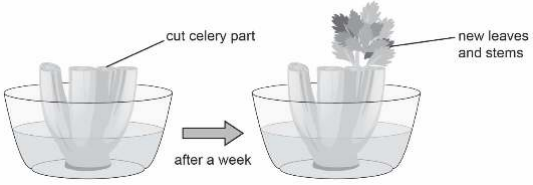
Medha cut a celery plant into two pieces.
She placed the lower part of the cut celery in a jar of water.
The pictures show what Medha observed after a week.

Image
4. What can Medha conclude from her activity?
A. Some plants can regenerate.
B. Some plants grow best indoors.
C. Some plants can grow without sunlight.
D. Some plants need both male and female organs to reproduce.
5. Scientists grow new plants from groups of cells in laboratories.
What is the technique known as?

You must have noticed many dramatic changes in your appearance as well as that of your friends as you approached 10-12 years of age. These changes associated with puberty are because of the secretion of testosterone in males and oestrogen in females. Do you know anyone in your family or friends who has been advised by the doctor to take less sugar in their diet because they are suffering from diabetes? As a treatment, they might be taking injections of insulin. This is a hormone that is produced by the pancreas.
(a) Why is pancreas a dual gland?
(b) Name the hormone which is secreted by males and females during adolescence.
(c) What happens if Insulin is not secreted in the proper amount?
OR
From which cells of pancreatic islets insulin and glucagon hormone are secreted?
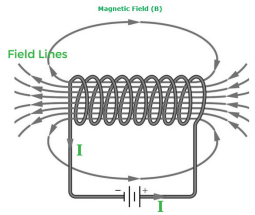
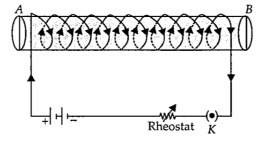
An insulated copper wire wound on a cylindrical cardboard tube such that its length is greater than its diameter is called a solenoid. When an electric current is passed through the solenoid, it produces a magnetic field around it. The magnetic field produced by a current-carrying solenoid is similar to the magnetic field produced by a bar magnet. The field lines inside the solenoid are in the form of parallel straight lines. The strong magnetic field produced inside a current-carrying solenoid can be used to magnetize a piece of a magnetic material like soft iron when placed inside the solenoid. The strength of the magnetic field produced by a current-carrying solenoid is directly proportional to the number of turns and strength of the current in the solenoid.

Image
(a) What would be the strength of the magnetic field inside a long current-carrying straight solenoid?
(b) Which end is north and which end is south pole when current flows through a solenoid?
(c) A long solenoid carrying a current produces a magnetic field B along its axis. If the current is double and
the number of turns per cm is halved, then what will be the new value of the magnetic field?

OR

A soft iron bar is enclosed by a coil of insulated copper wire as shown in the figure. When the plug of the
key is closed, then where would the face B of the iron bar be marked?

Image
Salt of a strong acid and strong base is neutral with a pH value of 7. NaCl common salt is formed by a combination of hydrochloride and sodium hydroxide solution. This is the salt that is used in food. Some salt is called rock salt, bed of rock salt was formed when seas of bygone ages dried up. The common salt thus obtained is an important raw material for various materials of daily use, such as sodium hydroxide, baking soda, washing soda, and bleaching powder.
(a). If given acids are phosphoric acid, carbonic acid, hydrochloric acid and sulphuric acid, then which acid
does not form an acidic salt?
(b). What is the formula of baking soda?

OR

Name the substance which on treatment with chlorine to obtain bleaching powder.
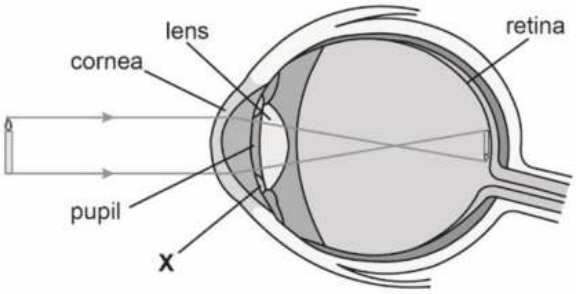
The diagram shows how a human eye sees a candle.

Image
1. What is X?<
2. Which part of the eye produces maximum refraction of light rays?
A. Lens
B. Pupil
C. Retina
D. Cornea
3. What type of image is formed on the retina?
A. Virtual and inverted
B. Real and inverted
C. Virtual and erect
D. Real and erect
4. What would the size of the image formed on the retina depend on?
A. Age of the person
B. Curvature of the lens
C. ocal length of the lens
D. Distance of the candle from the eyes
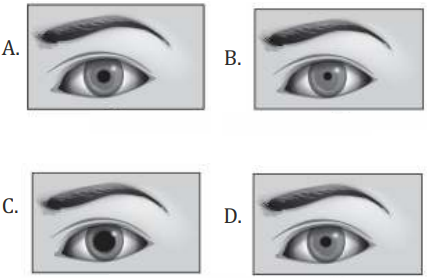
5. Which eye is likely to be in the brightest light?

Image
6. Which part of the eye controls the size of the pupil?
7. Presbyopia is a defect in vision.
What is the primary cause of presbyopia?
8. A young person can clearly see nearby objects but not distant objects.
Which of these statements is true for the person?
Circle ‘Yes’ or ‘No’ to mark your responses.

Is this statement correct?

Yes or No

His eye lens is not lexible.

Yes/No

His eyeballs are elongated.

Yes/No

All chromosomes in human cells are found in pairs.

Yes/No

Read the following and answer any three questions from (i) to (iv).An insulated copper wire wound on a cylindrical cardboard tube such that its length is greater than its diameter is called a solenoid. When an electric current is passed through the solenoid, it produces a magnetic field around it. The magnetic field produced by a current-carrying solenoid is similar to the magnetic field produced by a bar magnet. The field tines inside the solenoid are in the form of parallel straight tines. The strong magnetic field produced inside a current-carrying solenoid can be used to magnetise a piece of magnetic material, like soft iron, when placed inside the solenoid. The strength of magnetic field produced by a current carrying solenoid is directly proportional to the number of turns and strength of current in the solenoid.
  1. The strength of magnetic field inside a long current-carrying straight solenoid is called?
     
  2. The north-south polarities of an electromagnet can be found easily by using which rule?
     
  3. Define a solenoid?
     
  4. A long solenoid carrying a current produces a magnetic field B along its axis. If the current is double and the number of turns per cm is halved, then new value of magnetic field will be?