Question
Read the given passage carefully and answer the following questions:
Non-alignment as a strategy evolved in the Cold War context..... with the disintegration of USSR and the end of Cold War in 1991, non-alignment, both, as an international movement and as the core of India's foreign policy, lost some of its earlier relevance and effectiveness.
  1. Why did India adopt non-alignment?
  2. Explain any two reasons for the loss of its relevance by the Non-Aligned Movement.
  3. How far do you agree that the Non-Aligned Movement has become an international movement?
Answer

  1. India adopted Non-alignment to make international policies and decisions in a free manner and to actively intervene in world affairs to soften 'Cold War Rivalries.'
  2.  
  • Due to the end of cold war.
  • A disintegration of USSR.
  1. NAM has become an international movement because it is based on a resolve to democratise the international system. It provides an alternative world in order to redress the existing inequalities in various countries, especially the newly independent countries.

Need a full question paper?

Generate a complete, print-ready paper with questions like this in minutes — across 16+ boards, with answer keys.

Start Generating Free

Similar questions

Assess the efforts made by the Government of India in solving the ethnic conflict in Sri Lanka.
What does IAEA stand for? When was it established? Mention its two major objectives.

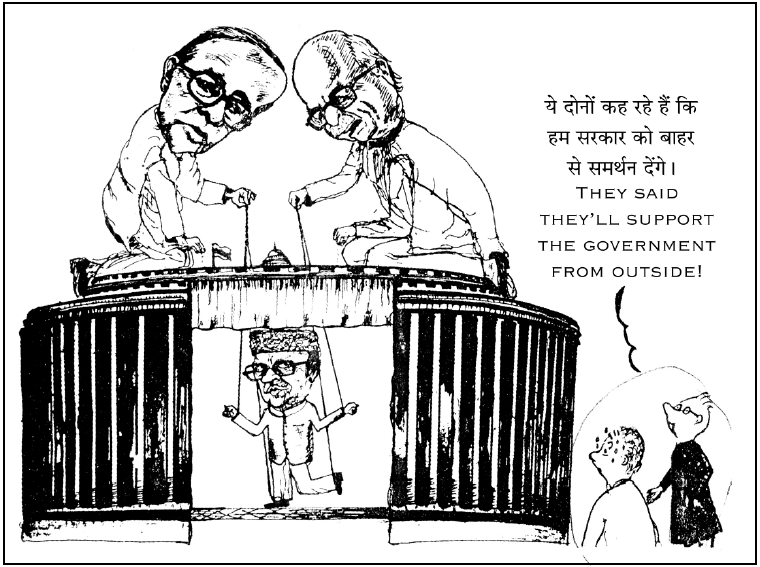
Study the above cartoon carefully and answer the following questions:
  1. Who was head of the Government formed by the National Front in 1989?
  2. Why was the government formed by him called a puppet government?
  3. Identify the puppeteers pulling the strings and the political parties they belong to.
Explain any three challenges for nation building faced by India at the time of its independence.
Examine the significant changes that India underwent after the Lok Sabha elections of 1967.
Study the passage given below carefully and answer the questions that follow:
The best way to respond to regional aspirations is through democratic negotiations rather than through suppression. Look at the situation in the eighties-militancy had erupted in Punjab; problems were persisting in the North-East; students in Assam were agitating; Kashmir Valley was on the boil. Instead of treating these as simple law and order problems, the Government of India reached negotiated settlement with regional movements.
  1. How are regional aspirations dangerous for the unity of the country?
  2. What is meant by democratic negotiations?
  3. Who was leading the agitation in Assam?
  4. What steps were taken by the Government of India to respond to the regional aspiration?
Analyse India's changing relationship with post Communist Russia.
Read carefully the passage given below and answer the following questions:
The Cold War was not simply a matter of power rivalries, military alliances and of balance of power. These were accompanied by a real ideological conflict as well, a difference over the best and most appropriate way of organising political, economic, and social life all over the world.
  1. Why is a war-like situation called Cold War?
  2. Identify one military pact each signed by each of the two super powers to balance the power rivalries.
  3. Differentiate between the ideologies represented by the rival blocs.
Examine the developments that gave rise to the conflict between the Union Government and the Judiciary in India.
Explain any two economic consequences of globalization.