Question
Read the passage given below and answer the following questions:

Amines are produced when an alcoholic solution of ammonia and an alkyl or a benzyl halide is heated in a sealed tube at 373K. This reaction is called ammonolysis and usually gives a mixture of primary, secondary and tertiary amines along with some quarternary ammonium salts. This reaction is an example of nucleophilic substitution reaction in which ammonia acts as a nucleophile due to the presence of a lone pair of electrons on the nitrogen atom. However this method cannot be used for the preparation of aryl amines. One of the most convenient methods for the preparation of aryl amines is reduction of nitro compounds. Aryl amines can also be prepared by reduction of nitrites or Gabriel phthalimide synthesis.

A statement of assertion followed by a statement of reason is given. Choose the correct answer out of the following choices.

  1. Assertion and reason both are correct statements and reason is correct explanation for assertion.
  2. Assertion and reason both are correct statements but reason is not correct explanation for assertion.
  3. Assertion is correct statement but reason is wrong statement.
  4. Assertion is wrong statement but reason is correct statement.
  1. Assertion: Ammonolysis of alkyl halides only produces 2° amines.

Reason: Ammonolysis of alkyl halides involves the reaction between alkyl halides and alcoholic ammonia.

  1. Assertion: Gabriel-phthalimide reaction can be used to prepare both aryl and alkyl primary amines.

Reason: Aryl halides are more reactive alkyl halides towards nucleophilic substitution reactions.

  1. Assertion: Anunonolysis method cannot be used for the preparation of aryl amines.

Reason: Aryl halides are much less reactive than alkyl halides towards nucleophilic substitution reaction.

  1. Assertion: Ammonolysis can be used to prepare pure primary amines.

Reason: Ammonolysis of haloalkanes lead to multiple ammonium salts.

  1. Assertion: Aromatic 1º amines can not be prepared by Gabriel phthalimide synthesis.

Reason: Aryl halides do not undergo nucleophilic substitution with anion formed by phthalimide.
Answer

  1. (d) Assertion is wrong statement but reason is correct statement.

Explanation:

Reaction can be used to prepare 1º, 2º, 3º amines and finally quaternary ammonium salts.

  1. (c) Assertion is correct statement but reason is wrong statement.

Explanation:

Aryl halides are less reactive than aralkyl halides towards nucleophilic substitution reactions.

  1. (a) Assertion and reason both are correct statements and reason is correct explanation for assertion.
  1. (d) Assertion is wrong statement but reason is correct statement.

Explanation:

Ammonolysis cannot be used to prepare pure primary amines. This method usually gives a mixture of primary, secondary and tertiary amines along with some quaternary ammonium salts.

  1. (a) Assertion and reason both are correct statements and reason is correct explanation for assertion.

Need a full question paper?

Generate a complete, print-ready paper with questions like this in minutes — across 16+ boards, with answer keys.

Start Generating Free

Similar questions

Read the passage given below and answer the following questions:

At the freezing point of a solvent, the solid and the liquid are in equilibrium. Therefore, a solution will freeze when its vapour pressure becomes equal to the vapour pressure of the pure solid solvent. It has been observed that when a non-volatile solute is added to a solvent, the freezing point of the solution is always lower than that of the pure solvent. Depression in freezing point can be given as, $\Delta\text{T}_\text{f}=\text{K}_\text{f}\text{m}$ Where, Kf = Molal freezing point depression constant or we can write, $\Delta\text{T}_\text{f}=\frac{\text{K}_\text{f}\times\text{W}_\text{B}\times1000}{\text{W}_A\times\text{M}_\text{B}}$

a statement of assertion followed by a statement of reason is given. Choose the correct answer out of the following choices.

  1. Assertion and reason both are correct statements and reason is correct explanation for assertion.
  2. Assertion and reason both are correct statements but reason is not correct explanation for assertion.
  3. Assertion is correct statement but reason is wrong statement.
  4. Assertion is wrong statement but reason is correct statement.
  1. Assertion: 0.1M solution of glucose has same depression in the freezing point as 0.1M solution of urea.

Reason: Kf for both has same value.

  1. Assertion: Increasing pressure on pure water decreases its freezing point.

Reason: Density of water is maximum at 273K.

  1. Assertion: Larger the value of cryoscopic constant of the solvent, lesser will be the freezing point of the solution.

Reason: Extent of depression in the freezing point depends on the nature of the solvent.

  1. Assertion: The water pouch of instant cold pack for treating athletic injuries breaks when squeezed and NH4N03 dissolves thus lowering the temperature.

Reason: Addition of non-volatile solute into solvent results into depression of freezing point of solvent.

  1. Assertion: If a non-volatile solute is mixed in a solution then elevation in boiling point and depression in freezing point both wiII be same.

Reason: Elevation in boiling point and depression in freezing point both depend on number of particles of solute.

Electrical work done in unit time is equal to electrical potential multiplied by total charge passed. ln order to obtain maximum work from a cell, the charge has to be passed reversibly. The reversible work done by a cell is equal to decrease in its Gibb's energy. Hence, Gibb's energy of reaction is given by

$\Delta\text{G}=\text{nFE}_\text{cell}$

Hence, Eis the emfof the cell and nFis the amount of energy.

In these questions (Q. No. i-Iv), a statement of assertion followed by a statement ofreason is given. Choose the correct answer out of the following choices.

  1. Assertion and reason both are correct statements and reason is correct explanation for assertion.
  2. Assertion and reason both are correct statements but reason is not correct explanation for assertion.
  3. Assertion is correct statement but reason is wrong statement.
  4. Assertion is wrong statement but reason is correct statement.
  1. Assertion: $\Delta\text{G}^\circ=-\text{nFE}^\circ$

Reason: Eº should be positive for a spontaneous reaction.

  1. Assertion: An electrochemical cell can be set up only if the red ox reaction is spontaneous.

Reason: A reaction is spontaneous if free energy change is negative.

  1. Assertion: For an electrochemical cell, $\Delta\text{G}<0$ and $\text{E}_\text{cell}>0.$

Reason: The given cell is non-spontaneous.

  1. Assertion: Current stops flowing when Ecell = 0.

Reason: Equilibrium of the cell reaction is attained.

  1. Assertion: Ecell should have a positive value for the cell to function.

Reason: Ecell = Ecathode - Eanode

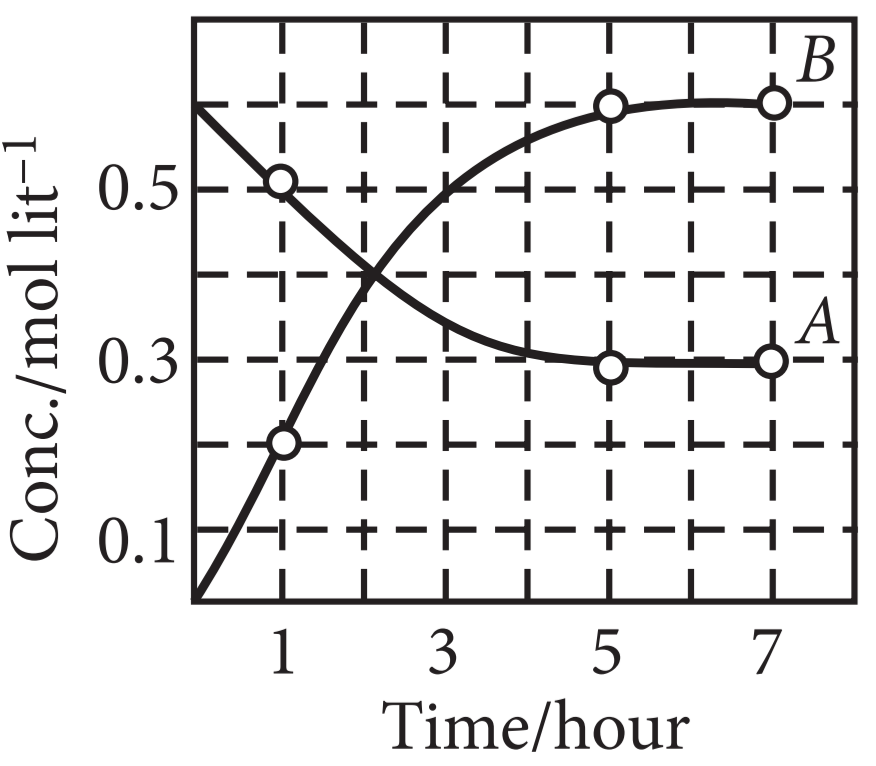
The progress of the reaction, $\text{A}\rightleftharpoons\text{nB}$ with time is represented in the following figure:

The following questions are multiple choice questions. Choose the most appropriate answer:
  1. What is the value of n?
  1. 1
  2. 2
  3. 3
  4. 4
  1. Find the value of the equilibrium constant.
  1. 0.6M
  2. 1.2M
  3. 0.3M
  4. 2.4M
  1. The initial rate of conversion of A will be:
  1. 0.1 mol L-1hr-1
  2. 0.2 mol L-1hr-1
  3. 0.4 mol L-1hr-1
  4. 0.8 mol L-1hr-1
  1. For the reaction, if $\frac{\text{d}[\text{B}]}{\text{dt}}=2\times10^{-4},$ value of $-\frac{\text{d}[\text{A}]}{\text{dt}}$ will be:
  1. 2 × 10-4
  2. 10-4
  3. 4 × 10-4
  4. 0.5 × 10⁻⁴
  1. Which factor has no effect on rate of reaction?
  1. Temperature.
  2. Nature of reactant.
  3. Concentration of reactant.
  4. Molecularity.
Read the passage given below and answer the following questions:
Valence bond theory considers the bonding between the metal ion and the ligands as purely covalent. On the other hand, crystal field theory considers the metal-ligand bond to be ionic arising from electrostatic interaction between the metal ion and the ligands. In coordination compounds, the interaction between the ligand and the metal ion causes the five d-orbitals to split-up. This is called crystal field splitting and the energy difference between the two sets of energy level is called crystal field splitting energy. The crystal field splitting energy $(\Delta_0)$ depends upon the nature of the ligand. The actual configuration of complexes is divided by the relative values of $\Delta_0$ and P (pairing energy).
If $\Delta_0<\text{P},$ then complex will be high spin.
If $\Delta_0>\text{P},$ then complex will be low spin
The following questions are multiple choice questions. Choose the most appropriate answer:
  1. Which of the following ligand has lowest $\Delta_0$ value?
  1. CN-
  2. CO
  3. F-
  4. NH3
  1. The crystal field splitting energy for octahedral $(\Delta_0)$ and tetrahedral $(\Delta_t)$ complex is related as:
  1. $\Delta_\text{t}=\frac{1}{2}\Delta_0$
  2. $\Delta_\text{t}=\frac{4}{9}\Delta_0$
  3. $\Delta_\text{t}=\frac{3}{5}\Delta_0$
  4. $\Delta_\text{t}=\frac{2}{5}\Delta_0$
  1. On the basis of crystal field theory, the electronic configuration of d4 in two situations : (i) t.0 > P and (ii) t.0
  (i) (ii)
(a) $\text{t}^4_{2\text{g}}\text{e}^0_\text{g}$ $\text{t}^3_{2\text{g}}\text{e}^1_\text{g}$
(b) $\text{t}^3_{2\text{g}}\text{e}^1_\text{g}$ $\text{t}^4_{2\text{g}}\text{e}^0_\text{g}$
(c) $\text{t}^3_{2\text{g}}\text{e}^1_\text{g}$ $\text{t}^3_{2\text{g}}\text{e}^1_\text{g}$
(d) $\text{t}^4_{2\text{g}}\text{e}^0_\text{g}$ $\text{t}^4_{2\text{g}}\text{e}^0_\text{g}$
  1. Using crystal field theory, calculate magnetic moment of central metal ion of [FeF6]4-.
  1. 1.79B.M.
  2. 2.83B.M.
  3. 3.85B.M.
  4. 4.9B.M.
  1. Electronic configuration of d-orbitals in [Ti(H2O)6]3+ ion in an octahedral crystal field is:
  1. $\text{t}^1_{2\text{g}}\text{e}^0_\text{g}$
  2. $\text{t}^2_{2\text{g}}\text{e}^0_\text{g}$
  3. $\text{t}^0_{2\text{g}}\text{e}^1_\text{g}$
  4. $\text{t}^1_{2\text{g}}\text{e}^1_\text{g}$
Write detailed note on: Starch
Read the passage given below and answer the following questions:

Ligands are atoms or ions which can donate electrons to the central atoms. Ligands can be monodentate, bidentate or polydentate as well. Few ligands can coordinate with the central atom through more than one site, these are called ambidentate ligands. When a di- or polydentate ligand uses its two or more donor atoms to bind a single metal ion, it is said to be a chelating ligand.

In these questions (Q. No. i-iv), a statement of assertion followed by a statement ofreason is given. Choose the correct answer out of the following choices.

  1. Assertion and reason both are correct statements and reason is correct explanation for assertion.
  2. Assertion and reason both are correct statements but reason is not correct explanation for assertion.
  3. Assertion is correct statement but reason is wrong statement.
  4. Assertion is wrong statement but reason is correct statement.
The following questions are multiple choice questions. Choose the most appropriate answer:

  1. Assertion: Glycinate ion is an example of monodentate ligand.

Reason: Glycinate contains N and O as donor atoms.

  1. Assertion: EDTA forms complex with divalent metals of 3d-series in the ratio of 1 : 1.

Reason: EDTA has 4 - COOH groups.

  1. Assertion: Oxalate ion is a bidentate ligan.

Reason: Oxalate ion has two donor atoms.

  1. Assertion: A chelating ligand must possess two or more lone pairs at such a distance that it may form suitable strain free 5 and 6 membered rings with the metal ion.

Reason: H2N - NH2 is a chelating ligand.

  1. Assertion: In Zeise's salt coordination number of Pt is five.

Reason: Ethene is a monodentate ligand.

All chemical reactions involve interaction of atoms and molecules. A large number of atoms/molecules are present in a few gram of any chemical compound varying with their atomic/ molecular masses. To handle such large number conveniently, the mole concept was introduced. All electrochemical cell reactions are also based on mole concept. For example, a 4.0 molar aqueous solution of NaCl is prepared and 500mL of this solution is electrolysed. This leads to the evolution of chlorine gas at one of the electrode. The amount of products formed can be calculated by using mole concept.
The following questions are multiple choice questions. Choose the most appropriate answer:
  1. The total number of moles of chlorine gas evolved is:
  1. 0.5
  2. 1.0
  3. 1.5
  4. 1.9
  1. If cathode is a Hg electrode, then the maximum weight of amalgam formed from this solution is:
  1. 300g
  2. 446g
  3. 396g
  4. 296g
  1. The total charge (coulomb) required for complete electrolysis is:
  1. 186000
  2. 24125
  3. 48296
  4. 193000
  1. In the electrolysis, the number of moles of electrons involved are:
  1. 2
  2. 1
  3. 3
  4. 4
  1. In electrolysis of aqueous NaCl solution when Pt electrode is taken, then which gas is liberated at cathode?
  1. H2gas
  2. Cl2gas
  3. O2gas
  4. None of these.
Read the passage given below and answer the following questions:

Carboxylic acids having an $\alpha$-hydrogen atom when treated with chlorine or bromine in the presence of small amount of red phosphorus gives $\alpha$-halocarboxytic acids. The reaction is known as Hell-Volhard-Zelinsky reaction.

$\text{R}-\text{CH}_2-\text{COOH}+\text{X}_2\xrightarrow{\text{red p}}\text{R}-\text{CH}-\text{COOH}\\ \ \ \ \ \ \ \ \ \ \ \ \ \ \ \ \ \ \ \ \ \ \ \ \ \ \ \ \ \ \ \ \ \ \ \ \ \ \ \ \ \ \ \ \ \ \ \ \ \ \ \ \ \ \ \ \ \ \ \ \ \ |\\ \ \ \ \ \ \ \ \ \ \ \ \ \ \ \ \ \ \ \ \ \ \ \ \ \ \ \ \ \ \ \ \ \ \ \ \ \ \ \ \ \ \ \ \ \ \ \ \ \ \ \ \ \ \ \ \ \ \ \ \ \text{X}\\ \ \ \ \ \ \ \ \ \ \ \ \ \ \ \ \ \ \ \ \ \ \ \ \ \ \ \ \ \ \ \ \ \ \ \ \ \ \ \ \ \ \ \ \ \ \ \ \ \ \ \ \ \ \ (\text{X = Cl, Br)}$

When sodium salt of carboxylic acid is heated with soda lime it loses carbon dioxide and gives hydrocarbon with less number of C-atoms.

$\text{R}-\text{COOH}\xrightarrow{\text{NaOH}}\text{R}-\text{COONa}\xrightarrow[\Delta]{\text{NaOH}+\text{CaO}}\text{R}-\text{H}+\text{Na}_2\text{CO}_3\\\text{Carboxylic}\ \ \ \ \ \ \ \ \ \ \ \ \ \ \ \ \ \ \ \ \ \text{Sod.}\ \ \ \ \ \ \ \ \ \ \ \ \ \ \ \ \ \ \ \ \ \ \ \ \ \ \ \ \ \text{Alkane}\\\ \ \ \ \ \text{acid}\ \ \ \ \ \ \ \ \ \ \ \ \ \ \ \ \ \ \ \ \ \ \text{carboxylate}$

In these questions (Q. No. l-iv), a statement of assertion followed by a statement ofreason is given. Choose the correct answer out of the following choices.

  1. Assertion and reason both are correct statements and reason is correct explanation for assertion.
  2. Assertion and reason both are correct statements but reason is not correct explanation for assertion.
  3. Assertion is correct statement but reason is wrong statement.
  4. Assertion is wrong statement but reason is correct statement.
  1. Assertion: (CH3)3CCOOH does not give H.V.Z reaction.

Reason: (CH3)3CCOOH does not have $\alpha$-hydrogen atom.

  1. Assertion: H.V.Z. reaction involves the treatment of carboxylic acids having $\alpha$-hydrogens with Cl2 or Br2 in presence of small amount of red phosphorus.

Reason: Phosphorus reacts with halogens to form phosphorus trihalides.

  1. Assertion: Propionic acid with $\frac{\text{Br}_2}{\text{P}}$ yields CH2Br - CHBr - COOH.

Reason: Propionic acid has two $\alpha$-hydrogen atoms.

  1. Assertion: C6H5COCH2COOH undergoes decarboxylation easily than C6H5COCH2COOH.

Reason: C6H5COCH2COOH is $\beta$-keto acid.

  1. Assertion: On heating 3-methylbutanoic acid with soda lime, isobutane is obtained.

Reason: Soda lime is a mixture of NaOH + CaO in the ratio 3 : 1.

Nemst equation relates the reduction potential of an electrochemical reaction to the standard potential and activities of the chemical species undergoing oxidation and reduction.

Let us consider the reaction, $\text{M}^{\text{n+}}_{(\text{aq})}\xrightarrow{\ \ \ \ \ \ \ \ }\text{nM}_\text{(s)}$

For this reaction, the electrode potential measured with respect to standard hydrogen electrode can be given as

$\text{E}_{\Big(\frac{\text{M}^{\text{n+}}}{\text{M}}\Big)}=\text{E}^\circ_{\Big(\frac{\text{M}^\text{n+}}{\text{M}}\Big)}-\frac{\text{RT}}{\text{nF}}\text{ln}\frac{[\text{M}]}{[\text{M}^{\text{n}+}]}$

In these questions (Q. No. i-iv), a statement of assertion followed by a statement ofreason is given. Choose the correct answer out of the following choices.

  1. Assertion and reason both are correct statements and reason is correct explanation for assertion.
  2. Assertion and reason both are correct statements but reason is not correct explanation for assertion.
  3. Assertion is correct statement but reason is wrong statement.
  4. Assertion is wrong statement but reason is correct statement.
  1. Assertion: For concentration cell, $\text{Zn}_{(\text{s})}|\text{ Zn}^{2+}_{\text{(aq)}}||\text{ Zn}^{2+}_{(\text{aq})}|\text{ Zn}\\\ \ \ \ \ \ \ \ \ \ \ \ \text{C}_1\ \ \ \ \ \ \ \ \text{C}_2$

For spontaneous cell reaction, C1 < C2

Reason: For concentration cell, $\text{E}_\text{cell}=\frac{\text{RT}}{\text{nF}}\log\frac{\text{C}_2}{\text{C}_1}$

For spontaneous reaction, $\text{E}_\text{cell}=+\text{ve}\Rightarrow\text{C}_2>\text{C}_1$

  1. Assertion: For the cell reaction, $\text{Zn}_{(\text{s})}+\text{Cu}^{2+}_{(\text{aq})}\xrightarrow{\ \ \ \ \ }\text{Zn}^{2+}_{(\text{aq})}+\text{Cu}_{(\text{s})}$ voltmeter gives zero reading at equilibrium.

Reason: At the equilibrium, there is no change in concentration of Cu2+ and Zn2+ ions.

  1. Assertion: The Nernst equation gives the concentration dependence of emf of the cell.

Reason: In a cell, current flows from cathode to anode.

  1. Assertion: Increase in the concentration of copper half cell in a cell, increases the emfofthe cell.

Reason: $\text{E}_\text{cell}=\text{E}^\circ_\text{cell}+\frac{0.059}{2}\log\frac{[\text{Cu}^{2+}]}{[\text{Zn}^{2+}]}$

  1. Assertion: Electrode potential for the electrode $\frac{\text{Mn}^+}{\text{Mn}}$ with concentration is given by the expression under STP conditions.

$\text{E}=\text{E}^\circ+\frac{0.059}{\text{n}}\log[\text{Mn}^{+}]$

Reason: STP conditions require the temperature to be 273K.