Question
Read the passage given below and answer the following questions:

Amines are produced when an alcoholic solution of ammonia and an alkyl or a benzyl halide is heated in a sealed tube at 373K. This reaction is called ammonolysis and usually gives a mixture of primary, secondary and tertiary amines along with some quarternary ammonium salts. This reaction is an example of nucleophilic substitution reaction in which ammonia acts as a nucleophile due to the presence of a lone pair of electrons on the nitrogen atom. However this method cannot be used for the preparation of aryl amines. One of the most convenient methods for the preparation of aryl amines is reduction of nitro compounds. Aryl amines can also be prepared by reduction of nitrites or Gabriel phthalimide synthesis.

A statement of assertion followed by a statement of reason is given. Choose the correct answer out of the following choices.

  1. Assertion and reason both are correct statements and reason is correct explanation for assertion.
  2. Assertion and reason both are correct statements but reason is not correct explanation for assertion.
  3. Assertion is correct statement but reason is wrong statement.
  4. Assertion is wrong statement but reason is correct statement.
  1. Assertion: Ammonolysis of alkyl halides only produces 2° amines.

Reason: Ammonolysis of alkyl halides involves the reaction between alkyl halides and alcoholic ammonia.

  1. Assertion: Gabriel-phthalimide reaction can be used to prepare both aryl and alkyl primary amines.

Reason: Aryl halides are more reactive alkyl halides towards nucleophilic substitution reactions.

  1. Assertion: Anunonolysis method cannot be used for the preparation of aryl amines.

Reason: Aryl halides are much less reactive than alkyl halides towards nucleophilic substitution reaction.

  1. Assertion: Ammonolysis can be used to prepare pure primary amines.

Reason: Ammonolysis of haloalkanes lead to multiple ammonium salts.

  1. Assertion: Aromatic 1º amines can not be prepared by Gabriel phthalimide synthesis.

Reason: Aryl halides do not undergo nucleophilic substitution with anion formed by phthalimide.
Answer

  1. (d) Assertion is wrong statement but reason is correct statement.

Explanation:

Reaction can be used to prepare 1º, 2º, 3º amines and finally quaternary ammonium salts.

  1. (c) Assertion is correct statement but reason is wrong statement.

Explanation:

Aryl halides are less reactive than aralkyl halides towards nucleophilic substitution reactions.

  1. (a) Assertion and reason both are correct statements and reason is correct explanation for assertion.
  1. (d) Assertion is wrong statement but reason is correct statement.

Explanation:

Ammonolysis cannot be used to prepare pure primary amines. This method usually gives a mixture of primary, secondary and tertiary amines along with some quaternary ammonium salts.

  1. (a) Assertion and reason both are correct statements and reason is correct explanation for assertion.

Need a full question paper?

Generate a complete, print-ready paper with questions like this in minutes — across 16+ boards, with answer keys.

Start Generating Free

Similar questions

Read the passage given below and answer the following questions:

Aldehydes and ketones having acetyl group $\left(\begin{array}{c}\ \ \ \ \ \ \ \ \ \ \ \ \text{O}\\\ \ \ \ \ \ \ \ \ \ \ \ ||\\\ \ \ \text{CH}_3-\text{C}-\end{array}\right)$ are oxidised by sodium hypohalate (NaOX) or halogen and alkali (X2 + OH-) to corresponding sodium salt having one carbon atoms less than the carbonyl compound and give a haloform.

$\ \ \ \ \ \ \ \ \text{O}\\\ \ \ \ \ \ \ \ ||\\\text{R}-\text{C}-\text{CH}_3\xrightarrow[\text{orX}_2+\text{NaOH}]{\text{NaOX}}\\ \ \ \ \ \ \ \ \ \text{O}\\\ \ \ \ \ \ \ \ ||\\\text{R}-\text{C}-\stackrel{-}{\hbox{ O}}\stackrel{+}{\hbox{Na}}+\text{CHX}_3(\text{X = Cl, Br, I})$

Sodium hypoiodite (NaOl) when treated with compounds containing CH3CO-group gives yellow precipitate of iodoform. Haloform reaction does not affect a carbon-carbon double bond present in the compound.

The following questions are multiple choice questions. Choose the most appropriate answer:

  1. Which of the following compounds will give positive iodoform test?
  1. Isopropyl alcohol.
  2. Propionaldehyde.
  3. Ethylphenyl ketone.
  4. Benzyl alcohol.
  1. Which of the following compounds is not formed in iodoform reaction of acetone?
  1. CH3COCH2l
  2. lCH2COCH2l
  3. CH3COCHl2
  4. CH3COCl3
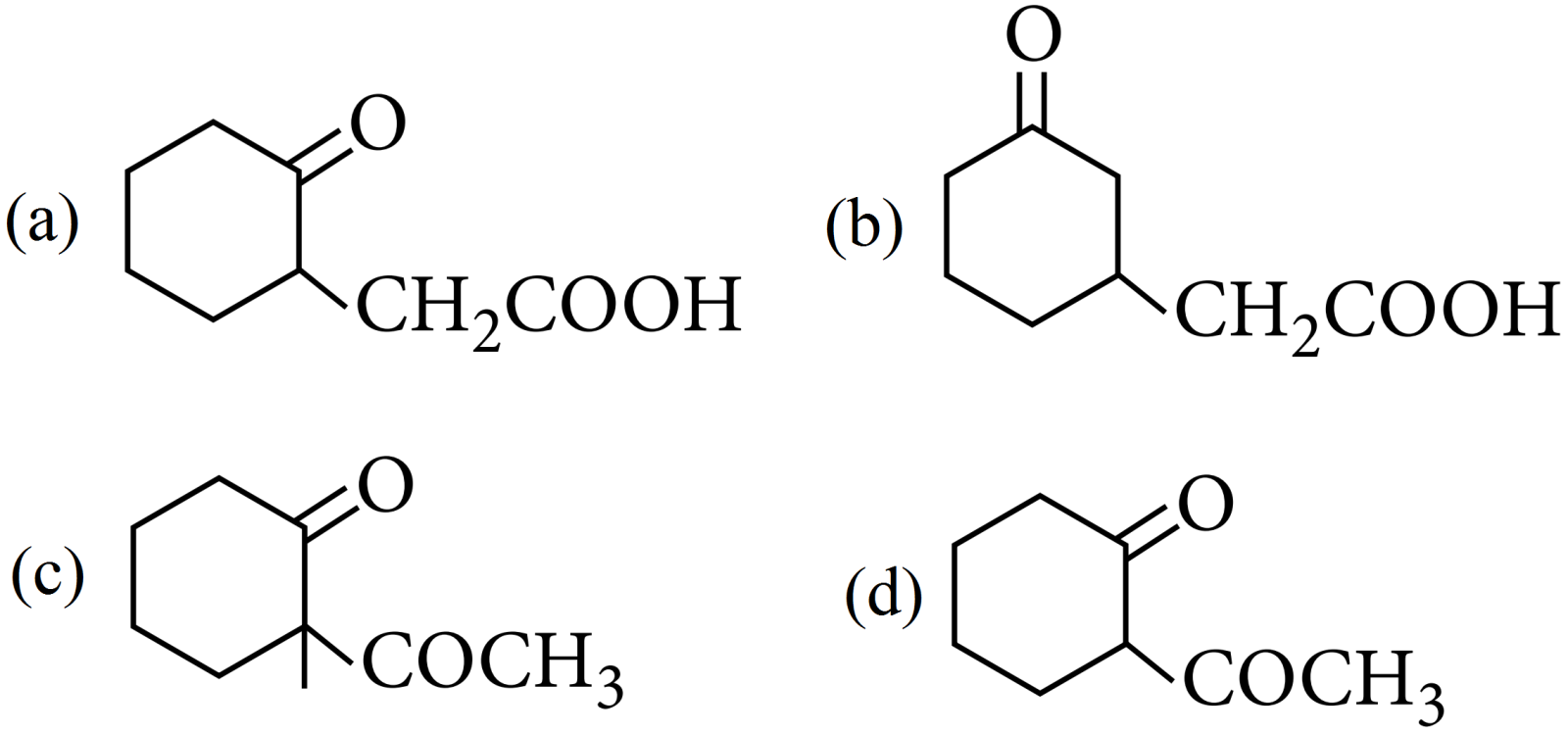
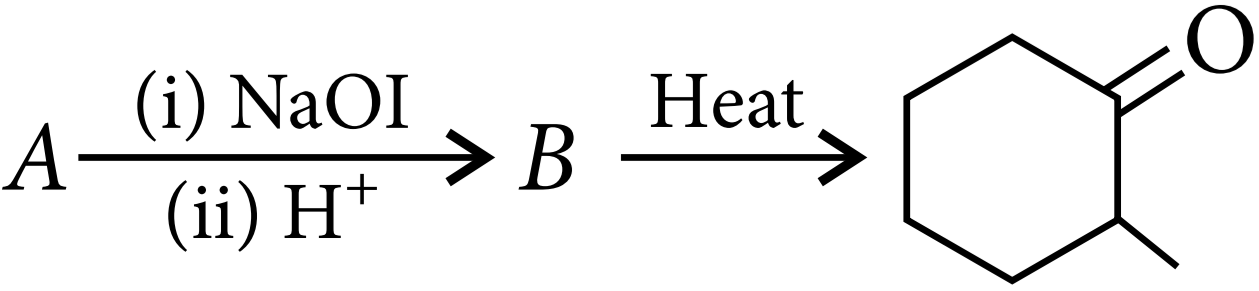
  1. For the given set of reactions,

starting compound A corresponds to:

  1. In the following reaction sequence, the correct structures of E, F and G are:

(* implies 13C labelled carbon)

  1. An organic compound 'A' has the molecular formula C3H6O. It undergoes iodoform test. When saturated with HCl it gives 'B' of molecular formula C9H14O. 'A' and 'B' respectively are:
  1. propanal and mesityl oxide.
  2. Propanone and mesityl oxide.
  3. propanone and 2,6-dimethyl-2,5-hepta-dien-4-one.
  4. propanone and propionaldehyde.
Read the passage given below and answer the following questions:
Coordination compounds are formulated and named according to the IUPAC system.
Few rules for naming coordination compounds are:
  1. In ionic complex, the cation is named first and then the anion.
  2. In the coordination entity, the ligands are named first and then the central metal ion.
  3. When more than one type of ligands are present, they are named in alphabetical order of preference without any consideration of charge.
The following questions are multiple choice questions. Choose the most appropriate answer:
  1. The IUPAC name of the complex [Pt(NH3)3Br(NO2)Cl]Cl is:
  1. Triamminechlorobromonitroplatinum (IV) chloride.
  2. Triamminebromonitrochloroplatinum (IV) chloride.
  3. Triamminebromidochloridonitroplatinum (IV) chloride.
  4. Triamminenitrochlorobromoplatinum (IV) chloride.
  1. The IUPAC name of [Ni(CO)4] is:
  1. Tetracarbonylnickel (II).
  2. Tetracarbonylnickel (0).
  3. Tetracarbonylnickelate (II).
  4. Tetracarbonylnickelate (0).
  1. As per IUPAC nomenclature, the name of the complex [Co(H2O)4(NH3)2]Cl3 is:
  1. Tetraaquadiamminecobalt (II) chloride.
  2. Tetraaquadiamminecobalt (III) chloride.
  3. Diamminetetraaquacobalt (II) chloride.
  4. Diamminetetraaquacobalt (III) chloride.
  1. Which of the following represents correct formula of dichloridobis(ethane -1, 2-diamine)cobalt (III) ion?
  1. [CoCl2(en)]2+
  2. [CoCl2(en)2]2+
  3. [CoCl2(en)]+
  4. [CoCl2(en)2]+
  1. Correct formula of pentaamminenitro-O-cobalt (III) sulphate is:
  1. [Co(NO2)(NH3)5]SO4
  2. [Co(ONO)(NH3)5]SO4
  3. [Co(NO2)(NH3)4](SO4)2
  4. [Co(ONO)(NH3)4](SO4)2
Read the passage given below and answer the following questions:
The properties of the solutions which depend only on the number of solute particles but not on the nature of the solute are called colligative properties. Relative lowering in vapour pressure is also an example of colligative properties. For an experiment, sugar solution is prepared, for which lowering in vapour pressure was found to be 0.061 mm of Hg. (Vapour pressure of water at 20° C is 17.5 mm of Hg)
The following questions are multiple choice questions. Choose the most appropriate answer:
  1. Relative lowering of vapour pressure for the given solution is.
  1. 0.00348
  2. 0.061
  3. 0.122
  4. 1.75
  1. The vapour pressure (mm of Hg) of solution will be.
  1. 17.5
  2. 0.61
  3. 17.439
  4. 0.00348
  1. Mole fraction of sugar in the solution is.
  1. 0.00348
  2. 0.9965
  3. 0.061
  4. 1.75
  1. If weight of sugar taken is 5g in 108g of water, then molar mass of sugar will be.
  1. 358
  2. 120
  3. 240
  4. 400
  1. The vapour pressure (mm of Hg) of water at 293K when 25g of glucose is dissolved in 450g of water is.
  1. 17.2
  2. 17.4
  3. 17.120
  4. 17.02

Read the passage given below and answer the following questions:

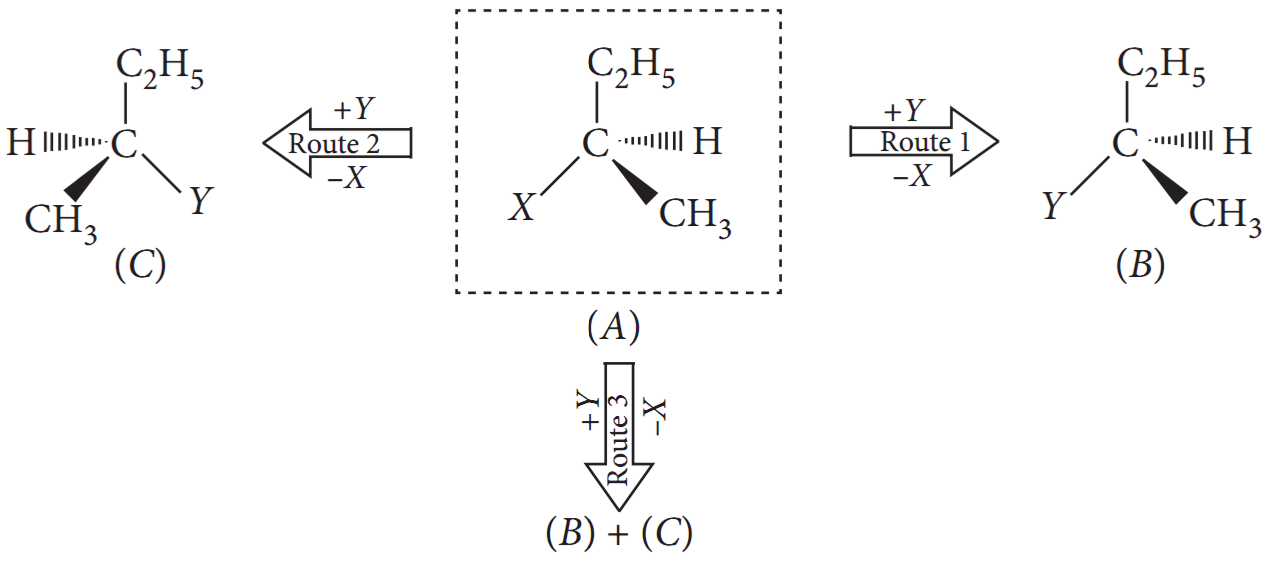
When a chemical reaction involves bond cleavage or bond formation at an asymmetric carbon atom, three different products may be formed. For example, during the substitution of a group X by Y in the following reaction, the three possible products may be shown below:

  1. If Bis the only product, the process is called retention of configuration because B has the same configuration as the starting reactant (A).
  2. If C is the only product, the process is called inversion of configuration because C has the configuration opposite to the starting reactant (A).
  3. If an equimolar mixture of Band C (r.e., a 50 : 50 mixture) is fanned, then the process is called racemisation and the product is optically inactive because one isomer will rotate the light in the direction opposite to another.

In these questions (Q. No. i-iv), a statement of assertion followed by a statement of reason is given. Choose the correct answer out of the following choices.

  1. Assertion and reason both are correct statements and reason is correct explanation for assertion.
  2. Assertion and reason both are correct statements but reason is not correct explanation for assertion.
  3. Assertion is correct statement but reason is wrong statement.
  4. Assertion is wrong statement but reason is correct statement.
  1. Assertion: A reaction is said to be stereospecific if a particular stereoisomer of the reactant produces a specific stereoisomer of the product.

Reason: Bromination of cis-2-butene gives meso-2, 3-dibromobutane which is stereospecific.

  1. Assertion: Addition of Br2 to cis-but-2-ene is stereoselective.

Reason: SN2 reactions are stereospecific as well as stereoselective.

  1. Assertion: Optically active 2-iodobutane on treatment with Nal in acetone undergoes recemization.

Reason: Repeated Walden inversions on the reactant and its product eventually gives a racemic mixture.

  1. Assertion: SN2 reaction of an optically active alkyl halide with an aqueous solution of KOH always gives an alcohol with opposite sign of rotation.

Reason: SN2 reactions always proceed with inversion of configuration.

  1. Assertion: Nudeophilic substitution reaction of an optically active alkyl halide gives a mixture of en an ti om ers.

Reason: The reaction occurs by SN2 mechanism.


Read the passage given below and answer the following questions:
When haloalkanes with $\beta-$hydrogen atom are boiled with alcoholic solution of KOH, they undergo elimination of hydrogen halide resulting in the formation of alkenes. These reactions are called $\beta-$elimination reactions or dehydrohalogenation reactions. These reactions follow Saytzeff's rule. Substitution and elimination reactions often compete with each other. Mostly bases behave as nucleophiles and therefore can engage in substitution or elimination reactions depending upon the alkyl halide and the reaction conditions.
The following questions are multiple choice questions. Choose the most appropriate answer:
  1. Among the following the most reactive towards alcoholic KOH is:
  1. CH2 = CHBr
  2. CH3COCH2CH2Br
  3. CH3CH2Br
  4. CH3CH2CH2Br
  1. The general reaction, $\text{R}-\text{X}\xrightarrow{\text{aq.OH}^-}\text{ROH}+\text{X}^-,$ is expected to follow decreasing order of reactivity as in:
  1. t-BuI> t-BuBr > t-BuCI > t-BuF
  2. t-BuF > t-BuCI > t-BuBr > t-BuI
  3. t-BuBr > t-BuCI >t-BuI> t-BuF
  4. t-BuF > t-BuCI > t-BuI > t-BuBr
  1. Reaction of t-butyl bromide with sodium methoxide produces:
  1. Sodium t-butoxide.
  2. t-butyl methyl ether.
  3. Iso-butane.
  4. Iso-butylene.
  1. In the elimination reactions, the reactivity of alkyl halides follows the sequence:
  1. R - F > R - CI > R - Br > R - I
  2. R - I > R - Br > R - Cl > R - F
  3. R - I > R - F > R - Br > R - CI
  4. R - F > R - I > R - Br > R - CI
  1. The ease of dehydrohalogenation of alkyl halide with alcoholic KOH is:
  1. 3º < 2º < 1º
  2. 3º > 2º > 1º
  3. 3º < 2º > 1º
  4. 3º > 2º < 1º
Read the passage given below and answer the following questions:
Nucleophilic substitution reactions are of two types; substitution nucleophilic bimolecular (SN2) and substitution nucleophilic unimolecular (SN1) depending on molecules taking part in determining the rate of reaction. Reactivity of alkyl halide towards SN1 and SN2 reactions depends on various factors such as steric hindrance, stability of intermediate or transition state, and polarity of solvent. SN2 reaction mechanism is favoured mostly by primary alkyl halide then secondary and then tertiary. This order is reversed in case of SN1 reactions.
The following questions are multiple choice questions. Choose the most appropriate answer:
  1. Which of the following is most reactive towards nucleophilic substitution reaction?
  1. C6H5Cl
  2. CH2 = CHCl
  3. ClCH2CH = CH2
  4. CH3CH = CHCl
  1. Isopropyl chloride undergoes hydrolysis by:
  1. SN1 mechanism.
  2. SN2 mechanism.
  3. SN1 and SN2 mechanism.
  4. Neither SN1 nor SN2 mechanism.
  1. The most reactive nucleophile among the following is:
  1. CH3O-
  2. C6H5O-
  3. (CH3)2CHO-
  4. (CH3)3CO-
  1. Tertiary alkyl halides are practically inert to substitution by SN2 mechanism because of:
  1. Insolubility.
  2. Instability.
  3. Inductive effect.
  4. Stearic hindrance.
  1. Which of the following is the correct order of decreasing SN2 reactivity?
  1. RCH2X > R2CHX > R3CX
  2. R3CX > R2CHX > RCH2X
  3. R2CHX > R3CX > RCH2X
  4. RCH2X > R3CX > R2CHX
Read the passage given below and answer the following questions:
The solubility of gases increases with increase of pressure. William Henry made a systematic investigation of the solubility of a gas in a liquid. According to Henry's law "the mass of a gas dissolved per unit volume of the solvent at constant temperature is directly proportional to the pressure of the gas in equilibrium with the solution". Dalton during the same period also concluded independently that the solubility of a gas in a ti quid solution depends upon the partial pressure of the gas. If we use the mole fraction of gas in the solution as a measure of its solubility, then Henry's law can be modified as "the partial pressure of the gas in the vapour phase is directly proportional to the mole fraction of the gas in the solution"
The following questions are multiple choice questions. Choose the most appropriate answer:
  1. Henry's law constant for the solubility of methane in benzene at 298K is 4.27 x 105mm Hg. The solubility of methane in benzene at 298K under 760mm Hg is:
  1. 4.27 × 10⁻⁵
  2. 1.78 × 10⁻³
  3. 4.27 × 10⁻³
  4. 1.78 × 10⁻⁵
  1. The partial pressure of ethane over a saturated solution containing 6.56 × 10-2g of ethane is I bar. If the solution contains 5.00 × 10⁻²g of ethane then what will be the partial pressure (in bar) of the gas?
  1. 0.762
  2. 1.312
  3. 3.81
  4. 5.0
  1. KH (K bar) values for Ar(g), CO2(g), HCHO(g) and CH4(g) are 40.39, 1.67, 1.83 × 10-5 and 0.413 respectively. Arrange these gases in the order of their increasing solubility. Arrange these gases in the order of their increasing solubility.
  1. HCHO < CH4 < CO2 < Ar
  2. HCHO < CO2 < CH4 < Ar
  3. Ar < CO2 < CH4 < HCHO
  4. Ar < CH4 < CO2 < HCHO
  1. When a gas is bubbled through water at 298K, a very dilute solution of the gas is obtained. Henry's law constant for the gas at 298K is 150 kbar. If the gas exerts a partial pressure of 2 bar, the number of millimoles of the gas dissolved in IL of water is:
  1. 0.55
  2. 0.87
  3. 0.37
  4. 0.66
  1. Which of the following statements is correct?
  1. KH increases with increase of temperature.
  2. KH decreases with increase of temperature.
  3. KH remains constant with increase of temperature.
  4. KH first increases then decreases, with increase of temperature.
The concentration of potassium ions inside a biological cell is at least twenty times higher than the outside. The resulting potential difference across the cell is important in several processes such as transmission of nerve impulses and maintaining the ion balance. A simple model for such a concentration cell involving a metal M is,
M(s) | M+(aq.; 0.05 molar) || M+(aq; 1 molar) | M(s)
The following questions are multiple choice questions. Choose the most appropriate answer:
  1. For the above cell,
  1. $\text{E}_\text{cell}<0;\Delta\text{G}>0$
  2. $\text{E}_\text{cell}>0;\Delta\text{G}<0$
  3. $\text{E}_\text{cell}<0;\Delta\text{G}^\circ>0$
  4. $\text{E}_\text{cell}>0;\Delta\text{G}^\circ<0$
  1. If the 0.05 molar solution of M+ is replaced by a 0.0025 molar M+ solution, then the magnitude of the cell potential would be:
  1. 130mV
  2. 185mV
  3. 154mV
  4. 600mV
  1. The value of equilibrium constant for a feasible cell reaction is:
  1. < 1
  2. = 1
  3. > 1
  4. Zero
  1. What is the emf of the cell when the cell reaction attains equilibrium?
  1. 1
  2. 0
  3. > 1
  4. < 1
  1. The potential of an electrode change with change in:
  1. Concentration ofions in solution.
  2. Position of electrodes.
  3. Voltage of the cell.
  4. All of these.
Read the passage given below and answer the following questions:

Glucose is known as dextrose because it occurs in nature as the optically active dextrorotatory isomer. lt is essential constituent of human blood. The blood normally contains 65 to 110mg of glucose per 100mL (hence named Blood sugar). The level may be much higher in diabetic persons. The urine of diabetic persons also contain considerable amount of glucose. ln combined form, it occurs in cane sugar and polysaccharides such as starch and cellulose.

Glucose has an aldehyde group (-CHO), one primary alcoholic group (-CH2OH) and four secondary alcoholic groups (-CHOH) in their structure. Due to the presence five hydroxyl groups (-OH). glucose undergoes acetylation. Glucose also undergoes oxidation with mild oxidising agents like bromine water as well as with strong oxidising agents like nitric acid. Since glucose is readily oxidised, it acts as a strong reducing agent and reduces Tollen's reagent and Fehling solution. Glucose exists in two crystalline forms: $\alpha$-D-glucose and $\beta$-D-glucose. If either of the two forms is dissolved in water and allowed to stand, the specific rotation of the solution changes gradually, until a constant value is obtained. This change is called mutarotation.

A statement of assertion followed by a statement of reason is given. Choose the correct answer out of the following choices.

  1. Assertion and reason both are correct statements and reason is correct explanation for assertion.
  2. Assertion and reason both are correct statements but reason is not correct explanation for assertion.
  3. Assertion is correct statement but reason is wrong statement.
  4. Assertion is wrong statement but reason is correct statement.
  1. Assertion: A diabetic person carries a packet of glucose with him always.

Reason: Glucose increases the blood sugar level almost instantaneously.

  1. Assertion: On oxidation with nitric acid, glucose as well as gluconic acid both yield saccharic acid.

Reason: The pentaacetate of glucose does not react with hydroxylamine indicating the absence of free -CHO group.

  1. Assertion: Glucose reacts with acetyl chloride to form pentaacetyl glucose.

Reason: The formation of pentaacetyl derivative confirms the presence of five -OH groups in glucose.

  1. Assertion: A certain compound gives negative test with ninhydrin and positive test with Benedict's solution, the compound is an amino acid.

Reason: Glucose is a monosaccharide.

  1. Assertion: The rapid interconversion of $\alpha$-D-glucose and $\beta$-D-glucose in solution is known as racemisation.

Reason: Hydrolysis reaction will take place when a mineral acid is treated with sugar.

What is the most suitable pKa value of the substituted propylamine formed with substituent "X" with electronegativity 3.0
(i)10.67 (ii)10.08 (iii) 10.15 (iv)11.10