Question
Read the passage given below and answer the following questions from 1 to 5.
Important compounds of calcium are calcium Oxide, calcium hydroxide, calcium sulphate, Calcium carbonate and cement. These are Industrially important compounds. The large Scale preparation of these compounds and Their uses are described below. Calcium Oxide or Quick Lime CaO – It is prepared on a commercial scale by Heating limestone $(CaCO_3)$ in a rotary kiln at 1070-1270 K.
$\text{CaCO}_3\overset{\text{heat}}{\rightleftharpoons}\text{CaO} + \text{CO}_2$
The carbon dioxide is removed as soon as It is produced to enable the reaction to proceed To completion. Calcium oxide is a white amorphous solid. It has a melting point of 2870 K. On exposure To atmosphere, it absorbs moisture and carbon Dioxide.
$\text{CaO}+\text{H}_2\text{O}\rightarrow\text{Ca}{\text{OH}}_2$
$\text{CaO}+\text{CO}_2\rightarrow\text{CaCO}_3$
The addition of limited amount of water Breaks the lump of lime. This process is called Slaking of lime. Quick lime slaked with soda Gives solid sodalime. Being a basic oxide, it Combines with acidic oxides at high Temperature.
$\text{CaO}+\text{SiO}_2\rightarrow\text{CaSiO}_3$
$6\text{CaO}+\text{P}_4\text{O}_{10}\rightarrow2\text{Ca}_3(\text{PO}_4)_2$
Uses: It is an important primary material for Manufacturing cement and is the cheapest Form of alkali. It is used in the manufacture of sodium Carbonate from caustic soda. It is employed in the purification of sugar And in the manufacture of dye stuffs.
Calcium Carbonate – $CaCO_3$ occurs in nature in several Forms like limestone, chalk, marble etc. It can Be prepared by passing carbon dioxide Through slaked lime or by the addition of Sodium carbonate to calcium chloride.
$\text{Ca}\text{(OH)}_2+\text{CO}_2\rightarrow\text{CaCO}_3+\text{H}_2\text{O}$
$\text{CaCl}_2+\text{Na}_2\text{CO}_3+\text{CaCO}_3+2\text{NaCl}$
excess of carbon dioxide should be Avoided since this leads to the formation of Water soluble calcium hydrogencarbonate. Calcium carbonate is a white fluffy powder. It is almost insoluble in water. When heated To 1200 K, it decomposes to evolve carbon Dioxide. It is used as a building material in the form of Marble and in the manufacture of quick lime. Calcium carbonate along with magnesium Carbonate is used as a flux in the extraction of Metals such as iron. Specially precipitated CaCO3 Is extensively used in the manufacture Of high quality paper. It is also used as an Antacid, mild abrasive in tooth paste, a Constituent of chewing gum, and a filler in Cosmetics.
Calcium Sulphate (Plaster of Paris), $\text{CaSO}_4·\frac{1}{2}\text{H}_2\text{O}^ –$ It is a hemihydrate of calcium sulphate. It is Obtained when gypsum, $CaSO_4·2H_2O$, is Heated to 393 K.
$2(\text{CaSO}_4.2\text{H}_2)\rightarrow2\text{(CaSO}_4)\text{H}_2\text{O}+3\text{H}_2\text{O}$
above 393 K, no water of crystallisation is left and anhydrous calcium sulphate, $CaSO_4$ is Formed. This is known as ‘dead burnt plaster’. It has a remarkable property of setting with Water. On mixing with an adequate quantity Of water it forms a plastic mass that gets into a Hard solid in 5 to 15 minutes.
Uses: The largest use of Plaster of Paris is in the Building industry as well as plasters. It is used For immoblising the affected part of organ where There is a bone fracture or sprain. It is also Employed in dentistry, in ornamental work and For making casts of statues and busts.
Cement: Cement is an important building Material. it was first introduced in England in 1824 by Joseph Aspdin. It is also called Portland cement because it resembles with the Natural limestone quarried in the Isle of Portland, England. Cement is a product obtained by Combining a material rich in lime, $CaO$ with Other material such as clay which contains Silica, $SiO_2$ along with the oxides of Aluminium, iron and magnesium. The average Composition of Portland cement is : CaO, 50-60%; $SiO_2, 20-25\%; Al2O_3, 5-10\%; MgO, 2-3\%; Fe2O_3, 1-2\%$ and $SO_3, 1-2\%$. For a good Quality cement, the ratio of silica $(SiO_2)$ to Alumina $(Al2O_3)$ should be between 2.5 and 4 And the ratio of lime (CaO) to the total of the Oxides of silicon $(SiO_2)$ aluminium $(Al2O_3)$ And iron $(Fe2O_3)$ should be as close as possible To 2. The raw materials for the manufacture of Cement are limestone and clay. When clay and Lime are strongly heated together they fuse and React to form ‘cement clinker’. This clinker is Mixed with 2-3% by weight of gypsum $(CaSO_4·2H_2O)$ to form cement. Thus important Ingredients present in Portland cement are Dicalcium silicate $(Ca_2SiO4)$ 26%, tricalcium silicate $(Ca_3SiO_5)$ 51% and tricalcium Aluminate $(Ca_3Al_2O_6)$ 11%.
Setting of Cement: When mixed with water, The setting of cement takes place to give a hard Mass. This is due to the hydration of the Molecules of the constituents and their Rearrangement. The purpose of adding Gypsum is only to slow down the process of Setting of the cement so that it gets sufficiently Hardened.
Uses: Cement has become a commodity of National necessity for any country next to iron And steel. It is used in concrete and reinforced Concrete, in plastering and in the construction Of bridges, dams and buildings.
Biological importance of magnesium and calcium - An adult body contains about 25g of Mg and 1200g of Ca compared with only 5g of iron And 0.06 g of copper. The daily requirement In the human body has been estimated to be 200 – 300 mg. All enzymes that utilise ATP in phosphate Transfer require magnesium as the cofactor. The main pigment for the absorption of light In plants is chlorophyll which contains Magnesium. About 99% of body calcium is Present in bones and teeth. It also plays Important roles in neuromuscular function, Interneuronal transmission, cell membrane Integrity and blood coagulation. The calcium Concentration in plasma is regulated at about $100\ mgL^{–1}.$ It is maintained by two hormones: Calcitonin and parathyroid hormone. Do you Know that bone is not an inert and unchanging Substance but is continuously being Solubilised and redeposited to the extent of 400mg per day in man? All this calcium Passes through the plasma.
  1. Quick Lime is prepared on a commercial scale by heating … in a rotary kiln at 1070-1270 K.
  1. $CaCO_3$
  2. $Ca_3Al_2O_6$
  3. $CaSO_42H_2O$
  4. $CaO$
  1. An adult body contains about … of Ca
  1. 600g
  2. 1200g
  3. 1800g
  4. 2400g
  1. The calcium Concentration in plasma is regulated at about …
  1. 10
  2. 50
  3. 100
  4. 500
  1. It was first introduced in England in 1824 by ….
  1. Edgar Dobbs
  2. Egor Cheliev
  3. James Parker
  4. Joseph Aspdin
  1. Molecular Formula of plaster of paris is …
  1. $CaSO_42H_2O$
  2. $\text{CaSO}_4·\frac{1}{2}\text{H}_2\text{O}^ –$
  3. $Ca_2SiO_4$
  4. $Ca_3Al_2O_6$

Answer

  1. (a) $CaCO_3$
  2. (b) $1200g$
  3. (c) $100$
  4. (d) Joseph Aspdin
  5. (b) $\text{CaSO}_4·\frac{1}{2}\text{H}_2\text{O}^ –$

Need a full question paper?

Generate a complete, print-ready paper with questions like this in minutes — across 16+ boards, with answer keys.

Start Generating Free

Similar questions

Once an organic compound is extracted from a natural source or synthesised in the laboratory, it is essential to purify it. Various methods used for the purification of organic compounds are based on the nature of the compound and the impurity present in it. Finally, the purity of a compound is ascertained by determining its melting or boiling point. This is one of the most commonly used techniques for the purification of solid organic compounds. In crystallisation Impurities, which impart colour to the solution are removed by adsorbing over activated charcoal. In distillation Liquids having different boiling points vaporise at different temperatures. The vapours are cooled and the liquids so formed are collected separately. Steam Distillation is applied to separate substances which are steam volatile and are immiscible with water. Distillation under reduced pressure: This method is used to purify liquids having very high boiling points.

i. Which method can be used to separate two compounds with different solubilities in a solvent?
ii. Distillation method is used to separate which type of substance?
iii. Which technique is used to separate aniline from aniline water mixture?
OR
Why chloroform and aniline are easily separated by the technique of distillation?
Read the passage given below and answer the following questions from (i) to (v).
A system in thermodynamics refers to that part of universe in which observations are made and remaining universe constitutes the surroundings. The surroundings include everything other than the system. System and the surroundings together constitute the universe. The universe = The system + The surroundings However, the entire universe other than the system is not affected by the changes taking place in the system. Therefore, for all practical purposes, the surroundings are that portion of the remaining universe which can interact with the system. Usually, the region of space in the neighbourhood of the system constitutes its surroundings.
The wall that separates the system from the surroundings is called boundary.
Types of the System We, further classify the systems according to the movements of matter and energy in or out of the system.
  1. Open System In an open system, there is exchange of energy and matter between system and surroundings. The presence of reactants in an open beaker is an example of an open system. Here the boundary is an imaginary surface enclosing the beaker and reactants.
  2. Closed System In a closed system, there is no exchange of matter, but exchange of energy is possible between system and the surroundings. The presence of reactants in a closed vessel made of conducting material e.g., copper or steel is an example of a closed system.
  3. Isolated System In an isolated system, there is no exchange of energy or matter between the system and the surroundings. The presence of reactants in a thermos flask or any other closed insulated vessel is an example of an isolated system.
The State of the System The system must be described in order to make any useful calculations by specifying quantitatively each of the properties such as its pressure (p), volume (V), and temperature (T) as well as the composition of the system. We need to describe the system by specifying it before and after the change. You would recall from your Physics course that the state of a system in mechanics is completely specified at a given instant of time, by the position and velocity of each mass point of the system. In thermodynamics, a different and much simpler concept of the state of a system is introduced. It does not need detailed knowledge of motion of each particle because, we deal with average measurable properties of the system. We specify the state of the system by state functions or state variables. The state of a thermodynamic system is described by its measurable or macroscopic (bulk) properties. We can describe the state of a gas by quoting its pressure (p), volume (V), temperature (T), amount (n) etc. Variables like p, V, T are called state variables or state functions because their values depend only on the state of the system and not on how it is reached. In order to completely define the state of a system it is not necessary to define all the properties of the system; as only a certain number of properties can be varied independently. This number depends on the nature of the system. Once these minimum number of macroscopic properties are fixed, others automatically have definite values. The state of the surroundings can never be completely specified; fortunately it is not necessary to do so.
By conventions of IUPAC in chemical thermodynamics. The q is positive, when heat is transferred from the surroundings to the system and the internal energy of the system increases and q is negative when heat is transferred from system to the surroundings resulting in decrease of the internal energy of the system.
Let us consider the general case in which a change of state is brought about both by doing work and by transfer of heat. We write change in internal energy for this case as: $ \triangle{\text{U}}=\text{q}+\text{w}$
For a given change in state, q and w can vary depending on how the change is carried out. However, $\text{q}+\text{w}=\triangle{\text{U}}$ will depend only on initial and final state. It will be independent of the way the change is carried out. If there is no transfer of energy as heat or as work (isolated system) i.e., if w = 0 and q = 0, then $ \triangle{\text{U}}=0.$ The equation i.e., $ \triangle{\text{U}}=\text{q}+\text{w}$ is mathematical statement of the first law of thermodynamics, which states that The energy of an isolated system is constant. It is commonly stated as the law of conservation of energy i.e., energy can neither be created nor be destroyed.
  1. $\triangle\text{U}=\ ....$
  1. q + w
  2. q + v
  3. q + m
  4. q + z
  1. Which of the following is not an example of state variable?
  1. Pressure
  2. Ionic radius
  3. Volume
  4. Amount
  1. $\triangle\text{U}=\text{q}+\text{w}$ is termed as …
  1. Third law of thermodynamics
  2. Second law of thermodynamics
  3. First law of thermodynamics
  4. None of above
  1. A … in thermodynamics refers to that part of universe in which observations are made.
  1. Universe
  2. System
  3. Surrounding
  4. Boundary
  1. Which of the following is a type if system ?
  1. Open system
  2. Closed system
  3. Lsolated system
  4. All the above
Read the passage given below and answer the following questions from (i) to (v).
Arrhenius Concept of Acids and Bases According to Arrhenius theory, acids are substances that dissociates in water to give hydrogen ions $H ^{+}{ }_{(a q)}$ and bases are substances that produce hydroxyl ions $OH ^{-}{ }_{( aq )}$. The ionization of an acid $HX { }_{\text {(aq) }}$ can be represented by the following equations:
$HX_{(aq)} \rightarrow H^{+}{ }_{(aq)}+X_{(aq)}^{-}$
or
$HX_{(aq)}+H_2 O(l) \rightarrow H_3 O^{+}{ }_{(aq)}+X_{(aq)}^{-}$
A bare proton, $H ^{+}$is very reactive and cannot exist freely in aqueous solutions. Thus, it bonds to the oxygen atom of a solvent water molecule to give trigonal pyramidal hydronium ion, $H _3 O ^{+}\left\{\left[ H \left( H _2 O \right)\right]^{+}\right\}$(see box). In this chapter we shall use $H ^{+}{ }_{( aq )}$ and $H _3 O ^{+}{ }_{( aq )}$ interchangeably to mean the same i.e., a hydrated proton. Similarly, a base molecule like MOH ionizes in aqueous solution according to the equation:
$MOH_{(aq)} \rightarrow M^{+}{ }_{(aq)}+OH^{-}(aq)$
The hydroxyl ion also exists in the hydrated form in the aqueous solution. Arrhenius concept of acid and base, however, suffers from the limitation of being applicable only to aqueous solutions and also, does not account for the basicity of substances like, ammonia which do not possess a hydroxyl group.
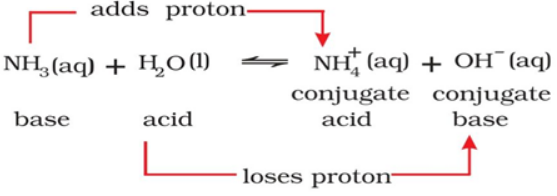
The Brönsted-Lowry Acids and Bases The Danish chemist, Johannes Brönsted and the English chemist, Thomas M. Lowry gave a more general definition of acids and bases. According to Brönsted-Lowry theory, acid is a substance that is capable of donating a hydrogen ion $H ^{+}$and bases are substances capable of accepting a hydrogen ion, $H ^{+}$. In short, acids are proton donors and bases are proton acceptors. Consider the example of dissolution of $NH _3$ in $H _2 O$ represented by the following equation:

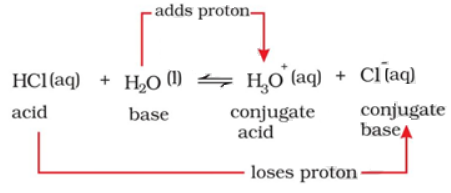
Hydronium and Hydroxyl lons Hydrogen ion by itself is a bare proton with very small size ( $\sim 10-15 m$ radius) and intense electric field, binds itself with the water molecule at one of the two available lone pairs on it giving $H _3 O ^{+}$. This species has been detected in many compounds (e.g., $H _3 O ^{+} Cl -$ ) in the solid state. In aqueous solution the hydronium ion is further hydrated to give species like $H _5 O _2^{+}, H7O3^{+}$and $H _9 4^{+}$. Similarly the hydroxyl ion is hydrated to give several ionic species like, $H _5 O 3$ - and H 7 O 4 - etc. The basic solution is formed due to the presence of hydroxyl ions. In this reaction, water molecule acts as proton donor and ammonia molecule acts as proton acceptor and are thus, called Lowry-Brönsted acid and base, respectively. In the reverse reaction, $H ^{+}$is transferred from $NH _4^{+}$to $OH ^{-}$. In this case, $NH _4^{+}$acts as a Bronsted acid while $OH ^{-}$acted as a Brönsted base. The acid-base pair that differs only by one proton is called a conjugate acid-base pair. Therefore, OH - is called the conjugate base of an acid $H _2 O$ and $NH _4{ }^{+}$is called conjugate acid of the base $NH _3$. f Brönsted acid is a strong acid then its conjugate base is a weak base and vice- versa. It may be noted that conjugate acid has one extra proton and each conjugate base has one less proton. Consider the example of ionization of hydrochloric acid in water. $HCl _{( aq )}$ acts as an acid by donating a proton to $H _2 O$ molecule which acts as a base.

It can be seen in the above equation, that water acts as a base because it accepts the proton. The species $H _3 O ^{+}$is produced when water accepts a proton from HCl . Therefore, Cl - is a conjugate base of HCl and HCl is the conjugate acid of base $Cl -$. Similarly, $H _2 O$ is a conjugate base of an acid $H _3 O ^{+}$and $H _3 O ^{+}$is a conjugate acid of base $H _2 O$. It is interesting to observe the dual role of water as an acid and a base. In case of reaction with HCl water acts as a base while in case of ammonia it acts as an acid by donating a proton.
Lewis Acids and Bases G.N. Lewis in 1923 defined an acid as a species which accepts electron pair and base which donates an electron pair. As far as bases are concerned, there is not much difference between Brönsted-Lowry and Lewis concepts, as the base provides a lone pair in both the cases. However, in Lewis concept many acids do not have proton. A typical example is reaction of electron deficient species $BF _3$ with $NH _3 . BF _3$ does not have a proton but still acts as an acid and reacts with $NH _3$ by accepting its lone pair of electrons. The reaction can be represented by, $BF _3+: NH _3 \rightarrow BF _3: NH _3$
Electron deficient species like $AlCl _3, Co ^{3+}, Mg ^{2+}$, etc. can act as Lewis acids while species like $H _2 O , NH _3, OH ^{-}$etc. which can donate a pair of electrons, can act as Lewis bases.
The pH Scale Hydronium ion concentration in molarity is more conveniently expressed on a logarithmic scale known as the pH scale. The pH of a solution is defined as the negative logarithm to base 10 of the activity ( $a _{ H }{ }^{+}$) of hydrogen ion. In dilute solutions ( $<0.01 M$ ), activity of hydrogen ion $\left( H ^{+}\right)$is equal in magnitude to molarity represented by $\left[ H ^{+}\right]$. It should be noted that activity has no units and is defined as:
$\text{a}=\frac{[\text{H}^+]}{\text{mol}\text{L}^{–1}}$
From the definition of pH, the following can be written,
$\text{pH}={–\log\text{a}_\text{H}^+=\frac{-\log[\text{H}^+]}{\text{mol}\text{L}^{–1}}}$
Thus, an acidic solution of HCl (10–2M) will have a pH = 2. Similarly, a basic solution of NaOH having $[OH^–] =10^{–4}​​​​​​​$​​​​​​​M and [ $H_3O^+] = 10^{–10}M$ will have a $pH = 10. At 25 ^\circ C$, pure water has a concentration of hydrogen ions,$ [H^+] = 10^{–7} M.$ Hence, the pH of pure water is given as:
$pH = –\log(10^{–7}) = 7$
Acidic solutions possess a concentration of hydrogen ions, $[H^+] > 10^{–7}​​​​​​​$​​​​​​​M, while basic solutions possess a concentration of hydrogen ions,$ [H^+] < 10^{–7}​​​​​​​$M. thus, we can summarise that
Acidic solution has pH < 7
Basic solution has pH > 7
Neutral solution has pH = 7
Now again, consider the equation at 298K
$Kw = [H_3O^+][OH^–] = 10^{–14}​​​​​​​$​​​​​​​
Taking negative logarithm on both sides of equation, we obtain
$–\log Kw = – \log{[ H_3O^+ ][OH– ]}$
$= – \log[H_3O^+] – \log[OH–]$
$= – log10^{–14}$
$pKw = pH + pOH = 14$
Note that although Kw may change with temperature the variations in pH with temperature are so small that we often ignore it. pKw is a very important quantity for aqueous solutions and controls the relative concentrations of hydrogen and hydroxyl ions as their product is a constant. It should be noted that as the pH scale is logarithmic, a change in pH by just one unit also means change in $\left[ H ^{+}\right]$by a factor of 10 . Similarly, when the hydrogen ion concentration, $\left[ H ^{+}\right]$changes by a factor of 100 , the value of pH changes by 2 units. Now you can realise why the change in pH with temperature is often ignored. Ionization Constants of Weak Acids Consider a weak acid HX that is partially ionized in the aqueous solution. The equilibrium can be expressed by::
$HX_{(aq)}+H_2O(l) \rightarrow H_3O^+_{(aq)} + X^–_{(aq)}​​​​​​​$
Initial concentration (M)
c 0 0
Let α be the extent of ionization Change (M) -cα +cα +cα Equilibrium concentration (M) c-cα cα cα Here, c = initial concentration of the undissociated acid, HX at time, t = 0. α = extent up to which HX is ionized into ions. Using these notations, we can derive the equilibrium constant for the above discussed acid- dissociation equilibrium:
$\text{Ka}=\frac{\text{c}^2\alpha^2}{\text{c}(1-\alpha)}=\frac{\text{c}\alpha^2}{1-\alpha}$
Ka is called the dissociation or ionization constant of acid HX. It can be represented alternatively in terms of molar concentration as follows,
$\text{Ka}=\frac{[\text{H}^+][\text{X}^–]}{[\text{HX}]}$
At a given temperature T, Ka is a measure of the strength of the acid HX i.e., larger the value of Ka, the stronger is the acid. Ka is a dimensionless quantity with the understanding that the standard state concentration of all species is 1M.
  1. … is a substance that is capable of donating a hydrogen ion $H^+.$
  1. Acid
  2. Base
  3. Neutral substances
  4. Alkaline
  1. … are proton acceptors.
  1. Acids
  2. Bases
  3. Neutral substances
  4. All the above
  1. According to …bases are substances that produce hydroxyl ions $OH^–.$
  1. Johannes Brönsted
  2. Thomas M. Lowry
  3. Arrhenius
  4. G. N. Lewis
  1. Brönsted acid is a strong acid then its conjugate base is a … base.
  1. Strong
  2. Medium
  3. Non
  4. Weak
  1. According to … an acid as a species which accepts electron pair.
  1. Johannes Brönsted
  2. Thomas M. Lowry
  3. Arrhenius
  4. G. N. Lewis
We must bear in mind that when Mendeleev developed his Periodic Table, chemists knew nothing about the internal structure of atom. However, the beginning of the 20th century witnessed profound developments in theories about sub-atomic particles. In 1913, the English physicist, Henry Moseley observed regularities in the characteristic X-ray spectra of the elements. A plot of ν (whereν is frequency of X-rays emitted) against atomic number (Z ) gave a straight line and not the plot of ν vs atomic mass. He thereby showed that the atomic number is a more fundamental property of an element than its atomic mass. Mendeleev’s Periodic Law was, therefore, accordingly modified. This is known as the Modern Periodic Law and can be stated as : The physical and chemical properties of the elements are periodic functions of their atomic numbers.Numerous forms of Periodic Table have been devised from time to time. Some forms emphasise chemical reactions and valence, whereas others stress the electronic configuration of elements. A modern version, the so-called “long form” of the Periodic Table of the elements , is the most convenient and widely used. The horizontal rows (which Mendeleev called series) are called periods and the vertical columns, groups. Elements having similar outer electronic configurations in their atoms are arranged in vertical columns, referred to as groups or families. According to the recommendation of International Union of Pure and Applied Chemistry (IUPAC), the groups are numbered from 1 to 18 replacing the older notation of groups IA … VIIA, VIII, IB … VIIB and 0. There are altogether seven periods. The period number corresponds to the highest principal quantum number (n) of the elements in the period. The first period contains 2 elements. The subsequent periods consists of 8, 8, 18, 18 and 32 elements, respectively. The seventh period is incomplete and like the sixth period would have a theoretical maximum (on the basis of quantum numbers) of 32 elements. In this form of the Periodic Table, 14 elements of both sixth and seventh periods (lanthanoids and actinoids, respectively) are placed in separate panels at the bottom. the IUPAC has made recommendation that until a new element’s discovery is proved, and its name is officially recognised, a systematic nomenclature be derived directly from the atomic number of the element using the numerical roots for 0 and numbers 1-9. The roots are put together in order of digits which make up the atomic number and “ium” is added at the end.Groupwise Electronic Configurations Elements in the same vertical column or group have similar valence shell electronic configurations, the same number of electrons in the outer orbitals, and similar properties. theoretical foundation for the periodic classification. The elements in a vertical column of the Periodic Table constitute a group or family and exhibit similar chemical behaviour. This similarity arises because these elements have the same number and same distribution of electrons in their outermost orbitals. We can classify the elements into four blocks viz., s-block, p-block, d-block and f-block depending on the type of atomic orbitals that are being filled with electrons. Two exceptions to this categorisation. Strictly, helium belongs to the s-block but its positioning in the p-block along with other group 18 elements is justified because it has a completely filled valence shell (1s) and as a result, exhibits properties characteristic of other noble gases. The other exception is hydrogen. It has only one s-electron and hence can be placed in group 1 (alkali metals). It can also gain an electron to achieve a noble gas arrangement and hence it can behave similar to a group 17 (halogen family) elements. Because it is a special case, we shall place hydrogen separately at the top of the Periodic Table.
  1. In 1913, the English physicist, ….observed regularities in the characteristic X-ray spectra of the elements.
  1. Johann Dobereiner
  2. John Alexander Newlands
  3. Demitri Mendeleev
  4. Henry Moseley
  1. Horizontal row in periodic table called:
  1. Group
  2. Period
  3. Triad
  4. Octave
  1. Vertical Column in periodic table called:
  1. Group
  2. Period
  3. Triad
  4. Octave
  1. According to Modern Periodic Law the physical and chemical properties of the elements are periodic functions of their ….
  1. Atomic mass
  2. Atomic numbers
  3. Atomic structure
  4. Atomic size
  1. What is IUPAC name of element having atomic number 107.
  1. Unnilpentium
  2. Unnilhexium
  3. Unnilseptium
  4. Unniloctium

Read the passage given below and answer the following questions from 1 to 5.

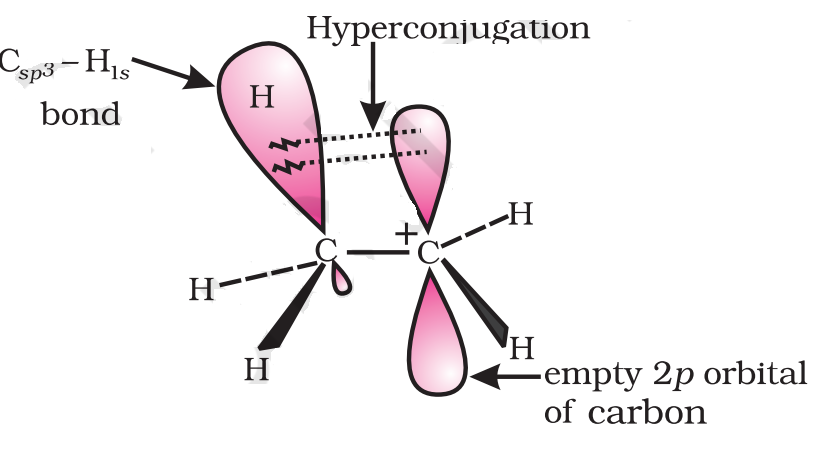
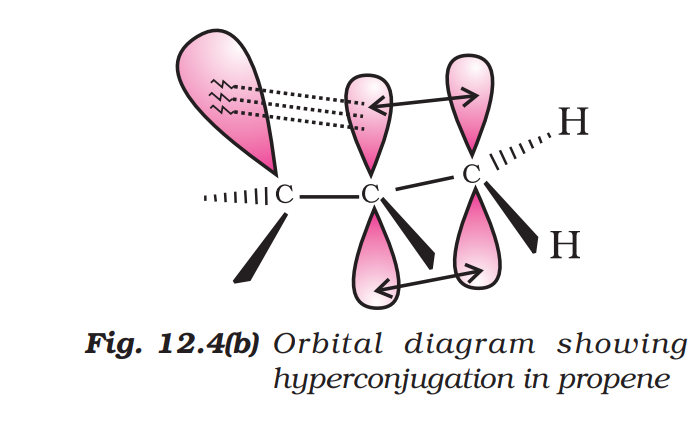
Hyperconjugation is a general stabilising interaction. It involves delocalisation of σ electrons of C—H bond of an alkyl group directly attached to an atom of unsaturated system or to an atom with an unshared p orbital. The σ electrons of C—H bond of the alkyl group enter into partial conjugation with the attached unsaturated system or with the unshared p orbital. Hyperconjugation is a permanent effect. To understand hyperconjugation effect, let us take an example of CH 32 + (ethyl cation) in which the positively charged carbon atom has an empty p orbital. One of the C-H bonds of the methyl group can align in the plane of this empty p orbital and the electrons constituting the C-H bond in plane with this p orbital can then be delocalised into the empty p orbital as depicted in Figure.
This type of overlap stabilises the carbocation because electron density from the adjacent σ bond helps in dispersing the positive charge.

In general, greater the number of alkyl groups attached to a positively charged carbon atom, the greater is the hyperconjugation interaction and stabilisation of the cation. Thus, we have the following relative stability of carbocations:

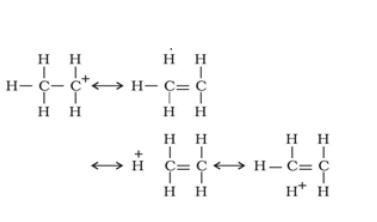
Hyperconjugation is also possible in alkenes and alkylarenes. Delocalisation of electrons by hyperconjugation in the case of alkene can be depicted as in Figure.
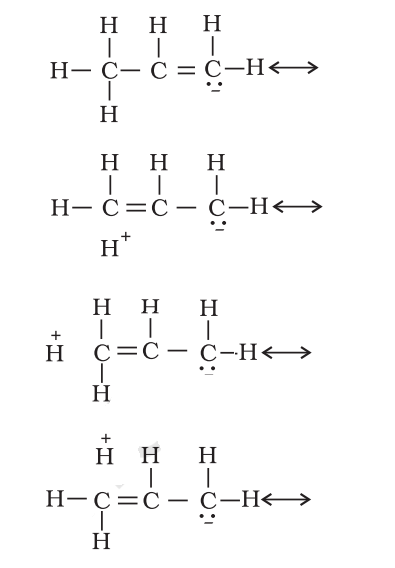
There are various ways of looking at the hyperconjugative effect. One of the way is to regard C—H bond as possessing partial ionic character due to resonance.
The hyperconjugation may also be regarded as no bond resonance.

The hyperconjugation may also be regarded as no bond resonance.
Methods of purification of organic compounds Once an organic compound is extracted from a natural source or synthesised in the laboratory, it is essential to purify it. Various methods used for the purification of organic compounds are based on the nature of the compound and the impurity present in it. The common techniques used for purification are as follows :
i) Sublimation
ii) Crystallisation
iii) Distillation
iv) Differential extraction and
v) Chromatography
Finally, the purity of a compound is ascertained by determining its melting or boiling point. Most of the pure compounds have sharp melting points and boiling points. New methods of checking the purity of an organic compound are based on different types of chromatographic and spectroscopic techniques.
Sublimation On heating, some solid substances change from solid to vapour state without passing through liquid state. The purification technique based on the above principle is known as sublimation and is used to separate sublimable compounds from non- sublimable impurities.
Crystallisation This is one of the most commonly used techniques for the purification of solid organic compounds. It is based on the difference in the solubilities of the compound and the impurities in a suitable solvent. The impure compound is dissolved in a solvent in which it is sparingly soluble at room temperature but appreciably soluble at higher temperature. The solution is concentrated to get a nearly saturated solution. On cooling the solution, pure compound crystallises out and is removed by filtration. The filtrate (mother liquor) contains impurities and small quantity of the compound. If the compound is highly soluble in one solvent and very little soluble in another solvent, crystallisation can be satisfactorily carried out in a mixture of these solvents. Impurities, which impart colour to the solution are removed by adsorbing over activated charcoal. Repeated crystallisation becomes necessary for the purification of compounds containing impurities of comparable solubilities.
Distillation This important method is used to separate
i) volatile liquids from nonvolatile impurities and
ii) the liquids having sufficient difference in their boiling points.

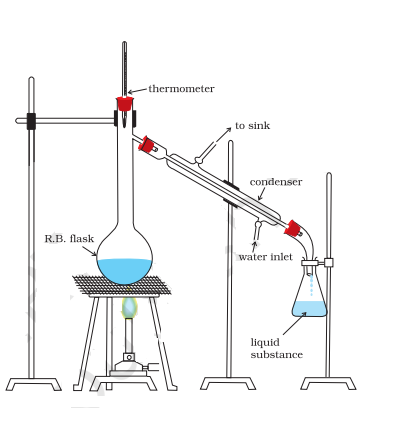
Liquids having different boiling points vaporise at different temperatures. The vapours are cooled and the liquids so formed are collected separately. Chloroform (b.p 334 K) and aniline (b.p. 457 K) are easily separated by the technique of distillation (Fig 12.5). The liquid mixture is taken in a round bottom flask and heated carefully. On boiling, the vapours of lower boiling component are formed first. The vapours are condensed by using a condenser and the liquid is collected in a receiver. The vapours of higher boiling component form later and the liquid can be collected separately.
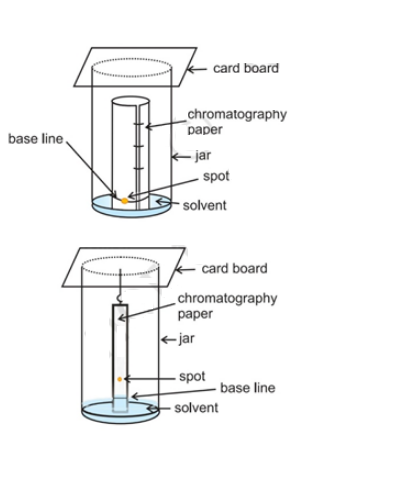
Partition Chromatography: Partition chromatography is based on continuous differential partitioning of components of a mixture between stationary and mobile phases. Paper chromatography is a type of partition chromatography. In paper chromatography, a special quality paper known as chromatography paper is used. Chromatography paper contains water trapped in it, which acts as the stationary phase. A strip of chromatography paper spotted at the base with the solution of the mixture is suspended in a suitable solvent or a mixture of solvents (Fig. 12.13). This solvent acts as the mobile phase. The solvent rises up the paper by capillary action and flows over the spot. The paper selectively retains different components according to their differing partition in the two phases. The paper strip so developed is known as a chromatogram. The spots of the separated coloured compounds are visible at different heights from the position of initial spot on the chromatogram. The spots of the separated colourless compounds may be observed either under ultraviolet light or by the use of an appropriate spray reagent as discussed under thin layer chromatography.
  1. Hyperconjunction involves delocalisation of … electrons of C—H bond of an alkyl group directly attached to an atom of unsaturated system or to an atom with an unshared p orbital.
  1. $\sigma$
  2. $\pi$
  3. $\delta$
  4. $\eta$
  1. Which of the is an example of technique used for purification.
  1. Distillation
  2. Differential extraction
  3. Chromatography
  4. All the above
  1. On heating, some solid substances change from solid to vapour state without passing through liquid state is known as …
  1. Melting
  2. Boiling
  3. Sublimation
  4. Condensation
  1. The hyperconjugation may also be regarded as ….
  1. bonding resonance
  2. no bond resonance
  3. no bond induction
  4. bonding induction
  1. Chromatography paper contains water trapped in it, which acts as the … phase.
  1. mobile
  2. stationery
  3. Secondary
  4. quaternary
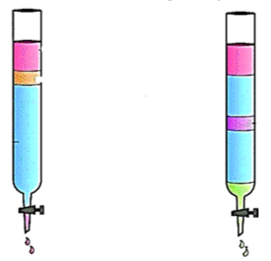
Chromatography is an important technique extensively used to separate mixtures into their components, purify compounds and also test the purity of compounds. Based on the principle involved, chromatography is classified into different categories. Two of these are Adsorption chromatography and Partition chromatography. Two main types of chromatographic techniques are based on the principle of differential adsorption column chromatography, and thin-layer chromatography. Adsorption chromatography is based on the fact that different compounds are adsorbed on an adsorbent to different degrees. Column chromatography involves the separation of a mixture over a column of adsorbent (stationary phase) packed in a glass tube. Thin-layer chromatography (TLC) is another type of adsorption chromatography, which involves the separation of substances of a mixture over a thin layer of an adsorbent coated on a glass plate. Partition chromatography is based on the continuous differential partitioning of components of a mixture between stationary and mobile phases.

1. Which adsorbent is used in adsorption chromatography?
2. How do you visualize colourless compounds after separation in Paper Chromatography?
3. Why paper chromatography is a type of partition chromatography?
OR
Which chromatography is shown in following image?
Image
Read the passage given below and answer the following questions from (i) to (v).
It is well known fact that liquids assume theshape of the container. Why is it then smalldrops of mercury form spherical bead insteadof spreading on the surface. Why do particlesof soil at the bottom of river remain separatedbut they stick together when taken out? Whydoes a liquid rise (or fall) in a thin capillary assoon as the capillary touches the surface ofthe liquid? All these phenomena are causeddue to the characteristic property of liquids,called surface tension. A molecule in the bulkof liquid experiences equal intermolecularforces from all sides. The molecule, thereforedoes not experience any net force. But for themolecule on the surface of liquid, net attractiveforce is towards the interior of the liquid, due to the molecules below it. Since thereare no molecules above it.Liquids tend to minimize their surface area.The molecules on the surface experience a netdownward force and have more energy than the molecules in the bulk, which do notexperience any net force. Therefore, liquids tendto have minimum number of molecules at theirsurface. If surface of the liquid is increased bypulling a molecule from the bulk, attractiveforces will have to be overcome. This willrequire expenditure of energy. The energyrequired to increase the surface area of theliquid by one unit is defined as surface energy.Its dimensions are Jm. Surface tension isdefined as the force acting per unit lengthperpendicular to the line drawn on the surfaceof liquid. It is denoted by Greek letter γ(Gamma). It has dimensions of kg $s^{–2}$ and in SIunit it is expressed as $Nm^{–1}.$
The lowest energystate of the liquid will be when surface area isminimum. Liquid tends to rise (or fall) in the capillarybecause of surface tension. Liquids wet thethings because they spread across their surfacesas thin film. Moist soil grains are pulled togetherbecause surface area of thin film of water isreduced. It is surface tension which givesstretching property to the surface of a liquid.On flat surface, droplets are slightly flattenedby the effect of gravity; but in the gravity freeenvironments drops are perfectly spherical. Viscosity is a measure of resistance toflow which arises due to the internal frictionbetween layers of fluid as they slip past oneanother while liquid flows. Strongintermolecular forces between molecules holdthem together and resist movement of layerspast one another.
When a liquid flows over a fixed surface,the layer of molecules in the immediate contactof surface is stationary. The velocity of upperlayers increases as the distance of layers fromthe fixed layer increases. This type of flow inwhich there is a regular gradation of velocityin passing from one layer to the next is calledlaminar flow.‘$ η’$ is proportionality constant and is calledcoefficient of viscosity. Viscosity coefficientis the force when velocity gradient is unity andthe area of contact is unit area. Thus ‘$ η’$ ismeasure of viscosity. SI unit of viscositycoefficient is $1$ newton second per square metre $\left( N s m ^{-2}\right)=$ pascal second (Pa s $\left.=1 g cm ^{-1} s^{-1}\right)$. Incgs system the unit of coefficient of viscosity ispoise (named after great scientist Jean LouisePoiseuille). 1 poise $=1 g cm ^{-1} S^{-1}=10^{-1} kg m ^{-1} S^{-1}$ Greater the viscosity, the more slowly theliquid flows. Hydrogen bonding and van derWaals forces are strong enough to cause highviscosity. Glass is an extremely viscous liquid.It is so viscous that many of its propertiesresemble solids.Viscosity of liquids decreases as thetemperature rises because at high temperaturemolecules have high kinetic energy and canovercome the intermolecular forces to slip pastone another between the layers.
  1. The dimension of surface energy is:
  1. $Jm^{–2}$
  2. $Jm^2$
  3. $Kjm^{–2}$
  4. $Kjm^2$
  1. 1 poise =
  1. $1cmskg^{-1}$
  2. $1gcm^{–1}s^{–1}$
  3. $1gcms^–1$
  4. $1gcm^{–1}s$
  1. Which of the following is most viscous liquid?
  1. Glass
  2. Water
  3. Mercury
  4. Kerosene
  1. Surface Tension denoteed by greek letter...
  1. $\in$
  2. $\zeta$
  3. $\delta$
  4. $\gamma$
  1. Flow in which there is a regular gradation of velocity in passing from one layer to the next is called:
  1. Turbulent flow
  2. Shear flow
  3. Streamline flow
  4. laminar flow.
Read the passage given below and answer the following questions from (i) to (v).
Relation between Ka and Kb – Ka and Kb represent the strength of an acid and a base, respectively. In case of a conjugate acid-base pair, they are related in a simple manner so that if one is known, the other can be deduced. Considering the example of $NH_4^+$ and $NH_3$ we see,
${\text{NH}_4}^+{_{(\text{aq})}+\text{H}_2\text{O}_{(\text{l})}}\rightleftharpoons{\text{H}_3\text{O}}{^+}_{(\text{aq})}+\text{NH}_{3(\text{aq})}$
$\text{Ka}=\frac{[\text{H}_3\text{O}^+][\text{NH}_3]}{{[\text{NH}_4}^{+}]}=5.6\times10^{-10}$
$\text{NH}_{3(\text{aq})}+\text{H}_2\text{O}_{(\text{l})}\rightleftharpoons{{\text{NH}_4}^+}_{(\text{aq})}+{\text{OH}^-}_{(\text{aq})}$
$\text{Kb}=\frac{[{\text{NH}_4}^+][\text{OH}^-]}{[\text{NH}_3]}=1.8\times10^{-5}$
$\text{Net}:2{\text{H}_2\text{O}_{(\text{l})}}\rightleftharpoons{\text{H}_3\text{O}}{^+}_{(\text{aq})}+{\text{OH}^-}_{(\text{aq})}$
$\text{Kw}=[\text{H}_3\text{O}^+][\text{OH}^-]=1.0\times10^{-14}\text{M}$
Where, Ka represents the strength of $NH_4^+$ as an acid and Kb represents the strength of $NH_3$ as a base. It can be seen from the net reaction that the equilibrium constant is equal to the product of equilibrium constants Ka and Kb for the reactions added. Thus,
$\text{Ka}\times\text{Kb}=\Big\{\frac{[\text{H}_3\text{O}^+][\text{NH}_3]}{[{\text{NH}_4}^+]}\Big\}\times\Big\{\frac{[{\text{NH}_4}^+][\text{OH}^-]}{[\text{NH}_3]}\Big\}$
$= [H_3O^+ ][ OH^– ] = Kw = (5.6\times 10^{–10}) \times (1.8 \times 10^{–5}) = 1.0 \times 10^{–14} M$
This can be extended to make a generalisation. The equilibrium constant for a net reaction obtained after adding two (or more) reactions equals the product of the equilibrium constants for individual reactions:
$K_{NET} = K1 \times K2 \times$ ……
Similarly, in case of a conjugate acid-base pair,
Ka × Kb = Kw
Knowing one, the other can be obtained. It should be noted that a strong acid will have a weak conjugate base and vice-versa. Alternatively, the above expression
Kw = Ka × Kb, can also be obtained by considering the base-dissociation equilibrium reaction:
$\text{B}_{(\text{aq})}+\text{H}_2\text{O}_{(\text{l})}\rightleftharpoons{\text{BH}^+}_{(\text{aq})}+{\text{OH}^-}_{(\text{aq})}$
$\text{Kb}=\frac{[\text{BH}^+][\text{OH}^-]}{[\text{B}]}$
As the concentration of water remains constant it has been omitted from the denominator and incorporated within the dissociation constant. Then multiplying and dividing the above expression by $[H^+]$, we get:
$\text{Kb}=\frac{[\text{BH}^+][\text{OH}^-][\text{H}^+]}{[\text{B}][\text{H}^+]}$
$=\frac{[\text{OH}^-][\text{H}^+][\text{BH}^+]}{[\text{B}][\text{H}^+]}$
$=\frac{\text{Kw}}{\text{Ka}}$
or Ka × Kb = Kw
It may be noted that if we take negative logarithm of both sides of the equation, then pK values of the conjugate acid and base are related to each other by the equation:
pKa + pKb = pKw = 14 (at 298K)
Factors Affecting Acid Strength Having discussion on quantitatively the strengths of acids and bases, we come to a stage where we can calculate the pH of a given acid solution. But, the curiosity rises about why should some acids be stronger than others? What factors are responsible for making them stronger? The answer lies in its being a complex phenomenon. But, broadly speaking we can say that the extent of dissociation of an acid depends on the strength and polarity of the H-A bond. In general, when strength of H-A bond decreases, that is, the energy required to break the bond decreases, HA becomes a stronger acid. Also, when the H-A bond becomes more polar i.e., the electronegativity difference between the atoms H and A increases and there is marked charge separation, cleavage of the bond becomes easier thereby increasing the acidity. But it should be noted that while comparing elements in the same group of the periodic table, H-A bond strength is a more important factor in determining acidity than its polar nature. As the size of A increases down the group, H-A bond strength decreases and so the acid strength increases. For example,
Size increases
$HF << HCl << HBr << HI$
Acid strength increases
Similarly, $H_2S$ is stronger acid than $H_2O$. But, when we discuss elements in the same row of the periodic table, H-A bond polarity becomes the deciding factor for determining the acid strength. As the electronegativity of A increases, the strength of the acid also increases. For example,
Electronegativity of A increases
$CH4 < NH_3 < H_2O < HF$
Acid strength increases
Common Ion Effect in the Ionization of Acids and Bases Consider an example of acetic acid dissociation equilibrium represented as:
$CH3COOH_{(aq)} H^+_{(aq)} + CH3COO^–_{(aq)}$
or $HAc_{(aq)} H^+_{(aq)} + Ac^–_{(aq)}$
$\text{Ka}=\frac{[\text{H}^+][\text{Ac}^-]}{[\text{HAc}]}$
Addition of acetate ions to an acetic acid solution results in decreasing the concentration of hydrogen ions, $[H^+ ]$. Also, if $H^+$ ions are added from an external source then the equilibrium moves in the direction of undissociated acetic acid i.e., in a direction of reducing the concentration of hydrogen ions, $[H^+]$. This phenomenon is an example of common ion effect. It can be defined as a shift in equilibrium on adding a substance that provides more of an ionic species already present in the dissociation equilibrium. Thus, we can say that common ion effect is a phenomenon based on the Le Chatelier’s principle discussed earlier. In order to evaluate the pH of the solution resulting on addition of 0.05M acetate ion to 0.05M acetic acid solution, we shall consider the acetic acid dissociation equilibrium once again,
$\text{HAc}_{(\text{aq})}\rightleftharpoons{\text{H}^+}_{(\text{aq})}+{\text{Ac}^-}_{(\text{aq})}$
Initial concentration (M)
0.05 0 0.05
Let x be the extent of ionization of acetic acid.
Change in concentration (M)
-x +x +x
Equilibrium concentration (M)
0.05-x. x 0.05+x
Therefore, $\text{Ka}=\frac{[\text{H}^+][\text{Ac}^-]}{\text{HAc}}=\Big\{\frac{(0.05+\text{x})(\text{x})}{(0.05-\text{x})}\Big\}$
As Ka is small for a very weak acid, x<<0.05.
Hence, $(0.05+\text{x})\approx(0.05-\text{x})\approx0.05$
Thus, $=1.8\times10-5=\frac{(\text{x})(0.05+\text{x})}{(0.05-\text{x})}$
$=\frac{\text{x}(0.05)}{(0.05)}=\text{x}=[\text{H}^+]=1.8\times10^{-5}\text{M}$
$\text{pH}=-\log(1.8\times10^{-5})=4.74$
Buffer Solutions Many body fluids e.g., blood or urine have definite pH and any deviation in their pH indicates malfunctioning of the body. The control of pH is also very important in many chemical and biochemical processes. Many medical and cosmetic formulations require that these be kept and administered at a particular pH. The solutions which resist change in pH on dilution or with the addition of small amounts of acid or alkali are called Buffer Solutions. Buffer solutions.
Common Ion Effect on Solubility of Ionic Salts– It is expected from Le Chatelier’s principle that if we increase the concentration of any one of the ions, it should combine with the ion of its opposite charge and some of the salt will be precipitated till once again Ksp = Qsp . Similarly, if the concentration of one of the ions is decreased, more salt will dissolve to increase the concentration of both the ions till once again Ksp = Qsp . This is applicable even to soluble salts like sodium chloride except that due to higher concentrations of the ions, we use their activities instead of their molarities in the expression for Qsp . Thus if we take a saturated solution of sodium chloride and pass HCl gas through it, then sodium chloride is precipitated due to increased concentration (activity) of chloride ion available from the dissociation of HCl. Sodium chloride thus obtained is of very high purity and we can get rid of impurities like sodium and magnesium sulphates. The common ion effect is also used for almost complete precipitation of a particular ion as its sparingly soluble salt, with very low value of solubility product for gravimetric estimation. Thus we can precipitate silver ion as silver chloride, ferric ion as its hydroxide (or hydrated ferric oxide) and barium ion as its sulphate for quantitative estimations.
  1. H-A bond strength … and so the acid strength:
  1. Decreases, increases
  2. Increases, increases
  3. Increases, decreases
  4. Decreases, decreases
  1. As the electronegativity of A … the strength of the acid also:
  1. Decreases, increases
  2. Increases, increases
  3. Increases, decreases
  4. Decreases, decreases
  1. If the concentration of one of the ions is … more salt will dissolve to … the concentration of both the ions till once again Ksp = Qsp.
  1. Decreases, increases
  2. Increases, increases
  3. Increases, decreases
  4. Decreases, decreases
  1. The solutions which resist change in pH on dilution or with the addition of small amounts of acid or alkali are called:
  1. Neutral solution
  2. Basic solution
  3. Acidic solution
  4. Buffer solution
  1. When the H-A bond becomes more polar then the cleavage of the bond becomes easier thereby increasing the:
  1. Acidity
  2. Basicity
  3. Aromaticity
  4. Alkalinity
Read the passage given below and answer the following questions from 1 to 5.
Hydrogen has the simplest atomic structure among all the elements around us in Nature. In atomic form it consists of only one proton and one electron. However, in elemental form it exists as a diatomic $(H_2)$ molecule and is called dihydrogen. It forms more compounds than any other element. Do you know that the global concern related to energy can be overcome to a great extent by the use of hydrogen as a source of energy? In fact, hydrogen is of great industrial importance as you will learn in this unit. Hydrogen is the first element in the periodic table. However, its placement in the periodic table has been a subject of discussion in the past. As you know by now that the elements in the periodic table are arranged according to their electronic configurations. Hydrogen has electronic configuration $1s^1$. On one hand, its electronic configuration is similar to the outer electronic configuration $(ns^1)$ of alkali metals , which belong to the first group of the periodic table. On the other hand, like halogens (with $ns^2 np^5$ configuration belonging to the seventeenth group of the periodic table), it is short by one electron to the corresponding noble gas configuration, helium $(1s^2)$. Hydrogen, therefore, has resemblance to alkali metals, which lose one electron to form unipositive ions, as well as with halogens, which gain one electron to form uninegative ion. Like alkali metals, hydrogen forms oxides, halides and sulphides. However, unlike alkali metals, it has a very high ionization enthalpy and does not possess metallic characteristics under normal conditions. In fact, in terms of ionization enthalpy, hydrogen resembles more with halogens, $\triangle _iH$ of Li is $520\ kJ\ mol^{–1}$, F is $1680\ kJ\ mol^{–1}$and that of H is $1312\ kJ\ mol^{–1}$. Like halogens, it forms a diatomic molecule, combines with elements to form hydrides and a large number of covalent compounds. However, in terms of reactivity, it is very low as compared to halogens.
Inspite of the fact that hydrogen, to a certain extent resembles both with alkali metals and halogens, it differs from them as well. Now the pertinent question arises as where should it be placed in the periodic table? Loss of the electron from hydrogen atom results in nucleus $(H^+) of ~1.5 \times 10^{–3}\ pm$ size. This is extremely small as compared to normal atomic and ionic sizes of 50 to 200pm. As a consequence, $H^+$ does not exist freely and is always associated with other atoms or molecules. Thus, it is unique in behaviour and is, therefore, best placed separately in the periodic table. Occurrence – Dihydrogen $H^2$ is the most abundant element in the universe $(70 \%$ of the total mass of the universe) and is the principal element in the solar atmosphere. The giant planets Jupiter and Saturn consist mostly of hydrogen. However, due to its light nature, it is much less abundant (0.15% by mass) in the earth’s atmosphere. Of course, in the combined form it constitutes $15.4 \%$ of the earth’s crust and the oceans. In the combined form besides in water, it occurs in plant and animal tissues, carbohydrates, proteins, hydrides including hydrocarbons and many other compounds.
Hydrogen has three isotopes: protium, 1H, deuterium, 2H or D and tritium, 3H or T. These isotopes differ from one another in respect of the presence of neutrons. Ordinary hydrogen, protium, has no neutrons, deuterium (also known as heavy hydrogen) has one and tritium has two neutrons in the nucleus. In the year 1934, an American scientist, Harold C. Urey, got Nobel Prize for separating hydrogen isotope of mass number 2 by physical methods. The predominant form is protium. Terrestrial hydrogen contains 0.0156% of deuterium mostly in the form of HD. The tritium concentration is about one atom per 1018 atoms of protium. Of these isotopes, only tritium is radioactive and emits low energy $\beta\text{ -particles}(\text{t}\frac{1}{2}12.33\text{ years})$
  1. Hydrogen has electronic configuration ..
  1. $1s^1$
  2. $1s^2$
  3. $2s^1$
  4. $2s^2$
  1. Ionisation enthalpy of hydrogen is ..
  1. $520\ kJ\ mol^{–1}$​​​​​​​
  2. $1312\ kJ\ mol^{–1}$
  3. $1249\ kJ\ mol^{–1}$
  4. $950\ kJ\ mol^{–1}$
  1. Hydrogen has … Isotopes.
  1. 1
  2. 2
  3. 3
  4. 4
  1. got Nobel Prize for separating hydrogen isotope of mass number 2 by physical methods.
  1. Nyholm
  2. Gillespie
  3. Heitler
  4. Harold C. Urey
  1. tritium is radioactive and emits low energy…. particles.
  1. $\alpha$
  2. $\beta$
  3. $\gamma$
  4. $\sigma$
Read the passage given below and answer the following questions from 1 to 5. Uses of Dihydrogen:
  • The largest single use of dihydrogen is in the synthesis of ammonia which is used in the manufacture of nitric acid and nitrogenous
  • Dihydrogen is used in the manufacture of vanaspati fat by the hydrogenation of polyunsaturated vegetable oils like soyabean, cotton seeds
  • It is used in the manufacture of bulk organic chemicals, particularly
  • It is widely used for the manufacture of metal
  • It is used for the preparation of hydrogen chloride, a highly useful
  • In metallurgical processes, it is used to reduce heavy metal oxides to
  • Atomic hydrogen and oxy-hydrogen torches find use for cutting and welding purposes. Atomic hydrogen atoms (produced by dissociation of dihydrogen with the help of an electric arc) are allowed to recombine on the surface to be welded to generate the temperature of 4000
  • It is used as a rocket fuel in space
  • Dihydrogen is used in fuel cells for generating electrical energy. It has many advantages over the conventional fossil fuels and electric It does not produce any pollution and releases greater energy per unit mass of fuel in comparison to gasoline and other fuels.
Dihydrogen, under certain reaction conditions, combines with almost all elements, except noble gases, to form binary compounds, called hydrides. If ‘E’ is the symbol of an element then hydride can be expressed as EHx $($e.g., Mg $H_2)$ or EmHn $($e.g.,$B_2H_6)$. The hydrides are classified into three categories:
  • Ionic or saline or saltlike hydrides
  • Covalent or molecular hydrides
  • Metallic or non-stoichiometric hydrides
Ionic or Saline Hydrides are stoichiometric compounds of dihydrogen formed with most of the s-block elements which are highly electropositive in character. However, significant covalent character is found in the lighter metal hydrides such as LiH, $BeH_2$ and $MgH_2$. In fact Be $H_2$ and Mg $H_2$ are polymeric in structure. The ionic hydrides are crystalline, non-volatile and non- conducting in solid state. However, their melts conduct electricity and on electrolysis liberate dihydrogen gas at anode, which confirms the existence of $H^{–} ion$. Covalent or Molecular Hydride Dihydrogen forms molecular compounds with most of the p-block elements. Most familiar examples are $CH_4, NH_3, H_2O$ and $HF.$ For convenience hydrogen compounds of non- metals have also been considered as hydrides. Being covalent, they are volatile compounds. Molecular hydrides are further classified according to the relative numbers of electrons and bonds in their Lewis structure into:
  • electron-deficient,
  • electron-precise, and
  • electron-rich
An electron-deficient hydride, as the name suggests, has too few electrons for writing its conventional Lewis structure. Diborane $(B_2H_6)$ is an example. In fact all elements of group 13 will form electron-deficient compounds. They act as Lewis acids i.e., electron acceptors. Electron-precise compounds have the required number of electrons to write their conventional Lewis structures. All elements of group 14 form such compounds (e.g., $CH_4$) which are tetrahedral in geometry. Electron-rich hydrides have excess electrons which are present as lone pairs. Elements of group 15-17 form such compounds. (NH3 has 1 - lone pair, $H_2O – 2$ and $HF –3$ lone pairs). What do you expect from the behaviour of such compounds ? They will behave as Lewis bases i.e., electron donors. The presence of lone pairs on highly electronegative atoms like N, O and F in hydrides results in hydrogen bond formation between the molecules. This leads to the association of molecules. Metallic or Non-stoichiometric (or Interstitial ) Hydrides are formed by many d- block and f-block elements. However, the metals of group 7, 8 and 9 do not form hydride. Even from group 6, only chromium forms CrH. These hydrides conduct heat and electricity though not as efficiently as their parent metals do. Unlike saline hydrides, they are almost always non- stoichiometric, being deficient in hydrogen. For example, $La H_{2.87}, Yb H_{2.55}, TiH1_{.5–1.8}, ZrH_{1.3–1.75}$, etc. In such hydrides, the law of constant composition does not hold good. Earlier it was thought that in these hydrides, hydrogen occupies interstices in the metal lattice producing distortion without any change in its type. Consequently, they were termed as interstitial hydrides. However, recent studies have shown that except for hydrides of Ni, Pd, Ce and Ac, other hydrides of this class have lattice different from that of the parent metal. The property of absorption of hydrogen on transition metals is widely used in catalytic reduction / hydrogenation reactions for the preparation of large number of compounds. Some of the metals (e.g., Pd, Pt) can accommodate a very large volume of hydrogen and, therefore, can be used as its storage media. This property has high potential for hydrogen storage and as a source of energy. A major part of all living organisms is made up of water. Human body has about 65% and some plants have as much as 95% water. It is a crucial compound for the survival of all life forms. It is a solvent of great importance. The distribution of water over the earth’s surface is not uniform.​​​​​​​
  1. Dihydrogen, under certain reaction conditions, combines with almost all elements, except …
  1. Noble gases
  2. Halogens
  3. Alkali metals
  4. Alkaline earth metal
  1. Covalent or Molecular Hydride Dihydrogen forms molecular compounds with most of the p-block elements. Most familiar example is:
  1. $CH_4$
  2. $NH_3$
  3. $H_2O$
  4. All the above
  1. All elements of group 14 form such compounds have … geometry.
  1. pyramidal
  2. tetrahedral
  3. bilateral
  4. spherical
  1. From group 6, only … forms hydride.
  1. molybdenum
  2. tungsten
  3. chromium
  4. seaborgium
  1. Which of the following hydride is/ are deficient in hydrogen.
  1. $La H_2._{87}$
  2. $Yb H_2._{55}$
  3. TiH5–1.8
  4. All of above