Question
Read the passage given below and answer the following questions from 1 to 5. Rolling Motion
The rolling motion can be regarded as the combination of pure rotation and pure translation. It is also one of the most common motions observed in daily life. Suppose the rolling motion (without slipping) of a circular disc on a level surface. At any instant, the point of contact P0 of the disc with the surface is at rest (as there is no slipping). If v CM is the velocity of centre of mass which is the geometric centre C of the disc, then the translational velocity of disc is v CM , which is parallel to the level surface. Velocity of centre of mass, $\text{V}_\text{cm}=\text{R}\omega$
  1. A solid cylinder is sliding on a smooth horizontal surface with velocity $v_0$ without rotation. It enters on the rough surface. After that it has travelled some distance, the friction force increases its:
  1. translational kinetic energy
  2. rotational kinetic energy
  3. total mechanical energy
  4. angular momentum about an axis passing through point of contact of the cylinder and the surface
  1. A cylinder rolls down an inclined plane of inclination $30^\circ$, the acceleration of cylinder is:
  1. $\frac{\text{g}}{3}$
  2. g
  3. $\frac{\text{g}}{2}$
  4. $\frac{2g}{3}$
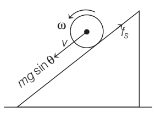
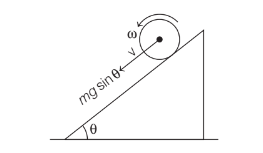
  1. Sphere is in pure accelerated rolling motion in the figure shown:

Choose the correct option.
  1. The direction of $f_s$ is upwards
  2. The direction of $f_s$ is downwards
  3. The direction of gravitational force is upwards
  4. The direction of normal reaction is downwards
  1. Kinetic energy of a rolling body will be:
  1. $\frac{1}{2}\text{mv}^2_\text{ cm}(\text{l}+\frac{\text{k}^2}{\text{R}^2}\big)$
  2. $\frac{1}{2}\text{I}\infty^2$
  3. $\frac{1}{2}\text{mv}^2\text{cm}$
  4. (d) None of the above
  1. A body is rolling down an inclined plane. Its translational and rotational kinetic energies are equal. The body is a:
  1. solid sphere
  2. hollow sphere
  3. solid cylinder
  4. hollow cylinder

Answer

  1. (b) rotational kinetic energy
Explanation:
The frictional force will reduce v 0, hence translational KE will also decrease. It will increases w, which increases its rotational kinetic energy. There is no torque about the line of contact, angular momentum will remain constant. The frictional force will decrease the mechanical energy.
  1. a$\frac{\text{g}}{3}$
Explanation:
$\text{a}=\frac{\text{g}\sin\theta}{1+\frac{\text{k}^2}{\text{R}^2}}=\frac{\text{g}\sin30^\circ}{1+\frac{1}{2}}\Rightarrow\text{a}\frac{\frac{\text{g}}{2}}{\frac{3}{2}}=\frac{\text{g}}{3}$
  1. (a) The direction of $f_s$ is upwards
Explanation:
As we know that,

The direction of $f_s$ will be upwards to provide torque for rolling of sphere.
  1. $\frac{1}{2}\text{mv}^2_\text{ cm}(\text{l}+\frac{\text{k}^2}{\text{R}^2}\big)$
Explanation:
KE of a rolling body = Rotational KE + Translational KE
$=\frac{1}{2}\text{l}\omega^2+\frac{1}{2}\text{mv}^2_\text{cm}(\because\text{I}=\text{mk}^2)$
and $\text{v}_\text{cm}=\text{R}\omega$
$=\frac{1}{2}\frac{\text{mk}^2\text{v}^2_\text{cm}}{\text{R}^2}+\frac{1}{2}\text{mv}^2_\text{cm}$
where, k is the corresponding radius of gyration of the body.
$\frac{1}{2}\text{mv}^2_\text{ cm}(\text{l}+\frac{\text{k}^2}{\text{R}^2}\big)$
  1. (d) hollow cylinder
Explanation:
When a body rolls down on inclined plane, it is accompanied by rotational and translational kinetic energies.
Rotational kinetic energy$=\frac{1}{2}\text{I}\omega^2=\text{K}_\text{R}$
where, I is the moment of inertia and w is the angular velocity. Translational kinetic energy for pure rolling,
$\text{v}_\text{cm}=\text{r}\omega$
$=\frac{1}{2}\text{mv}^2_\text{cm}=\text{K}_\text{r}=\frac{1}{2}\text{m}(r\omega)^2$
where, m is mass of the body, $v_{CM}$ is the velocity and $\omega$ is the angular velocity.
Given,
Translational KE = Rotational KE
$\therefore \frac{1}{2}\text{m}(\text{r}^2\omega^2)=\frac{1}{2}\text{I}\omega^2$
$\Rightarrow\text{I}=\text{mr}^2$
We know that, mr 2 is the moment of inertia of hollow cylinder about its axis, where m is the mass of hollow cylindrical body and r is the radius of the cylinder.

Need a full question paper?

Generate a complete, print-ready paper with questions like this in minutes — across 16+ boards, with answer keys.

Start Generating Free

Similar questions

Calculate $\frac{\text{n(T)}}{\text{n}(1000\text{K})}$ for tungsten emitter at T = 300K, 2000K and 3000K, where n(T) represents the number of thermions emitted per second by the surface at temperature T. Work function of tungsten is 4.52eV.
Calculate the force with which you attract the earth.
A long bar magnet has a pole strength of 10A-m. Find the magnetic field at a point on the axis of the magnet at a distance of 5cm from the north pole of the magnet.
An isolated metal sphere is heated to a high temperature. Will it become positively charged due to thermionic emission?
Read the passage given below and answer the following questions from 1 to 5. According to Hooke’s law, within the elastic limit, the stress applied to a body is directly proportional to the corresponding strain. $\text{Stress}\propto\text{Strain}$ or Stress = E × Strain or $\frac{\text{Stress }}{\text{Strain}}=\text{E}$ Where E is the constant of proportionality and is known as coefficient of elasticity or modulus of elasticity. Hooke’s law is an empirical law and is found to be valid for most materials. However, there are some materials which do not exhibit this linear relationship.
  1. According to Hooke’s law of elasticity, if stress is increased, the ratio of stress to strain:
  1. Decreases
  2. Increases
  3. Becomes zero
  4. Remains constant
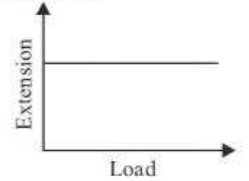
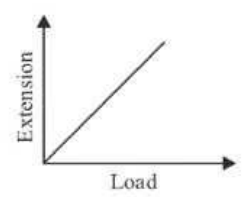
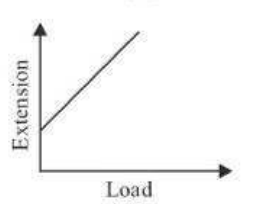
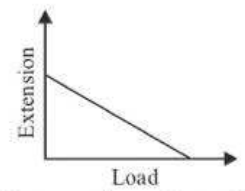
  1. Within elastic limit, which of the following graphs correctly represents the variation of extension in the length of a wire with the external load?
  1. According to Hooke’s law, ifstressis reduced to one-third, the ratio of stress to strain:
  1. Is increased to three time
  2. Is decreased
  3. Is zero
  4. Remains constant.
  1. Hooke’s law defines:
  1. Stress
  2. Strain
  3. Modulus of elasticity
  4. Elastic limit.
  1. Whenever a material is loaded with elasitic limits, stress is ......... strain.
  1. Equal to
  2. Directly proportional to
  3. Inxessely propotional to
  4. None of the above given remains constant.
The mean free path of electrons in a gas in a discharge tube is inversely proportional to the pressure inside it. The Crookes dark space occupies half the length of the discharge tube when the pressure is 0.02mm of mercury. Estimate the pressure at which the dark space will fill the whole tube.
A ladder is resting with one end on a vertical wall and the other end on a horizontal floor. Is it more likely to slip when a man stands near the bottom or near the top?
After a good meal at a party you wash your hands and find that you have forgotten to bring your handkerchief. You shake your hands vigorously to remove the water as much as you can. Why is water removed in this process?
Two discharge tubes have identical material structures and the same gas is filled in them. The length of one tube is 10cm and that of the other tube is 20cm. Sparking starts in both the tubes when the potential difference between the cathode and the anode is 100V. If the pressure in the shorter tube is 1.0mm of mercury, what is the pressure in the longer tube?
Consider a gravity-free hall in which an experimenter of mass $50kg$ is resting on a $5kg$ pillow, 8ft above the floor of the hall. He pushes the pillow down so that it starts falling at a speed of $8ft/s$. The pillow makes a perfectly elastic collision with the floor, rebounds and reaches the experimenter's head. Find the time elapsed in the process.