Question
Read the passage given below and answer the following questions from $1$ to $5$. When an object is in motion, its position changes with time. But how fast is the position changing with time and in what direction? To describe this, we define the quantity average velocity. Average velocity is defined as the change in position or displacement (x) divided by the time intervals (t), in which the displacement occurs: $\text{V}=\frac{\text{x2}-\text{x1}}{\text{t2}-\text{t1}}=\frac{\triangle\text{x}}{\triangle\text{t}}$ Where $x2$ and $x1$ are the positions of the object at time t2and t1, respectively. The SI unit for velocity is m/s or $m s^{–1},$ although km $h^{–1} $ is used in many everyday applications. Like displacement, average velocity is also a vector quantity. Average speed is defined as the total path length travelled divided by the total time interval during which the motion has taken place: Average speed = Total path length/ Total time interval. Average speed has obviously the same unit $(m s^{–1})$ as that of velocity. But it does not tell us in what direction an object is moving. Thus, it is always positive (in contrast to the average velocity which can be positive or negative). If the motion of an object is along a straight line and in the same direction, the magnitude of displacement is equal to the total path length. The velocity at an instant is defined as the limit of the average velocity as the time interval Dt becomes infinitesimally small. In other words $\text{V}=\lim_{\text{dt}-0}\frac{\text{dx}}{\text{dt}}$
$\text{V}=\frac{\text{dx}}{\text{dt}}$ Note that for uniform motion, velocity is the same as the average velocity at all instants. Instantaneous acceleration is defined in the same way as the instantaneous velocity $\text{A}=\lim_{\text{dt}-0}\frac{\text{dv}}{\text{dt}}$
$\text{A}=\frac{\text{dv}}{\text{dt}}$
  1. For uniform motion instantaneous velocity is same as:
  1. Average velocity
  2. Average acceleration
  3. Instantaneous speed
  4. None of these
  1. If velocity is constant then
  1. Acceleration is zero
  2. Acceleration is positive
  3. Acceleration is negative
  4. None of these
  1. Define average speed
  1. Define instantaneous acceleration
  1. Define average velocity

Answer

  1. (a) Average velocity
  2. (a) Acceleration is zero
  3. Average speed is defined as the total path length travelled divided by the total time.
Average speed= Total path length/ Total time interval.
Average speed has SI unit of m/ s. it is scalar quantity it has only magnitude and doesn’t have any direction. it is always positive
  1. Instantaneous acceleration is defined rate of change of velocity with time when time tends to zero
$\text{A}=\lim_{\text{dt}-0}\frac{\text{dv}}{\text{dt}}$
$\text{A}=\frac{\text{dv}}{\text{dt}}$
  1. Average velocity is defined as the change in position or displacement $(Dx)$ divided by the time intervals $(Dt),$ in which the displacement occurs:
$\text{V}=\frac{\text{x2}-\text{x1}}{\text{t2}-\text{t1}}=\frac{\triangle\text{x}}{\triangle\text{t}}$
Where $x2$ and $x1$ are the positions of the object at time $t2$ and $t1 $, respectively. The SI unit for velocity is m/ s or $m s^{–1}.$

Need a full question paper?

Generate a complete, print-ready paper with questions like this in minutes — across 16+ boards, with answer keys.

Start Generating Free

Similar questions

50cc of oxygen is collected in an inverted gas jar over water. The atmospheric pressure is 99.4kPa and the room temperature is 27°C. The water level in the jar is same as the level outside. The saturation vapour pressure at 27°C is 3.4kPa. Calculate the number of moles of oxygen collected in the jar.
No part of India is situated on the equator. Is it possible to have a geostationary satellite which always remains over New Delhi?
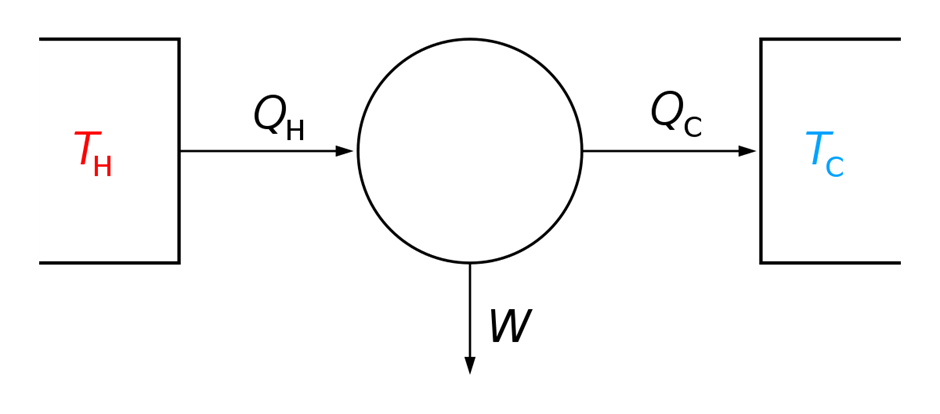
Read the passage given below and answer the following questions from (i) to (v) Carnot principles are only for the cyclical devices like heat engines, which state that the efficiency of an irreversible heat engine is always less than the efficiency of a reversible one operating between the same two reservoirs. The efficiencies of all reversible heat engines operating between the same two reservoirs are the same.
  1. In a Carnot cycle, the working medium rejects heat at a ________ temperature.
    1. Higher
    2. Lower
    3. constant
    4. none of these
  2. Which of the following is NOT a state variable?
    1. work
    2. internal energy.
    3. entropy
    4. all of the above
  3. The efficiency of reversible heat engine is:
    1. $1 +(T_2/T_1)$
    2. $(T_1/T_2)+1$
    3. $(T_1 /T_2)- 1$
    4. $1 - (T_2 / T_1)$
  4. Other factors remaining constant, if the temperature of the source is increased, the efficiency of the Carnot engine will:
    1. decrease
    2. increase
    3. constant
    4. increase or decrease depending upon temperature ratio
  5. Over the complete Carnot cycle, entropy:
    1. increase
    2. decrease
    3. constant
    4. first increase and then decrease
A silver ball of radius 4.8cm is suspended by a thread in a vacuum chamber. Ultraviolet light of wavelength 200 run is incident on the ball for some time during which a total light energy of $1.0 \times 10^{-7} \mathrm{~J}$ falls on the surface. Assuming that on the average one photon out of every ten thousand is able to eject a photoelectron, find the electric potential et the surface of the bell assuming zero potential at infinity. What is the potential at the centre of the bell?
Read the passage given below and answer the following questions from 1 to 5. Principle of Conservation of Energy: Total energy of an isolated system always remains constant. Since, the universe as a whole may be viewed as an isolated system, total energy of the universe is constant. If one part of the universe loses energy, then other part must gain an equal amount of energy. The principle of conservation of energy cannot be proved as such. However, no violation of this principle has been observed.
  1. When we rub two flint stones together, got them to heat up and to ignite a heap of dry leaves in the form of:
  1. chemical energy
  2. sound energy
  3. heat energy
  4. electrical energy
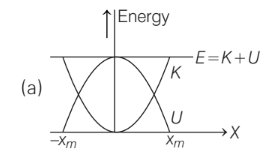
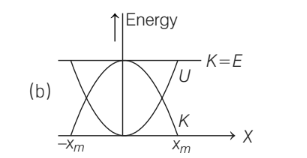
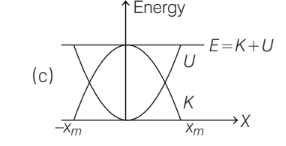
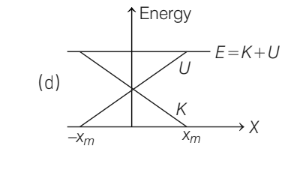
  1. Which graph represents conservation of total mechanical energy?
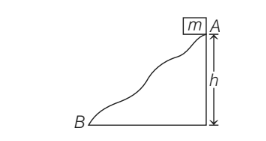
  1. In the given curved road, if particle is released from A, then:
  1. kinetic energy atB must be mgh
  2. kinetic energy atB must be zero
  3. kinetic energy atB must be less than mgh
  4. kinetic energy atB must not be equal to potential energy
  1. U is the potential energy, K is the kinetic energy and E is the mechanical energy. Which of the following is not possible for a stable system?
  1. U > E
  2. U < E
  3. E > K
  4. K > E
  1. A body of mass 5kg is thrown vertically up with a kinetic energy of 490 J. The height at which the kinetic energy of the body becomes half of the original value is
  1. 12.5m
  2. 10
  3. 2.5m
  4. 5m
When white radiation is passed through a sample of hydrogen gas at room temperature, absorption lines are observed in Lyman series only. Explain.
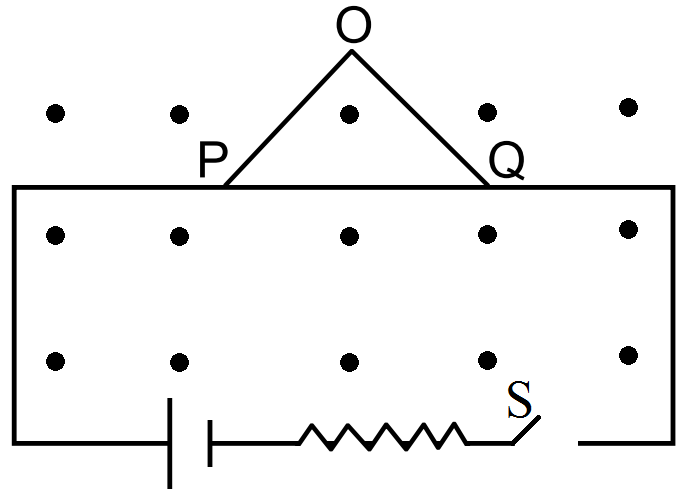
Shows a rod PQ of length 20.0cm and mass 200g suspended through a fixed point O by two threads of lengths 20.0cm each. A magnetic field of strength 0.500T exists in the vicinity of the wire PQ, as shown in the figure. The wires connecting PQ with the battery are loose and exert no force on PQ.
  1. Find the tension in the threads when the switch S is open.
  2. A current of 2.0A is established when the switch S is closed. Find the tension in the threads now.
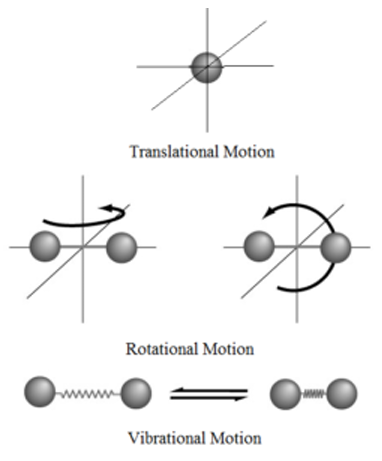
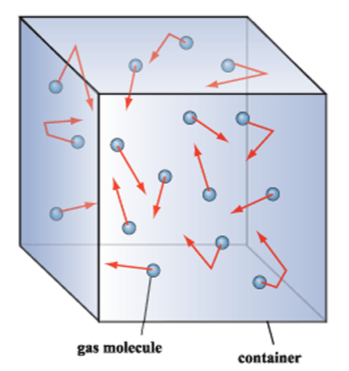
Gas molecules move in random motion inside the container. The pressure exerted by the gas is due to the continuous collision of the molecules against the walls of the container. Due to this continuous collision, the walls experience a continuous force which is equal to the total momentum imparted to the walls per second.
Image
1. If the mass of each molecule is halved and speed is doubled, find the ratio of initial and final pressure:
(a) $1: 16$ (b) $1: 4$ (c) $1: 8$ (d) $1: 2$
2. The pressure exerted by the gases is:
(a) inversely proportional to the density
(b) inversely proportional to the square of the density
(c) directly proportional to the density
(d) directly proportional to the square of the density
3. If the force of attraction between the molecules suddenly disappears, then what will be the change in pressure:
(a) pressure increase
(b) pressure decrease
(c) pressure remains constant
(d) pressure falls
4. If the pressure of a given gas is halved at a certain temperature. what will be its volume:
(a) becomes triple (b) becomes double (c) remains constant (d) becomes half
OR
Dimension formula for R ?
(a) $M ^1 L^2 T^2 K^{-1}$ (b) $M ^1 L^1 T^{-1}$
(c) $M ^{-1} L^0 T^1$ (d) $M ^1 L^2 T^{-2} K^{-1}$
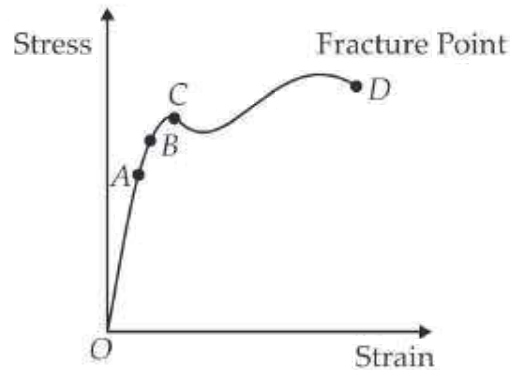
Read the passage given below and answer the following questions from 1 to 5. Stress-Strain Curve The graph shown below shows qualitatively the relation between the stress and the strain as the deformation gradually increases. Within Hooke’s limit for a certain region stress and strain relation is linear. Beyond that up to a certain value of strain the body is still elastic and if deforming forces are removed the body recovers its original shape.
  1. If deforming forces are removed up to which point the curve will be retraced?
  1. Upto OA only
  2. Upto OB
  3. Upto C
  4. Never retraced its path
  1. In the above question, during loading and unloading the force exerted by the material are conservative up to:
  1. OA only
  2. OB only
  3. OC only
  4. OD only
  1. During unloading beyond B, say C, the length at zero stress in now equal to:
  1. Less than original length
  2. Greater than original length
  3. Original length
  4. Can’t be predicted
  1. The breaking stress for a wire of unit cross - section is called:
  1. Yield point
  2. Elastic fatigue
  3. Tensile strength
  4. Young’s modulus
  1. Substances which can be stretched to cause large strains are called:
  1. Isomers
  2. Plastomers
  3. Elastomers
  4. Polymers