Question
Read the passage given below and answer the following questions from $i$ to $v.$ When an object follows a circular path at a constant speed, the motion of the object is called uniform circular motion. The word “uniform” refers to the speed, which is uniform (constant) throughout the motion. Suppose an object is moving with uniform speed $v$ in a circle of radius $R$ Since the velocity of the object is changing continuously in direction, the object undergoes acceleration. Let us find the magnitude and the direction of this acceleration. Thus, the acceleration of an object moving with speed v in a circle of radius $R$ has a magnitude $V^2/R$ and is always directed towards the centre. This is why this acceleration is called centripetal acceleration (a term proposed by Newton). A thorough analysis of centripetal acceleration was first published in $1673$ by the Dutch scientist Christiaan Huygens $(1629-1695)$ but it was probably known to Newton also some years earlier. “Centripetal” comes from a Greek term which means ‘centre-seeking’. Since $v$ and $R$ are constant, the magnitude of the centripetal acceleration is also constant. However, the direction changes pointing always towards the centre. Therefore, a centripetal acceleration is not a constant vector. We can express centripetal acceleration ac in terms of angular speed as $\text{a}_\text{c}=\omega^2\text{R}$ The time taken by an object to make one revolution is known as its time period T and the number of revolution made in one second is called its frequency $v (=1/T).$ However, during this time the distance moved by the object is $\text{s}=2\pi\text{R}.$ Therefore, $\text{v}=2\pi\frac{\text{R}}{\text{T}}=2\pi\text{ Rv}$ In terms of frequency n, we have $\omega=2\pi\text{v}$
$\text{V}=2\pi\text{ RV}$
$\text{ac}=4\pi^2\text{v}^2\text{R}$
  1. SI unit of angular velocity is
  1. Rev/ sec
  2. $m/ s$
  3. $m/ s^2$ 
  4. None of these
  1. A centripetal acceleration is not a constant vector. True or false?
  1. True
  2. False
  1. Define Uniform circular motion
  2. What is meaning of word centripetal?
  3. What is centripetal acceleration? Give its relation with angular velocity
Answer

  1. (a) Rev/ sec
  2. (a) True
  3. When an object moves in a circular path with uniform speed, its motion is called uniform circular motion.
  4. “Centripetal” comes from a Greek term which means ‘centre-seeking’ i.e. always directed towards centre of a circle.
  5. Acceleration of particle performing uniform circular motion which is always directed towards centre of a circle is called centripetal acceleration. We can express centripetal acceleration ac in terms of angular speed as.
$\omega=2\pi\text{v}$
However, during this time the distance moved by the object is $s = 2\pi R.$ In terms of frequency V, we have
$\omega=2\pi\text{v}$
$\text{V}=2\pi\text{ RV}$
$\text{ac}=4\pi^2\text{v}^2\text{R}$

Need a full question paper?

Generate a complete, print-ready paper with questions like this in minutes — across 16+ boards, with answer keys.

Start Generating Free

Similar questions

A small coin is placed on a record rotating at $33\frac{1}{3}$ rev/ minute. The coin does not slip on the record. Where does it get the required centripetal force from?
The absolute temperature of air in a region linearly increases from $T_1$ to $T_2$ in a space of width d . Find the time taken by a sound wave to go through the region in terms of $\mathrm{T}_1, \mathrm{~T}_2, \mathrm{~d}$ and the speed v of sound at 273 K . Evaluate this time for $T_1=280 \mathrm{~K}, T_2=310 \mathrm{~K}, d=33 \mathrm{~m}$ and $\mathrm{v}=330 \mathrm{~m} / \mathrm{s}$.
In a TV picture tube electrons are ejected from the cathode with negligible speed and reach a velocity of $5 \times 10^6 \mathrm{~m} / \mathrm{s}$ in travelling one centimeter. Assuming straight line motion, find the constant force exerted on the electron. The mass of the electron is $9.1 \times 10^{-31} \mathrm{~kg}$.
Read the passage given below and answer the following questions from 1 to 5. Moment of Inertia A heavy wheel called flywheel is attached to the shaft of steam engine, automobile engine etc., because of its large moment of inertia, the flywheel opposes the sudden increase or decrease of the speed of the vehicle. It allows a gradual change in the speed and prevents jerky motion and hence ensure smooth ride of passengers.
  1. Moment of inertia of a body depends upon:
  1. axis of rotation
  2. torque
  3. angular momentum
  4. angular velocity
  1. A particle of mass 1 kg is kept at (1m, 1m, 1m). The moment of inertia of this particle about Z-axis would be:
  1. $1 kg-m^2$
  2. $2 kg-m^2$
  3. $3 kg-m^2$
  4. (None of the above)
  1. Moment of inertia of a rod of mass m and length l about its one end is I. If one-fourth of its length is cut away, then moment of inertia of the remaining rod about its one end will be:
  1. $\frac{3}{4}\text{I}$
  2. $\frac{9}{16}\text{I}$
  3. $\frac{27}{64}\text{I}$
  4. $\frac{\text{I}}{16}$
  1. A circular disc is to be made by using iron and aluminium, so that it acquires maximum moment of inertia about its geometrical axis. It is possible with:
  1. iron and aluminium layers in alternate order
  2. aluminium at interior and iron surrounding it
  3. iron at interior and aluminium surrounding it
  4. Either (a) or (c)
  1. Three thin rods each of length L and mass M are placed along X ,Y and Z -axes such that one end of each rod is at origin. The moment of inertia of this system about Z-axis is:
  1. $\frac{2}{3}\text{ML}^2$
  2. $\frac{4\text{ML}^2}{3}$
  3. $\frac{5\text{ML}^2}{3}$
  4. $\frac{\text{ML}^2}{3}$
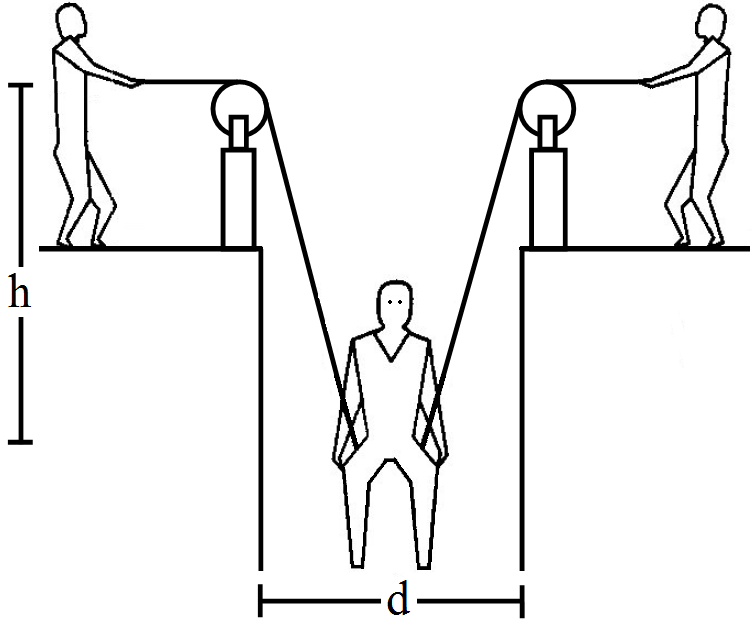
A man has fallen into a ditch of width d and two of his friends are slowly pulling him out using a light rope and two fixed pulleys as shown in figure. Show that the force (assumed equal for both the friends) exerted by each friend on the road increases as the man moves up. Find the force when the man is at a depth h.
Consider a gravity-free hall in which an experimenter of mass $50kg$ is resting on a $5kg$ pillow, 8ft above the floor of the hall. He pushes the pillow down so that it starts falling at a speed of $8ft/s$. The pillow makes a perfectly elastic collision with the floor, rebounds and reaches the experimenter's head. Find the time elapsed in the process.
Why is conducting easier in gases if the pressure is low? Will the conduction continue to improve if the pressure is made as low as nearly zero?
Read the passage given below and answer the following questions from (i) to (v). The amount of heat per unit mass transferred during change of state of the substance is called latent heat of the substance for the process. For example, if heat is added to a given quantity of ice at –10°C, the temperature of ice increases until it reaches its melting point (0°C). At this temperature, the addition of more heat does not increase the temperature but causes the ice to melt, or changes its state. Once the entire ice melts, adding more heat will cause the temperature of the water to rise. The latent heat for a solid to liquid state change is called the latent heat of fusion (Lf), and that for a liquid-gas state change is called the latent heat of vaporisation (Lv). These are often referred to as the heat of fusion and the heat of vaporisation. We have seen that heat is energy transfer from one system to another or from one part of a system to another part, arising due to temperature difference. What are the different ways by which this energy transfer takes place? There are three distinct modes of heat transfer: conduction, convection and radiation Conduction is the mechanism of transfer of heat between two adjacent parts of a body which are direct in contact because of their temperature difference. Suppose, one end of a metallic rod is put in a flame, the other end of the rod will soon be so hot that you cannot hold it by your bare hands. Here, heat transfer takes place by conduction from the hot end of the rod through its different parts to the other end. Gases are poor thermal conductors, while liquids have conductivities intermediate between solids and gas.Convection is a mode of heat transfer by actual motion of matter. It is possible only in fluids. Convection can be natural or forced. In natural convection, gravity plays an important part. When a fluid is heated from below, the hot part expands and, therefore, becomes less dense. Because of buoyancy, it rises and the upper colder part replaces it. This again gets heated, rises up and is replaced by the relatively colder part of the fluid. The process goes on. This mode of heat transfer is evidently different from conduction. Convection involves bulk transport of different parts of the fluid. Conduction and convection require some material as a transport medium. These modes of heat transfer cannot operate between bodies separated by a distance in vacuum. But the earth does receive heat from the Sun across a huge distance. Similarly, we quickly feel the warmth of the fire nearby even though air conducts poorly and before convection takes some time to set in. The third mechanism for heat transfer needs no medium; it is called radiation and the energy so transferred by electromagnetic waves is called radiant energy.
  1. Which of the following heat transfer mode needs medium?
  1. Conduction
  2. Convection
  3. Both a and b
  4. Radiation
  1. Convection is possible in:
  1. Solids only
  2. Fluid only
  3. Both solid and fluid
  4. None of these
  1. Define latent heat of fusion and latent heat of vapourisation.
  2. Define process of natural convection.
  3. Differentiate between conduction and radiation.
A sample contains a mixture of $^{108}Ag$ and $^{110}Ag$ isotopes each having an activity of $8.0 \times 10^8$ disintegration per second. $^{110}Ag$ is known to have larger half-life than $^{108}Ag$. The activity A is measured as a function of time and the following data are obtained.
Time (s) Activity (A) ($10^8$ disinte- grations $s^{-1}$) Time (s) Activity (A) ($10^8$ disinte-grations $s^{-1}$)
20 11.799 200 3.0828
40 9.1680 300 1.8899
60 7.4492 400 1.1671
80 6.2684 500 0.7212
100 5.4115    
  1. Plot ln $\Big(\frac{\text{A}}{\text{A}_0}\Big)$ versus time.
  2. See that for large values of time, the plot is nearly linear. Deduce the half-life of $^{110}Ag$ from this portion of the plot.
  3. Use the half-life of $^{110}Ag$ to calculate the activity corresponding to $^{108}Ag$ in the first $50s$.
  4. Plot In $\Big(\frac{\text{A}}{\text{A}_0}\Big)$ versus time for $^{108}Ag$ for the first $50s$.
  5. Find the half-life of $^{108}Ag$.
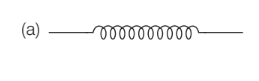
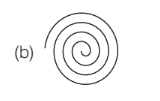
Read the passage given below and answer the following questions from 1 to 5. PE of Spring There are many types of spring. Important among these are helical and spiral springs as shown in figure.


Usually, we assume that the springs are massless. Therefore, work done is stored in the spring in the form of elastic potential energy of the spring. Thus, potential energy of a spring is the energy associated with the state of compression or expansion of an elastic spring.
  1. The potential energy of a body is increases in which of the following cases?
  1. If work is done by conservative force
  2. If work is done against conservative force
  3. If work is done by non-conservative force
  4. If work is done against non- conservative force
  1. The potential energy, i.e. U (x) can be assumed zero when:
  1. x = 0
  2. gravitational force is constant
  3. infinite distance from the gravitational source
  4. All of the above
  1. The ratio of spring constants of two springs is 2 : 3. What is the ratio of their potential energy, if they are stretched by the same force?
  1. 2 : 3
  2. 3 : 2
  3. 4 : 9
  4. 9 : 4
  1. The potential energy of a spring increases by 15 J when stretched by 3cm. If it is stretched by 4cm, the increase in potential energy is:
  1. 27 J
  2. 30 J
  3. 33 J
  4. 36 J
  1. The potential energy of a spring when stretched through a distance x is 10 J. What is the amount of work done on the same spring to stretch it through an additional distance x?
  1. 10 J
  2. 20 J
  3. 30 J
  4. 40 J